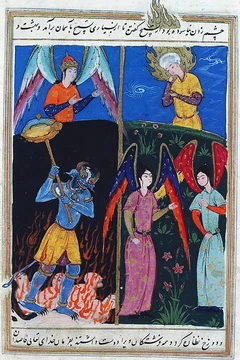
Christianization of saints and feasts
Pre-Christian traditions reshaped into Christian saints and feast days.
Last updated
The Christianization of saints and feasts often involved adapting pre-Christian figures and seasonal festivals into the church calendar.[1][2]
Quick Facts
- Feast of saint valentine
- 14 February
- Walpurgis night
- 30 April – 1 May
Facts from the source article.
Life and work
The king-turned-monk Joasaphat gets his name from the Sanskrit Bodhisattva.[3] The summer solstice has been observed since the Neolithic era.[2] Through Arabic and Georgian translations, the narrative of Barlaam and Josaphat originated from the biography of Siddartha Gautama, who is called the Buddha.[3] February 14 is the feast day for three distinct martyrs, each named Valentinus.[4][5]
During the medieval period, the feast day became linked to romantic traditions, based on the idea that birds start pairing halfway through February.[4][5] Within the ecclesiastical year, Easter is considered by Christians to be the most significant festival.[6] The Venerable Bede wrote that the English word "Easter" comes from an Anglo-Saxon name for Ēostre, a Teutonic goddess.[6][7]
What the cited sources add
The Catholic Encyclopedia notes that the Greek term for Easter, pascha, is the Aramaic form of the Hebrew pesach.[7] The same source states that the word "Easter" is, principally in Spain and Italy, identified with the word "solemnity."[7] The computus paschalis, the method of determining the date of Easter, was considered so important that Durandus declared a priest unworthy who does not know it.[7] The Armenian Church during the entire time from Easter to Pentecost celebrates the Resurrection alone to the exclusion of all feasts of the saints.[7]
The Catholic Encyclopedia confirms that at least three different Saint Valentines, all martyrs, are mentioned in early martyrologies under 14 February.[5] The popular customs associated with Saint Valentine's Day had their origin in a conventional belief that on 14 February the birds began to pair.[5]
References
- Wikipedia, "Christianization of saints and feasts" (CC BY-SA 4.0), which cites: Melton, "Religious Celebrations", ABC-CLIO, 2011, p. 915; Melton, "Religious Celebrations", ABC-CLIO, 2011, p. 915; Santino, "Halloween and Other Festivals of Death and Life", University of Tennessee Press, 1994, p. xix; Berger, "The Goddess Obscured: Transformation of the Grain Protectress from Goddess to Saint", Beacon Press, 1985, p. 61–64 (original not read by us) en.wikipedia.org
- Wikipedia, "Christianization of saints and feasts" (CC BY-SA 4.0), which cites: "The Oxford Handbook of Light in Archaeology", Oxford University Press, 2021; O'Neill, "Time and the Calendars", Manchester University Press, 1976, p. 85; Forsythe, "Time in Roman Religion: One Thousand Years of Religious History", Routledge, 2012, p. 123, 182; Billington, "The Concept of the Goddess", Routledge, 2002, p. 134 (original not read by us) en.wikipedia.org
- Wikipedia, "Christianization of saints and feasts" (CC BY-SA 4.0) en.wikipedia.org
- Wikipedia, "Christianization of saints and feasts" (CC BY-SA 4.0), which cites: Thurston, Herbert. "St. Valentine." The Catholic Encyclopedia. Vol. 15. New York: Robert Appleton Company, 1912. 18 Jan. 2015 (we also read that source) en.wikipedia.org
- Thurston, Herbert. "St. Valentine." The Catholic Encyclopedia. Vol. 15. New York: Robert Appleton Company, 1912. 18 Jan. 2015. facts only, no text reused. newadvent.org
- Wikipedia, "Christianization of saints and feasts" (CC BY-SA 4.0), which cites: Holweck, Frederick. "Easter." The Catholic Encyclopedia. Vol. 5. New York: Robert Appleton Company, 1909. 18 Jan. 2015 (we also read that source) en.wikipedia.org
- Holweck, Frederick. "Easter." The Catholic Encyclopedia. Vol. 5. New York: Robert Appleton Company, 1909. 18 Jan. 2015. facts only, no text reused. newadvent.org
Each numbered sentence above was checked against the source it cites before publication. Sentences citing Wikipedia adapt text from the English Wikipedia article Christianization of saints and feasts (contributors), used under CC BY-SA 4.0; this entry is available under the same licence. Other sources were used for facts only; no text or images are copied from them.
More in Supernatural beings identified with Christian saints
Sources
Compiled from Wikipedia and the sources listed below. Text from Wikipedia is available under CC BY-SA 4.0; this entry is adapted from it.
- Wikipedia: Christianization of saints and feasts (CC BY-SA 4.0).
Spotted an error? Know more?
Reader corrections go straight into our review queue. Suggest an edit · How this site is sourced