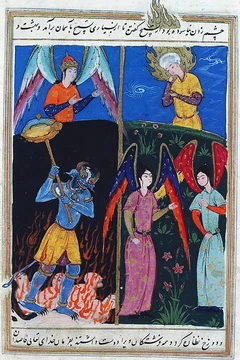
Dhu'l-Kifl
An Islamic prophet of uncertain identity, often linked to Ezekiel.
Last updated
A tomb in Ergani, Turkey, located 5 km from the city center on Makam Dağı hill, is believed by some to be his resting place.[1] The name Dhu'l-Kifl, which appears in the Quran, is formed from the Arabic word "kifl" meaning "double" or "duplicate," and the name is generally understood to mean "one of a double portion."[2][3] No one knows for certain who Dhu'l-Kifl was, but various scholars have proposed that he could be Ezekiel or other figures from the Hebrew Bible.[4]
Life and work
Classical commentators such as Ibn Ishaq and Ibn Kathir speak of him as a prophetic, saintly man who remained faithful in daily prayer and worship.[4] The name Dhu'l-Kifl is generally understood to mean "one of a double portion".[3] Some scholars suggest the name means "the man with the double recompense" and is a title for Job.[3] This lack of information has led some commentators to conclude the person named may not have been a prophet.[5]
Information given in tafsir and historical sources about the name relies almost entirely on unreliable narrations from some companions and followers.[5] According to the Qur'an, Dhu'l-Kifl is counted among the "Company of the Good."[4] The Qur'an states that Allah raised Dhu'l-Kifl to a high station.[4]
What the cited sources add
The name Dhu'l-Kifl is unheard of in Arab or Semitic references, according to the "The Prophets" account.[6] The same article states the name "Zü'l-Kifl" also means "nourisher" or "nourishment" or "food".[5] The source "The Prophets" explains that the word "Dhul-Kifl" exactly matches what is meant by the term "possessor of a double portion."[6] Dr. Mustafa Khattab's footnote on verse 38:48 of the Quran states that scholars disagree on whether Ⱬul-Kifl was a prophet or just a righteous man.[7]
References
- Wikipedia, "Dhu'l-Kifl" (CC BY-SA 4.0), which cites: İnanç ve kültür mirasının gözdesi: Hazreti Zülkifl Makamı (Turkish)ilkha. Posted 17 November 2018.; İNANÇ VE KÜLTÜR MİRASININ GÖZDESİ: HAZRETİ ZÜLKİFL MAKAMI (Turkish) GuneydoguGuncel. Posted 18 November 2018. (original not read by us) en.wikipedia.org
- Wikipedia, "Dhu'l-Kifl" (CC BY-SA 4.0), which cites: Encyclopedia of Islam, Dhu'l-Kifl (original not read by us) en.wikipedia.org
- Wikipedia, "Dhu'l-Kifl" (CC BY-SA 4.0), which cites: John Walker takes this viewpoint in Who is Dhul-Kifl?, in MW, xvi, 399–401; Job xlii: 10 (original not read by us) en.wikipedia.org
- Wikipedia, "Dhu'l-Kifl" (CC BY-SA 4.0), which cites: Encyclopedia of Islam, G. Vajda, Dhu al-Kifl; "The Prophets", Islam; "Buda'nın Peygamber Efendimizi bin yıl önceden müjdelediği doğru mudur? » Sorularla İslamiyet", Sorularla İslamiyet, 2015-01-26; "Buda Peygamber mi?", Ebubekir Sifil, 2006-01-30; ; Stories of The Prophets, page 299 (we also read that source) en.wikipedia.org
- "Buda Peygamber mi?", Ebubekir Sifil, 2006-01-30. facts only, no text reused. ebubekirsifil.com
- "The Prophets", Islam. facts only, no text reused. alislam.org
- Dr. Mustafa Khattab, The Clear Quran, 38:48 Footnote: "Scholars are in disagreement as to whether Ⱬul-Kifl was a prophet or just a righteous man. Those who main. facts only, no text reused. quran.com
Each numbered sentence above was checked against the source it cites before publication. Sentences citing Wikipedia adapt text from the English Wikipedia article Dhu'l-Kifl (contributors), used under CC BY-SA 4.0; this entry is available under the same licence. Other sources were used for facts only; no text or images are copied from them.
More in Supernatural beings identified with Christian saints
Sources
Compiled from Wikipedia and the sources listed below. Text from Wikipedia is available under CC BY-SA 4.0; this entry is adapted from it.
- Wikipedia: Dhu'l-Kifl (CC BY-SA 4.0).
Spotted an error? Know more?
Reader corrections go straight into our review queue. Suggest an edit · How this site is sourced