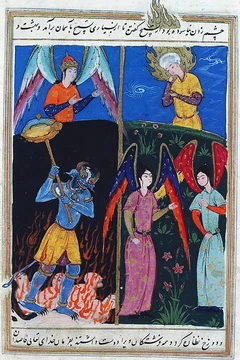
Apsat (mythology)
Caucasian deity of birds, animals, and the hunt.
Last updated
In the Caucasus region's traditional stories, a male figure named Apsat (also called Avsati or Æfsatī) oversees birds and wild creatures.[1] According to certain accounts, he governs all types of game animals, whereas alternative traditions limit his domain to fish and avian species.[1]
Quick Facts
- Also known as
- Avsati, Æfsatī
- Domain
- Birds and animals
- Possible name origin
- Abkhaz a-psaatʷ (bird) or Saint Eustathios
Facts from the source article.
Life and work
His name may come from the Abkhaz word a-psaatʷ, meaning "bird", or from the Christian saint Eustathios.[1] In Digor, Æfsæ means horse, so his name would be colloquially understood to mean "of horses".[1] Among the Ossetians, the hunt's foremost divine figure is known as Æfsatī.[2] This deity features in the Nart saga, an Ossetian epic narrative.[2]
Ossetian hunters considered wild game to be Æfsatī's livestock, and they sought his goodwill through devotional songs and sacrificial gifts.[2] Typical depictions show him as an old man with a beard, who possesses only one eye or is completely without sight.[2] His residence was a forest cabin where he lived alongside his spouse and female children.[2] For the Svan community in Georgia, Apsat belongs to a group of hunting divinities that serve Ber Shishvlish.[3]
What the cited sources add
A 2002 source by Chaudhri notes that in Svan tradition Apsat works with Dzhgyrag, Cxek'ish angelwez, and the goddess Dali.[4] The same 2002 source records that Ossetian hunters would offer roasted organs such as the heart or liver in thanks for a successful hunt.[2] Charachidzé's 1993 work explains that the eagle, a bird that fishes and connects sky with water, is the reason for Apsat's link to fish and birds.[5] Chirikba's 2015 publication mentions that Apsat's daughter Fatima was renowned for her attractiveness.[6]
The same 2015 source indicates that, similarly to the Ossetian Æfsatī, Apsatı frequently appeared as a white goat.[6]
References
- Wikipedia, "Apsat (mythology)" (CC BY-SA 4.0), which cites: Charachidzé, "Asian Mythologies", University of Chicago Press, 1993-05-15, p. 341; Chirikba, "Studies on Iran and The Caucasus: In Honour of Garnik Asatrian", BRILL, 2015-06-25, p. 161; Tuite, "Language, Culture and the Individual. A Tribute to Paul Friedrich", University of Montreal, 2006-02-20, p. 165–188; Arzhantseva, "Drevnosti Severnogo Kavkaza", 1999, p. 183–200; Tuite, "Le Corps Et Le Lieu: Nouveaux Terrains", University of Montreal, 2018, p. 144; "ӕфсӕ", Wiktionary, 2017-02-13; Tuite, "Le Corps Et Le Lieu: Nouveaux Terrains", en.wikipedia.org
- Wikipedia, "Apsat (mythology)" (CC BY-SA 4.0), which cites: Chaudhri 2002, p. 167-168; Tuite, "Le Corps Et Le Lieu: Nouveaux Terrains", University of Montreal, 2018, p. 144; Charachidzé, "Asian Mythologies", University of Chicago Press, 1993-05-15, p. 341; Chaudhri 2002, p. 167-168; Tuite 2018, p. 143; Chaudhri 2002, p. 167-168; Tuite, "Le Corps Et Le Lieu: Nouveaux Terrains", University of Montreal, 2018, p. 144 (original not read by us) en.wikipedia.org
- Wikipedia, "Apsat (mythology)" (CC BY-SA 4.0), which cites: Chaudhri, "The Concept of the Goddess", Routledge, 2002-09-11, p. 169 (original not read by us) en.wikipedia.org
- Wikipedia, "Apsat (mythology)" (CC BY-SA 4.0), which cites: Chirikba, "Studies on Iran and The Caucasus: In Honour of Garnik Asatrian", BRILL, 2015-06-25, p. 161; Chaudhri, "The Concept of the Goddess", Routledge, 2002-09-11, p. 169 (original not read by us) en.wikipedia.org
- Wikipedia, "Apsat (mythology)" (CC BY-SA 4.0), which cites: Charachidzé, "American, African, and Old European Mythologies", University of Chicago Press, 1993-05-15, p. 260 (original not read by us) en.wikipedia.org
- Wikipedia, "Apsat (mythology)" (CC BY-SA 4.0), which cites: Chirikba, "Studies on Iran and The Caucasus: In Honour of Garnik Asatrian", BRILL, 2015-06-25, p. 161; Tuite, "Le Corps Et Le Lieu: Nouveaux Terrains", University of Montreal, 2018, p. 144 (original not read by us) en.wikipedia.org
Each numbered sentence above was checked against the source it cites before publication. Sentences citing Wikipedia adapt text from the English Wikipedia article Apsat (mythology) (contributors), used under CC BY-SA 4.0; this entry is available under the same licence. Other sources were used for facts only; no text or images are copied from them.
More in Supernatural beings identified with Christian saints
Sources
Compiled from Wikipedia and the sources listed below. Text from Wikipedia is available under CC BY-SA 4.0; this entry is adapted from it.
- Wikipedia: Apsat (mythology) (CC BY-SA 4.0).
Spotted an error? Know more?
Reader corrections go straight into our review queue. Suggest an edit · How this site is sourced