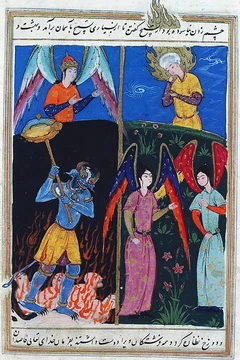
Donbettyr
Ossetian water god and protector of fish and fishermen.
Last updated
His name may combine don, meaning 'river', with Bettyr, a reference to Saint Peter.[1] Within Ossetian mythology, Donbettyr holds dominion over all bodies of water and serves as the guardian of both fish and those who fish, fulfilling a role comparable to that of the Greek deity Poseidon.[1] A Scythian deity sharing the same name is connected to Donbettyr.[1]
Quick Facts
- Mythology
- Ossetian
- Domain
- God of all waters, protector of fish and fishermen
- Equivalent
- Greek Poseidon
- Name etymology
- Possibly from don ('river') and Bettyr (possibly Saint Peter)
Facts from the source article.
Life and work
The daughters of Donbettyr, noted for their beauty, function as the Ossetian counterpart to sea nymphs.[2] Dzerassae, a daughter of Donbettyr with golden hair, gave birth to Uryzmaeg, Satanaya, and Xaemyts.[3] Batraz's maternal grandfather is Donbettyr, a relationship established through the union of Xaemyts with one of Donbettyr's unnamed daughters.[4] In the narrative of that marriage, Xaemyts pursues a white rabbit which perishes and revives three times, then plunges into the sea.[4][3]
Xaemyts consents, but is informed that his wife will manifest on land as a tortoise during daylight hours.[3] Her human form, the beautiful woman he married, is only assumed at night.[5]
What the cited sources add
The "Journal of Ancient History" states that Donbettyr's name means "Watery Peter" and that his descendants constitute the race of Donbettyrs.[6] That same source notes that the great narts wed the daughters of Donbettyrs.[6]
References
- Wikipedia, "Donbettyr" (CC BY-SA 4.0), which cites: Walter, "La Fée Mélusine : Le serpent et l'oiseau", Editions Imago, 2008-01-01; Vernadsky, "The Origins of Russia", Clarendon Press, 1959; "The Caucasus", Language and Communication Research Center, Columbia University, 1956; Peoples, "The Bronze Age and early Iron Age peoples of Eastern Central Asia", Institute for the Study of Man, May 1998; "Journal of Ancient History", vdi.igh.ru; Foltz, "The Ossetes: Modern-Day Scythians of the Caucasus", Bloomsbury Publishing, 30 December 2021, p. 108; Petrosyan, "The Indo-european and ancient Near East en.wikipedia.org
- Wikipedia, "Donbettyr" (CC BY-SA 4.0), which cites: Petrosyan, "The Indo-european and ancient Near Eastern sources of the Armenian epic: myth and history", Institute for the Study of Man, 2002; Tuite, "Achilles and the Caucasus", Journal of Indo-European Studies, 1998, p. 26–27; Woodard 2013, p. 217 (original not read by us) en.wikipedia.org
- Wikipedia, "Donbettyr" (CC BY-SA 4.0), which cites: Tuite, "Achilles and the Caucasus", Journal of Indo-European Studies, 1998, p. 26–27 (original not read by us) en.wikipedia.org
- Wikipedia, "Donbettyr" (CC BY-SA 4.0), which cites: Woodard, "Myth, Ritual, and the Warrior in Roman and Indo-European Antiquity", Cambridge University Press, 2013-01-28 (original not read by us) en.wikipedia.org
- Wikipedia, "Donbettyr" (CC BY-SA 4.0), which cites: Tuite, "Achilles and the Caucasus", Journal of Indo-European Studies, 1998, p. 26–27; "Soviet Anthropology and Archeology", International Arts and Sciences Press, 1985 (original not read by us) en.wikipedia.org
- "Journal of Ancient History", vdi.igh.ru. facts only, no text reused. vdi.igh.ru
Each numbered sentence above was checked against the source it cites before publication. Sentences citing Wikipedia adapt text from the English Wikipedia article Donbettyr (contributors), used under CC BY-SA 4.0; this entry is available under the same licence. Other sources were used for facts only; no text or images are copied from them.
More in Supernatural beings identified with Christian saints
Sources
Compiled from Wikipedia and the sources listed below. Text from Wikipedia is available under CC BY-SA 4.0; this entry is adapted from it.
- Wikipedia: Donbettyr (CC BY-SA 4.0).
Spotted an error? Know more?
Reader corrections go straight into our review queue. Suggest an edit · How this site is sourced