
Intertidal seagrass (Zostera japonica)
Source-cited species reference: taxonomy from WoRMS, biology from SeaLifeBase, occurrence map from GBIF, conservation from IUCN Red List, description from Wikipedia.
Zostera japonica is a species of aquatic plant in the Zosteraceae family.
- Scientific name
- Zostera japonica
- Authority
- Ascherson & Graebner, 1907
- Family
- Zosteraceae
- Order
- Alismatales
- Habitat zone
- sessile
- Iucn red list
- Least Concern
- Gbif occurrence records
- 13,585
Classification (WoRMS)
Full classification as recorded by WoRMS: Kingdom: Plantae · Phylum: Tracheophyta · Class: Magnoliopsida · Order: Alismatales · Family: Zosteraceae · Genus: Zostera.
Accepted name: Zostera japonica · Authority: Ascherson & Graebner, 1907 · Taxonomic status: accepted · AphiaID: 495080.
Synonyms and superseded combinations recorded for this taxon: Nanozostera americana (Hartog) Tomlinson & Posluszny, 2001; Nanozostera japonica (Ascherson & Graebner) Tomlinson & Posluszny, 2001; Zostera americana Hartog, 1970; Zostera americana den Hartog, 1970; Zostera japonica Ascherson & Graebner, 1907; Zostera japonica subsp. austroasiatica Ohba & Miyata.
Source: World Register of Marine Species (WoRMS) — https://www.marinespecies.org/aphia.php?p=taxdetails&id=495080 (CC BY 4.0). Accessed 2026-09-23.
Biology and life history (SeaLifeBase)
Measured values published by SeaLifeBase for Zostera japonica. Only fields the database actually holds for this species are shown; these are database values, not aquarium guidance.
Habitat zone: sessile · Aquarium trade: never/rarely.
Source: SeaLifeBase species summary (SpecCode 2380931) — https://www.sealifebase.se/summary/Zostera-japonica.html (CC BY-NC 3.0 — non-commercial use only). Accessed 2026-09-23.
Distribution and occurrence records (GBIF)
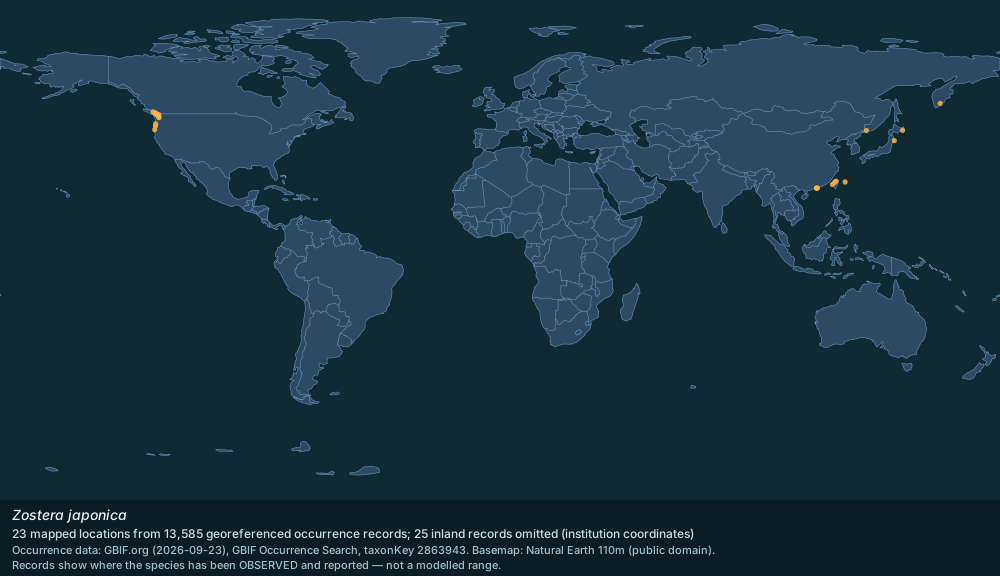
13,585 georeferenced occurrence records for Zostera japonica are published through GBIF from 9 countries or marine areas. The map above plots 23 distinct locations from a sample of 3,000 records, omitting 25 inland records that carry an institution's coordinates rather than a collection site; it shows where the species has been observed and reported, not a modelled range.
Most records by country or area: Japan (13,038); Canada (252); United States of America (205); Chinese Taipei (36); Russian Federation (26).
The full country table, WoRMS marine regions and the sampling notes are on this species' Distribution page.
Source: GBIF Occurrence Search (taxonKey 2863943) — https://www.gbif.org/occurrence/search?taxon_key=2863943&has_coordinate=true (records CC0 / CC BY); WoRMS distribution records (MarineRegions) — https://www.marinespecies.org/aphia.php?p=taxdetails&id=495080 (CC BY 4.0); Natural Earth 110m basemap — https://www.naturalearthdata.com/ (public domain). Accessed 2026-09-23.
Conservation status (IUCN Red List)
The IUCN Red List assesses Zostera japonica Asch. & Graebn. as Least Concern (code LC). No trend, population estimate or threat analysis is given here, because none is available from this source without the Red List API; follow the source link for the full assessment, including its date.
Source: IUCN Red List of Threatened Species (taxon 173348_1) — https://www.iucnredlist.org/species/173348_1/0; GBIF IUCN Red List category endpoint (taxonKey 2863943) — https://api.gbif.org/v1/species/2863943/iucnRedListCategory. Accessed 2026-09-23.
Description and natural history (Wikipedia)
It is referred to by the common names dwarf eelgrass or Japanese eelgrass, and is native to the seacoast of eastern Asia from Russia to Vietnam, and introduced to the western coast of North America. It is found in the intertidal zone and the shallow subtidal, and grows on sandy, muddy and silty substrates.
It is considered native in the Russian Far East (Sakhalin, Kamchatka, Primorye, and the Kuril Islands), Japan, Korea, China, the Ryukyu Islands, Taiwan and Vietnam. It was first reported as being naturalized in British Columbia and in the US State of Washington, but is now considered invasive as far south as California. It is believed to have been introduced with a shipment of Japanese oysters some time in the first half of the twentieth century. This seagrass is mainly found in sheltered bays where the seabed is sand, mud or silt. It occurs in the intertidal zone and at depths down to about 3 m.
Japanese eelgrass is a small species and usually grows on the upper edge of seagrass beds, typically on mudflats exposed at low tide. The plants lose many of their leaves in the winter. In Hong Kong, algae grows on the blades of this seagrass and snails in the species Clithon graze on this epiphytic growth. In a research study, where the snails were excluded from certain areas of seagrass bed, the epiphytic load increased and this had a deleterious effect on the total biomass of the seagrass, reducing the amount of photosynthesis and increasing physical damage from waves and currents. In the presence of the snails, the grass blades were kept cleaner, were less likely to break off and their total biomass was increased.
On the west coast of North America, the non-native Japanese eelgrass is now found in the same habitats as the native common eelgrass (Zostera marina), growing beside it and sometimes displacing it. The habitat in which they both occur is used by economically important shellfish. Further research is needed to clarify the roles of the two species in the habitat and whether any management strategies are needed to protect the native species from the invader. One difference between the two is that Z. marina undergoes microbial decomposition more slowly than does Z. japonica so that nutrients are recycled more quickly with the latter, giving alterations in both total productivity and in the structure of the decomposer community.
Source: Wikipedia: Zostera japonica — https://en.wikipedia.org/wiki/Zostera_japonica (CC BY-SA 4.0). Accessed 2026-09-23.
Gallery
Related in Intertidal seagrass
Links follow this subject's own source article.
Elsewhere in Intertidal seagrass
Spotted an error? Know more?
Reader corrections go straight into our review queue. Suggest an edit · How this site is sourced