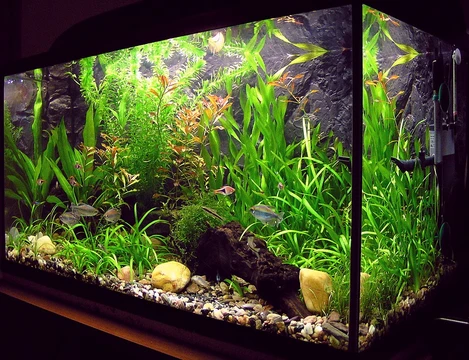
Aquatic plant
Vascular and non-vascular plants adapted to aquatic environments.

Aquatic plants, known scientifically as hydrophytes, include both vascular and non-vascular species that have evolved to thrive in saltwater or freshwater environments. In places like lakes, rivers, and wetlands, these plants offer shelter to fish, amphibians, and aquatic insects, provide a surface for benthic invertebrates to live on, release oxygen through photosynthesis, and are eaten by some herbivorous animals. Common examples are waterlily, lotus, duckweeds, mosquito fern, floating heart, water milfoils, mare's tail, water lettuce, and water hyacinth.
These plants need special adaptations to handle long periods underwater or to float on the surface. The most frequent adaptation is lightweight internal air spaces called aerenchyma, but floating leaves and finely divided leaves are also typical. Aquatic plants grow only in water or in soil that is constantly soaked, which is why they are often found in swamps and marshes.
Aquatic plants have adapted to either freshwater or saltwater. Vascular aquatic plants have evolved many separate times across different plant families, including ferns and angiosperms (both monocots and dicots). The only angiosperms that can grow fully underwater in seawater are seagrasses, such as those in the genera *Thalassia* and *Zostera*. The idea that angiosperms originated in water is supported by the fact that several of the oldest known fossil angiosperms were aquatic. Aquatic plants are spread widely across the angiosperm family tree, with at least 50 separate evolutionary origins, yet they make up less than 2% of all angiosperm species. *Archaefructus* is one of the oldest and most complete angiosperm fossils, dating to around 125 million years ago. These plants require special adaptations for living submerged or floating.
Fully submerged aquatic plants need little stiff or woody tissue because they stay in position using buoyancy from gas-filled lacunae or turgid aerenchyma cells. When taken out of water, they quickly become limp and lose turgor. However, plants living in rivers need enough structural xylem to withstand fast currents and strong attachment mechanisms to avoid being pulled loose. Many fully submerged plants have finely dissected leaves, likely to reduce drag in flowing water and to increase surface area for exchanging minerals and gases.
- Oldest known fossil
- Archaefructus, around 125 million years old
- Angiosperm origins
- at least 50 independent origins
- Angiosperm species percentage
- less than 2%
- Seagrass genera examples
- Thalassia and Zostera
Lore & Background
Aquatic plants require special adaptations for prolonged inundation and for floating at the water surface. The most common adaptation is the presence of lightweight internal packing cells called aerenchyma, along with floating leaves and finely dissected leaves. They only thrive in water or frequently saturated soil, making them common in swamps and marshlands. Aquatic vascular plants have originated on multiple occasions in different plant families, including ferns and angiosperms (both monocots and dicots). The only angiosperms capable of growing completely submerged in seawater are seagrasses, found in genera such as Thalassia and Zostera. An aquatic origin of angiosperms is supported by evidence that several of the earliest known fossil angiosperms were aquatic, with Archaefructus representing one of the oldest, most complete fossils at around 125 million years old.
Reader's Guide
Aquatic plants are classified as macrophytes or microphytes based on visibility to the naked eye. Macrophytes are further categorized by growth form into emergent, submerged (rooted or unrooted), floating-leaved, and free-floating types. Emergent plants grow in water but pierce the surface, allowing pollination by wind or flying insects. Submerged macrophytes grow completely underwater, with or without roots. Floating-leaved macrophytes have roots attached to the substrate and leaves on the surface, such as water lilies. Free-floating macrophytes, like duckweeds, are suspended on the water surface without root attachment. Microphytes include phytoplankton, periphyton, and benthic algae. Additional morphological classifications include amphiphytes, elodeids, isoetids, helophytes, nymphaeids, and neuston. Some terrestrial plants may undergo phenotypic plasticity when submerged, developing thinner leaves and cell walls, but may not be able to reproduce underwater.
Did You Know?
- Aquatic plants have at least 50 independent origins among angiosperms, though they comprise less than 2% of angiosperm species.
- Some aquatic plants, like water soldier, can alter their position in the water column at different seasons, floating to the surface in late spring for flowering.
- Floating aquatic angiosperms have stomata only on the top surface of leaves, which remain permanently open for gas exchange.
More in Aquarium and Aquatic Plants 1-24
Spotted an error? Know more?
Reader corrections go straight into our review queue. Suggest an edit · How this site is sourced