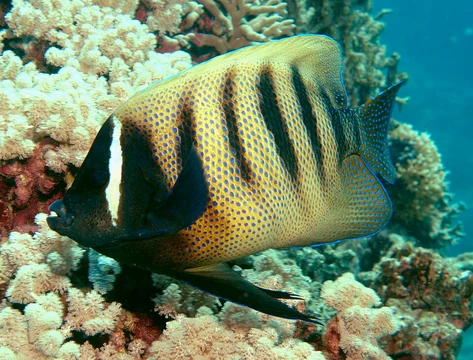
Sixbar angelfish (Pomacanthus sexstriatus)
Source-cited species reference: taxonomy from WoRMS, biology from FishBase, occurrence map from GBIF, conservation from IUCN Red List, description from Wikipedia.

Leonard Low from Australia · CC BY 2.0
The sixbar angelfish (Pomacanthus sexstriatus), also known as the six-banded angelfish, is a species of marine ray-finned fish in the angelfish family Pomacanthidae. It is found in Indo-Pacific region.
- Scientific name
- Pomacanthus sexstriatus
- Authority
- (Cuvier, 1831)
- Family
- Pomacanthidae
- Order
- Acanthuriformes
- Maximum length
- 46 cm
- Depth range
- 3–60 m
- Habitat zone
- reef-associated
- Iucn red list
- Least Concern
- Gbif occurrence records
- 3,641
Taxonomic History & Naming
The sixbar angelfish, a marine ray-finned member of the angelfish family Pomacanthidae, received its first formal scientific description in 1831. The French anatomist Georges Cuvier, working near the end of his life (he passed in 1832), published the species under the name Holacanthus sexstriatus, designating Java as the type locality. The specific epithet, meaning "six-banded," directly references the six vertical stripes that mark the flanks of mature individuals — a feature that also inspired the common names "sixbar" and "six-banded angelfish." Taxonomic placement has shifted over the decades. Some modern authorities assign this species to the subgenus Euxiphipops, a name originally erected as a standalone genus in 1934 by the British ichthyologist Alec Fraser-Brunner. That genus was subsequently synonymized back into Pomacanthus, folding the sixbar angelfish into the broader angelfish genus where it remains today.
A Dramatic Metamorphosis: Juvenile to Adult
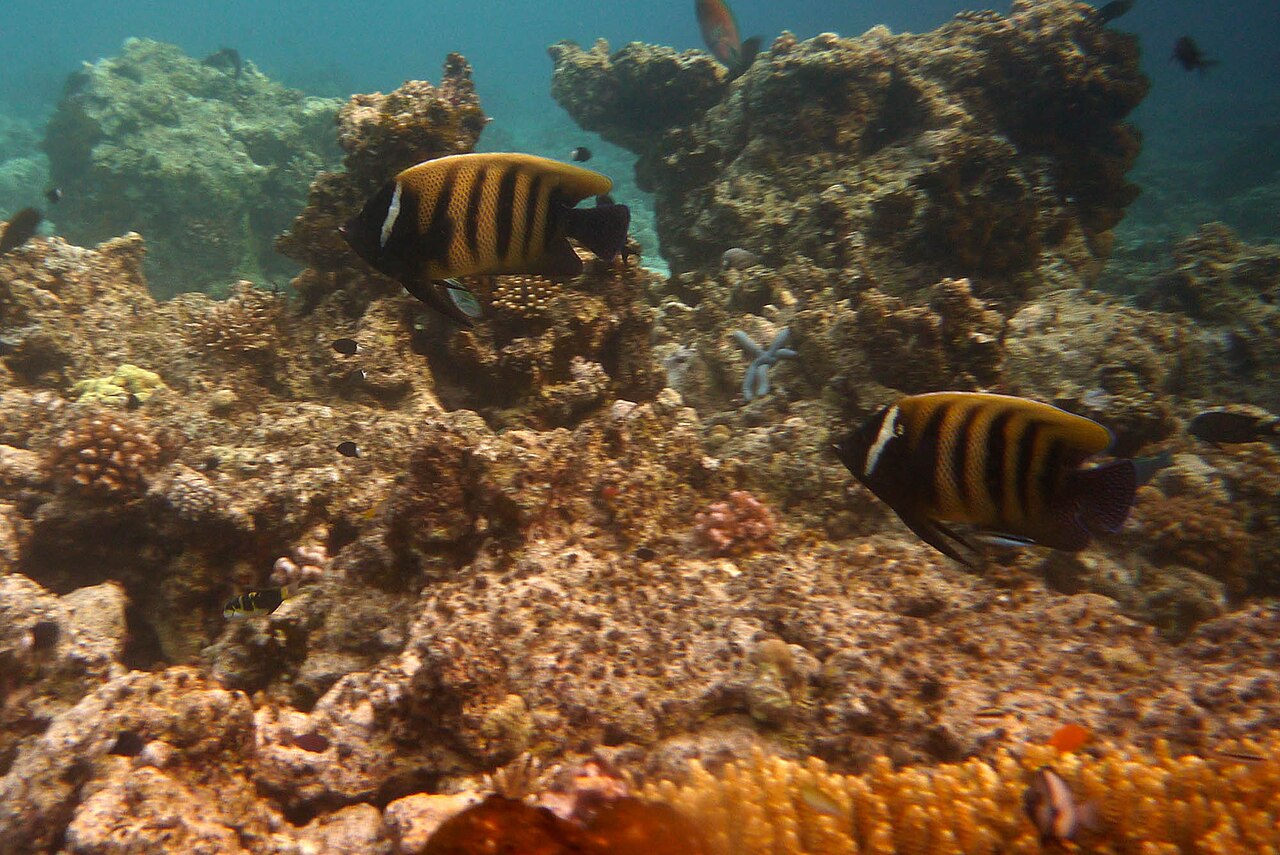
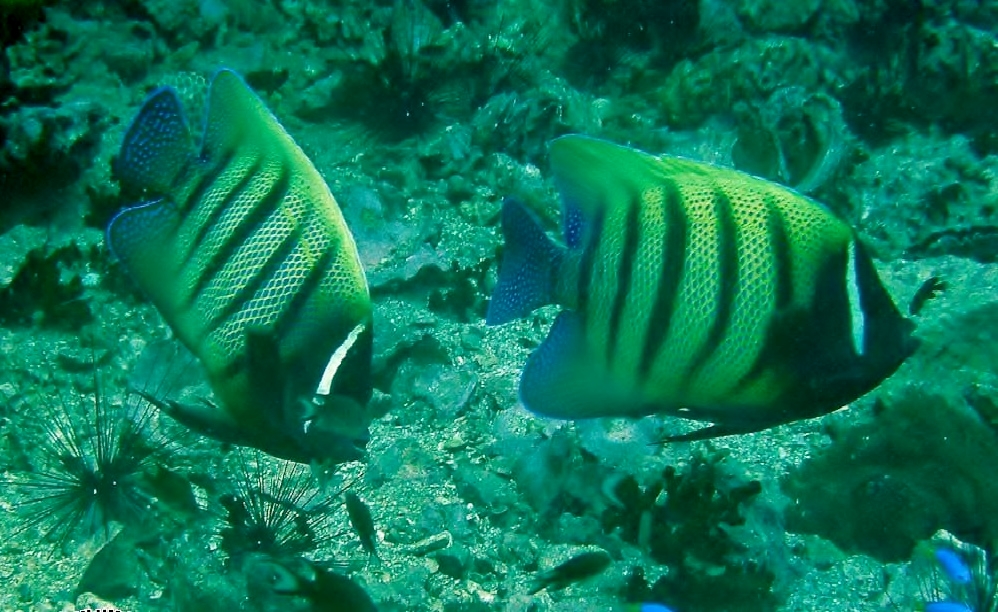
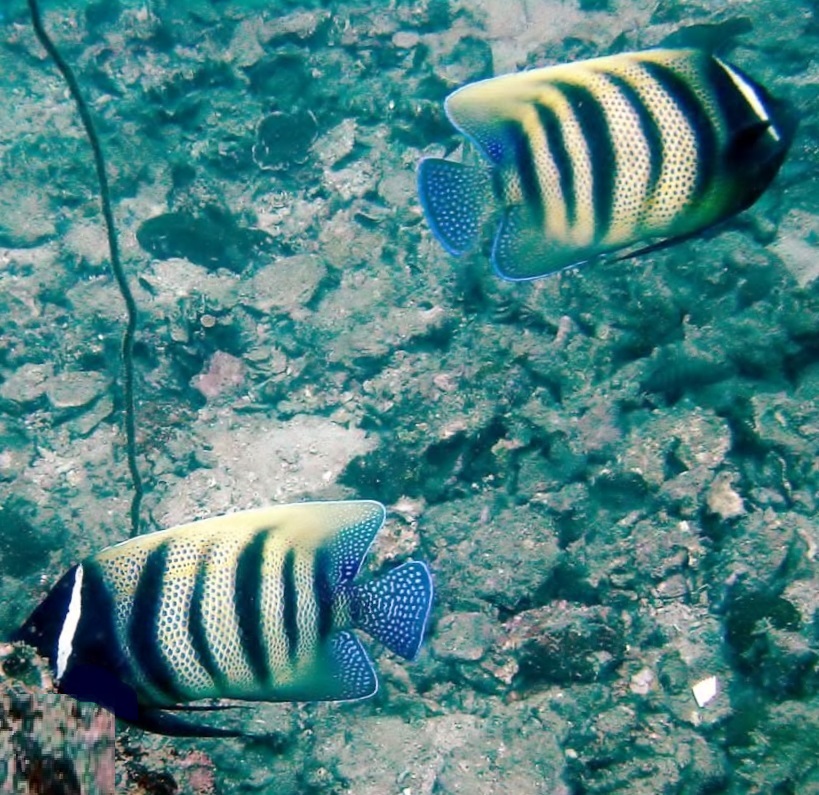
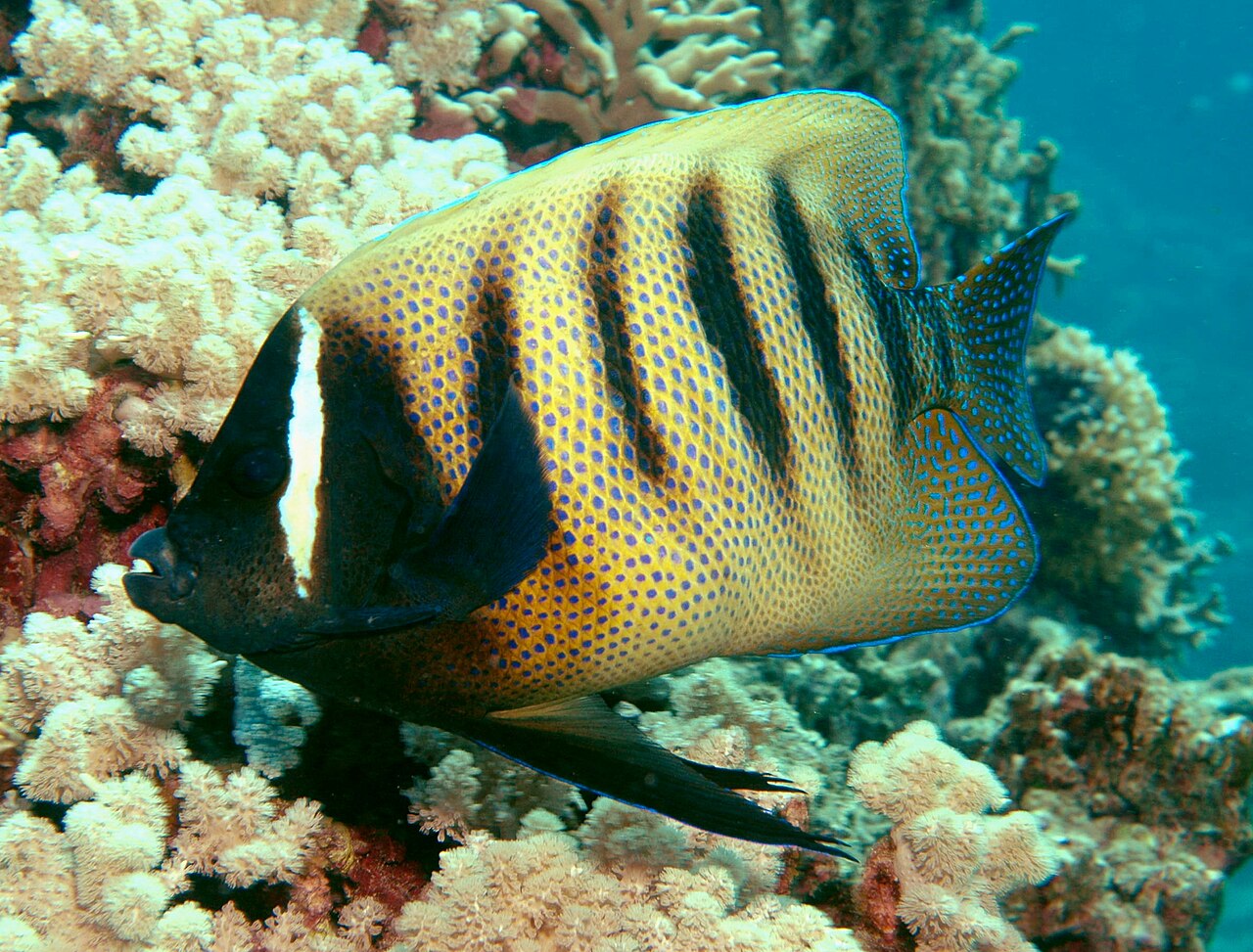
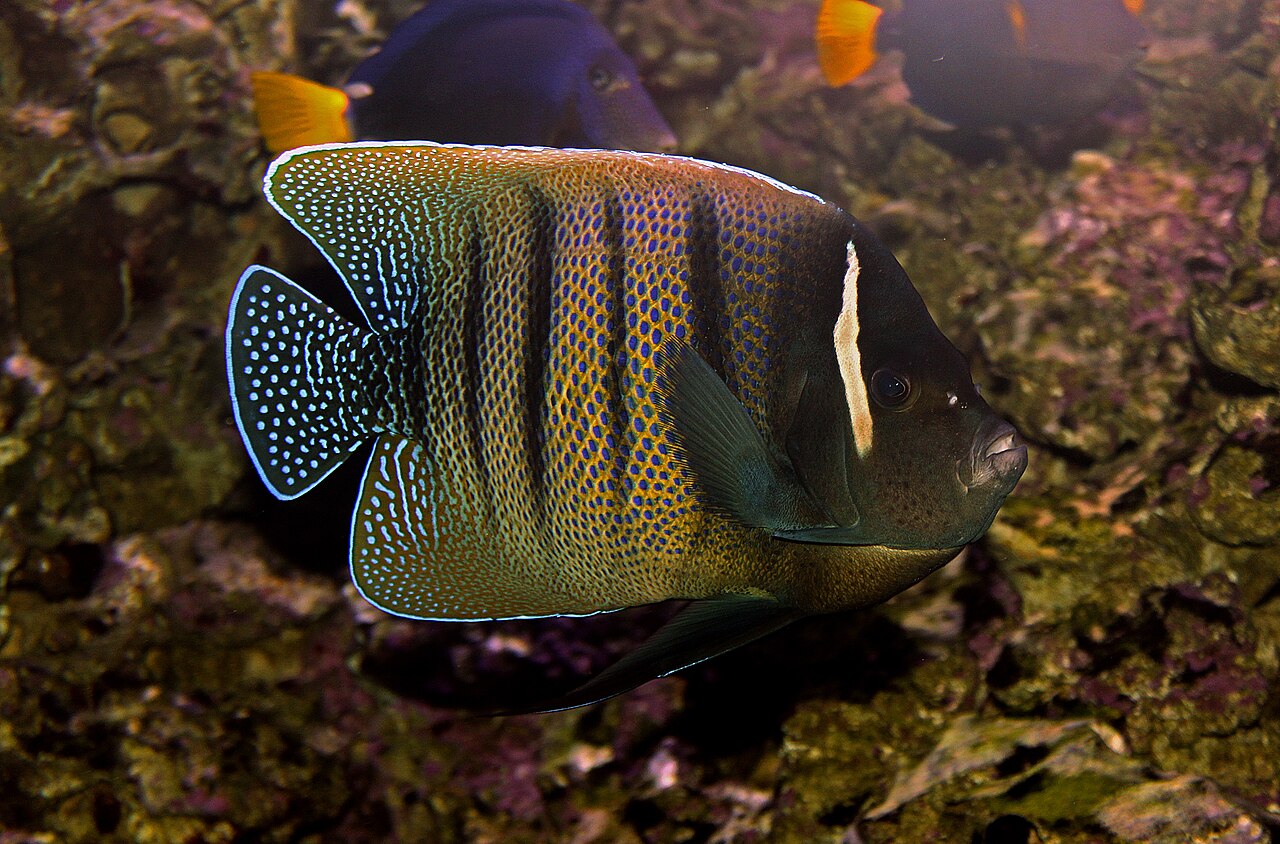
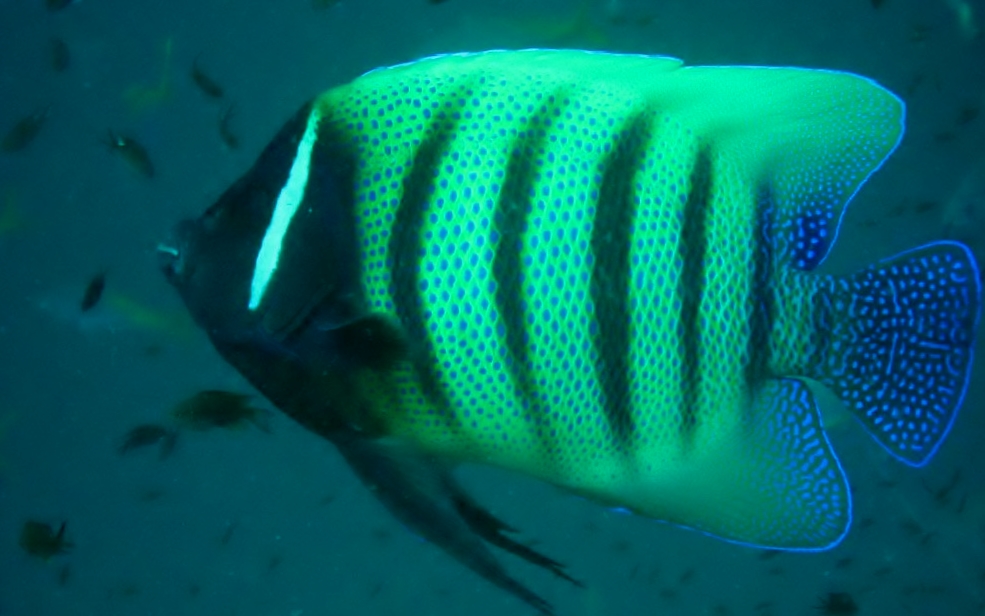
One of the most striking features of the sixbar angelfish is how radically its appearance changes between life stages, a pattern shared across the genus Pomacanthus. Young fish display a deep blue-black body crisscrossed by numerous vertical white bands. The bands nearest the head are relatively straight, while those toward the tail curve into increasingly pronounced arcs, giving the juvenile a flowing, ribbon-like silhouette. By the time the fish matures, this palette is entirely replaced. The adult body and median fins shift to a warm brownish-yellow, studded with vivid blue spots. Along the flanks, exactly six vertical bands remain: the first, positioned just behind the head, is a pale whitish stripe, while the other five are black. In terms of body plan, the species carries 13 to 14 spines and 18 to 23 soft rays in its dorsal fin, plus 3 spines and 18 to 19 soft rays in the anal fin. In the wild, a fully grown sixbar angelfish can reach roughly 46 centimeters — about 18 inches — making it a substantial reef dweller.
Range & Reef Habitat
The sixbar angelfish inhabits a broad swath of the Indo-Pacific. Its longitudinal span stretches from Sri Lanka eastward through the Malay Archipelago all the way to the Solomon Islands. In the north-south direction, its range reaches from the Ryukyu Islands and Palau in the north down to New Caledonia and the Australian coast in the south. Within Australian waters, the species occurs from Shark Bay in Western Australia along the entire northern coastline to the Capricorn and Bunker Group off Queensland, and it is also recorded around the Rowley Shoals, Scott Reef, and Ashmore Reef in the Timor Sea. Depth-wise, the fish occupies a wide band from just 1 meter down to 60 meters. Habitat preferences differ by age: juveniles favor the sheltered inner reefs, while adults gravitate toward lagoons and outer reef slopes where coral growth is particularly dense and diverse.
Social Life, Diet & the Aquarium Trade
Adult sixbar angelfish are not highly social; they typically exist either as a pair or as a solitary individual on their chosen reef. Their diet is omnivorous, drawing on macroalgae, sponges, and tunicates — a varied menu that reflects the rich biological community of the coral reefs they inhabit. One of the species' more unusual traits is its ability to produce loud, grunting sounds when alarmed, a vocalization that adds an auditory dimension to reef ecology. In terms of human interaction, the sixbar angelfish is occasionally harvested for the ornamental aquarium trade. However, only the juvenile stage is practical for home aquaria, since the adult's potential size of nearly 46 centimeters far exceeds what a typical domestic tank can accommodate. This size constraint means the trade is inherently limited to the smaller, more colorful young fish, while the impressive adults remain a feature of the open ocean.
Gallery
Related in Sixbar angelfish
Links follow this subject's own source article.
Elsewhere in Sixbar angelfish
Spotted an error? Know more?
Reader corrections go straight into our review queue. Suggest an edit · How this site is sourced