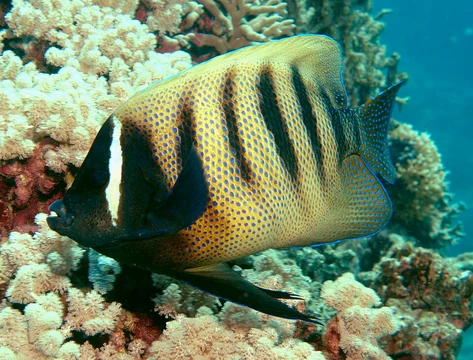
Where Sixbar angelfish has been recorded
GBIF occurrence records for Pomacanthus sexstriatus, mapped and tabulated by country.

3,641 georeferenced occurrence records with coordinates are published for Pomacanthus sexstriatus through GBIF, from 17 countries or marine areas. This page maps those records and lists where they come from. Occurrence records reflect where people have looked as well as where the species lives, so well-surveyed coastlines are over-represented.
- Georeferenced records
- 3,641
- Countries / areas
- 17
- Mapped locations
- 225
- Records sampled for the map
- 3,000
- Inland records omitted
- 24
- Gbif taxonkey
- 2396414
Taxonomic Classification and Hierarchical Placement
The Sixbar angelfish occupies a well-defined position within the hierarchical framework of vertebrate classification. As a member of the parvphylum Osteichthyes, the bony fishes, it belongs to one of the most diverse and abundant groups of vertebrate animals, a clade whose endoskeletons are constructed primarily from bone tissue rather than cartilage. Within this vast grouping, the species falls under the gigaclass Actinopterygii, the ray-finned fishes, one of only two such gigaclasses represented in the South African marine fish records. Further down the taxonomic ladder, it is placed within the class Teleostei and ultimately assigned to the order Acanthuriformes, a grouping that also encompasses surgeonfishes and related reef-dwelling families. This layered arrangement, running from parvphylum through gigaclass, class, and order, reflects the current taxonomic usage as maintained by the World Register of Marine Species, ensuring that the angelfish's placement aligns with the most up-to-date scientific consensus rather than potentially outdated regional citations.
Range Documentation in South African Waters
Recording the geographic presence of the Sixbar angelfish within South African waters follows a carefully defined protocol. The species appears in a dedicated sublist of the broader catalogue of marine fishes documented along the coastlines bordering the Republic of South Africa. Each entry pairs a locally recognized common name with the full scientific name, complete with the original author citation and the year of description. The range information provided is intentionally scoped: it captures the known distribution within South African territorial and adjacent waters, but it is explicitly noted that these boundaries may not represent the species' complete global range. In other words, the listed extent is a regional snapshot rather than a definitive biogeographic statement. This approach acknowledges that a fish species' true distribution can extend far beyond any single nation's waters, while still providing researchers and conservationists with a practical, locally relevant reference point for where the angelfish has been confirmed in the region.
Methodology, Nomenclature, and List Standards
The compilation of the South African marine fish list, within which the Sixbar angelfish is catalogued, adheres to a set of methodological principles designed to ensure consistency and scientific rigour. Taxonomic ordering and nomenclature are aligned wherever possible with the current usage maintained by the World Register of Marine Species, a globally recognized authority on marine taxonomy. This means the classification presented may occasionally diverge from the original source citations attached to each entry, since those citations are included primarily to document the range or the existence of records for the region rather than to establish taxonomic authority. Within any given taxonomic group, sub-taxa are arranged alphabetically as a general rule, providing a predictable and accessible structure for readers navigating the list. Synonyms are noted where relevant, and internal links connect each species entry to more detailed information, creating a layered reference system that balances brevity with depth.
Context Within South African Marine Biodiversity
The Sixbar angelfish is one thread in an extraordinarily rich tapestry of marine life documented along South Africa's coastlines. The bony fish clade to which it belongs, Osteichthyes, represents one of the most diverse assemblages of vertebrate animals on Earth, encompassing roughly forty-five orders, more than four hundred and thirty-five families, and approximately twenty-eight thousand described species. The vast majority of all extant fish species are members of this group, making it both an extremely diverse and an extremely abundant component of marine ecosystems. Within the South African list specifically, the angelfish shares its taxonomic neighbourhood with a remarkable array of reef-associated families, including surgeonfishes, boarfishes, and butterflyfishes, each represented by multiple species with their own distinct range limits stretching from the western Indian Ocean to the eastern Pacific. This concentration of closely related yet ecologically varied taxa underscores the richness of the waters surrounding the Republic and the importance of maintaining accurate, well-organized records of each species' presence.
Related in Sixbar angelfish
Links follow this subject's own source article.
Elsewhere in Sixbar angelfish
Spotted an error? Know more?
Reader corrections go straight into our review queue. Suggest an edit · How this site is sourced