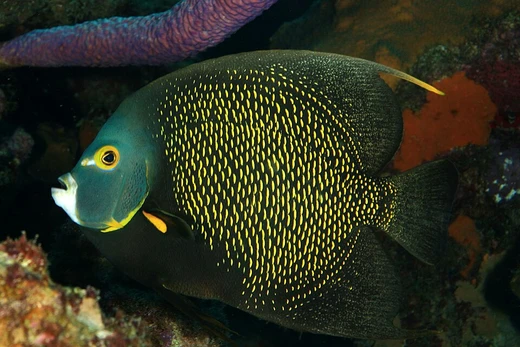
Pomacanthus arcuatus
Last updated

Andy Blackledge · CC BY 2.0
Adults are pale grayish with black spots, while juveniles are black with five vertical yellow stripes.[1][2] The gray angelfish possesses a compressed, disc-shaped body and a small mouth.[2][3] This fish grows up to 60 cm in total length.[2][4]
Scientific classification
- KingdomAnimalia
- PhylumChordata
- ClassActinopterygii
- DivisionTeleostei
- OrderAcanthuriformes
- FamilyPomacanthidae
- GenusPomacanthus
- SpeciesPomacanthus arcuatus
Named by (Linnaeus, 1758)
Close relatives
Other species of Pomacanthus with a Codexery entry.
- Arabian angelfish Pomacanthus asfur
- Old woman angelfish Pomacanthus rhomboides
- Pomacanthus annularis Pomacanthus annularis
- Pomacanthus chrysurus Pomacanthus chrysurus
- Pomacanthus imperator Pomacanthus imperator
- Pomacanthus maculosus Pomacanthus maculosus
- Pomacanthus navarchus Pomacanthus navarchus
- Pomacanthus paru Pomacanthus paru
Sources: Wikipedia taxobox: Gray angelfish (CC BY-SA 4.0) · differs from this box at order: WoRMS AphiaID 159287 (CC BY 4.0)
Conservation status
Least Concern (LC)
- LC▲ this species
- NT
- VU
- EN
- CR
- EW
- EX
Source: IUCN Red List assessment · GBIF copy of the Red List category
How big is it?
Largest length in the source, 0.6 m, next to a 1.8 m person.
Diagram: drawn by Codexery, schematic shapes to scale (not a likeness). Length: Wikipedia: Gray angelfish
Where the pomacanthus arcuatus has been recorded
Each dot is a place where the species has been observed and reported (38,919 records, half-degree grid) — not a modelled range. 27 inland records left out (institution coordinates). 3 isolated far-off records not drawn.
Map: drawn by Codexery. Data: GBIF occurrence search (records CC0 / CC BY) · Natural Earth basemap (public domain) · place coordinates: Wikipedia (CC BY-SA 4.0)
Biology and range
Females release between 25,000 and 75,000 eggs per spawning event, and the eggs hatch into larvae after 15–20 hours.[5][2] Its distribution covers the entire Caribbean Sea and Gulf of Mexico; the species was brought to Bermuda from the Bahamas.[6] During the day the gray angelfish is active, and at night it conceals itself within the reef.[5][2] Young gray angelfish serve as cleaner fish, operating cleaning stations that attract larger fish.[5]

Spawning takes place from April through September in the northern portion of the species' range.[5]
What the specialist sources record
The Discover Fish account by Cathleen Bester notes that the gray angelfish is easily confused with the French angelfish (Pomacanthus paru).[2] Bester states that the juvenile gray angelfish has a yellow band running through the mouth to the chin, distinguishing it from the French angelfish.[2] Bester also reports that the gray angelfish is marketed fresh or salted due to its flesh of excellent quality.[2] The Saltcorner account by Bob Goemans gives a maximum size of 20 inches (50 cm) and notes adults are mainly at depths of 50 to 100 feet (15–30 m).[7]
Goemans describes the adult as having an overall pale silvery-grayish body with numerous darker dots and a whitish gray head.[7] The GBIF database holds 39,181 occurrence records for this taxon.[8]
References
- Wikipedia, "Gray angelfish" (CC BY-SA 4.0), which cites: "Pomacanthus arcuatus", Saltcorner!, 2012 (we also read that source) en.wikipedia.org
- Cathleen Bester, "Pomacanthus arcuatus", Discover Fish. facts only, no text reused. floridamuseum.ufl.edu
- Wikipedia, "Gray angelfish" (CC BY-SA 4.0), which cites: "Species: Pomacanthus arcuatus, Grey angelfish", Shorefishes of the Greater Caribbean online information (original not read by us) en.wikipedia.org
- Wikipedia, "Gray angelfish" (CC BY-SA 4.0) en.wikipedia.org
- Wikipedia, "Gray angelfish" (CC BY-SA 4.0), which cites: Cathleen Bester, "Pomacanthus arcuatus", Discover Fish (we also read that source) en.wikipedia.org
- Wikipedia, "Gray angelfish" (CC BY-SA 4.0), which cites: Pyle, R., "Pomacanthus arcuatus", 2010; "Pomacanthus arcuatus introduced to Bermuda from Bahamas Date of introduction: 1920s", Food and Agriculture Organization (original not read by us) en.wikipedia.org
- "Pomacanthus arcuatus", Saltcorner!, 2012. facts only, no text reused. saltcorner.com
- GBIF Backbone Taxonomy and occurrence index, Pomacanthus arcuatus (taxon key 2396435). CC BY 4.0 (backbone); counts are facts. gbif.org
Each numbered sentence above was checked against the source it cites before publication. Sentences citing Wikipedia adapt text from the English Wikipedia article Gray angelfish (contributors), used under CC BY-SA 4.0; this entry is available under the same licence. Other sources were used for facts only; no text or images are copied from them.
More in Marine Angelfish
Sources
Compiled from Wikipedia and the sources listed below. Text from Wikipedia is available under CC BY-SA 4.0; this entry is adapted from it.
- Wikipedia: Gray angelfish (CC BY-SA 4.0).
- Classification: the source article's taxobox; compare WoRMS, the World Register of Marine Species (CC BY 4.0).
- Conservation status: IUCN Red List assessment.
- Occurrence records: GBIF (CC0 / CC BY). Basemap: Natural Earth (public domain).
Spotted an error? Know more?
Reader corrections go straight into our review queue. Suggest an edit · How this site is sourced