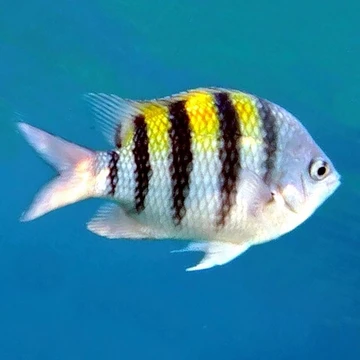
Sergeant major (fish) (Abudefduf saxatilis)
Source-cited species reference: taxonomy from WoRMS, biology from FishBase, occurrence map from GBIF, conservation from IUCN Red List, description from Wikipedia.

The sergeant major or píntano (Abudefduf saxatilis) is a species of damselfish. It grows to a maximum length of about 22.9 cm.
- Scientific name
- Abudefduf saxatilis
- Authority
- (Linnaeus, 1758)
- Family
- Pomacentridae
- Order
- Ovalentaria incertae sedis
- Maximum length
- 22.899999618530273 cm
- Depth range
- 0–20 m
- Habitat zone
- reef-associated
- Iucn red list
- Least Concern
- Gbif occurrence records
- 64,865
Classification (WoRMS)
Full classification as recorded by WoRMS: Kingdom: Animalia · Phylum: Chordata · Class: Teleostei · Order: Ovalentaria incertae sedis · Family: Pomacentridae · Genus: Abudefduf.
Accepted name: Abudefduf saxatilis · Authority: (Linnaeus, 1758) · Taxonomic status: accepted · AphiaID: 159288.
Synonyms and superseded combinations recorded for this taxon: Abudefduf ascensionis Fowler, 1919; Abudefduf marginatus (Bloch, 1787); Abudefduf saxiatilis (Linnaeus, 1758); Abudefduf sexatilis (Linnaeus, 1758); Apogon quinquevittatus Blyth, 1858; Chaetodon marginatus Bloch, 1787; Chaetodon mauritii Bloch, 1787; Chaetodon sargoides Lacepède, 1802; Chaetodon saxatilis Linnaeus, 1758; Glyphidodon saxatilis (Linnaeus, 1758); Glyphisodon biniar Montrouzier, 1857; Glyphisodon moucharra Lacepède, 1802; Glyphisodon saxatilis.
Source: World Register of Marine Species (WoRMS) — https://www.marinespecies.org/aphia.php?p=taxdetails&id=159288 (CC BY 4.0). Accessed 2026-09-23.
Biology and life history (FishBase)
Measured values published by FishBase for Abudefduf saxatilis. Only fields the database actually holds for this species are shown; these are database values, not aquarium guidance.
Maximum length: 22.899999618530273 cm · Common length: 15 cm · Depth range: 0–20 m · Habitat zone: reef-associated · Body shape: short and / or deep · Vulnerability index: 12.9 of 100 · Fishery importance: minor commercial · Aquarium trade: commercial.
FishBase notes: Juveniles are common in tide pools while adults are found over shallow reef tops. Adults frequently form large feeding aggregations of up to several hundred individuals. Food items include algae, small crustaceans and fish, and various invertebrate larvae (Ref. 3139). At Fernando de Noronha Archipelago, this species feeds on spinner dolphins’ feces and vomits. The offal feeding may be regarded as a simple behavioral shift from plankton feeding to drifting offal picking. Also, juveniles may hold cleaning stations together with the doctorfish ( Acanthurus chirurgus ) and the blue tang ( Acanthurus coeruleus ) and graze algae as well as pick molted skin and parasites from green turtles ( Chelonia mydas ). This behavior is preceded by a characteristic inspection usually followed by feeding nips on the turtles’ skin (head, limbs, and tail), as well as on the carapace. The most inspected and cleaned body parts are the flippers (Ref. 48727, 51385). Adult males adopt a bluish ground color when guarding eggs. Oviparous, distinct pairing during breeding (Ref. 205). Eggs are demersal and adhere to the substrate (Ref. 205). Attracted to divers who feed fish. Marketed fresh (Ref. 3139). Has been reared in captivity (Ref. 35420).
Source: FishBase species summary (SpecCode 1119) — https://www.fishbase.se/summary/Abudefduf-saxatilis.html (CC BY-NC 3.0 — non-commercial use only). Accessed 2026-09-23.
Distribution and occurrence records (GBIF)
64,865 georeferenced occurrence records for Abudefduf saxatilis are published through GBIF from 95 countries or marine areas. The map above plots 185 distinct locations from a sample of 3,000 records, omitting 67 inland records that carry an institution's coordinates rather than a collection site; it shows where the species has been observed and reported, not a modelled range.
Most records by country or area: United States of America (36,269); Brazil (16,133); Puerto Rico (3,332); Mexico (2,299); Virgin Islands (U.S.) (937).
The full country table, WoRMS marine regions and the sampling notes are on this species' Distribution page.
Source: GBIF Occurrence Search (taxonKey 2398623) — https://www.gbif.org/occurrence/search?taxon_key=2398623&has_coordinate=true (records CC0 / CC BY); WoRMS distribution records (MarineRegions) — https://www.marinespecies.org/aphia.php?p=taxdetails&id=159288 (CC BY 4.0); Natural Earth 110m basemap — https://www.naturalearthdata.com/ (public domain). Accessed 2026-09-23.
Conservation status (IUCN Red List)
The IUCN Red List assesses Abudefduf saxatilis (Linnaeus, 1758) as Least Concern (code LC). No trend, population estimate or threat analysis is given here, because none is available from this source without the Red List API; follow the source link for the full assessment, including its date.
Source: IUCN Red List of Threatened Species (taxon 188581) — https://www.iucnredlist.org/species/188581/0; GBIF IUCN Red List category endpoint (taxonKey 2398623) — https://api.gbif.org/v1/species/2398623/iucnRedListCategory. Accessed 2026-09-23.
Description and natural history (Wikipedia)
Abudefduf saxatilis is found in the Atlantic Ocean. Populations in the western part of the Atlantic Ocean are found from the northeastern coast of the United States south to the Gulf of Mexico, the Bahamas, islands around the Caribbean Sea, and the eastern coast of Central and South America to Uruguay. In the eastern Atlantic, they are found from Portugal, the Azores, the Canary Islands, Cape Verde, and western Africa. Its distribution remains unclear in the Mediterranean Sea due to possible confusion with A. vaigiensis and A. troschelii.
Juveniles are common in tidal pools, while adults are found over coral reefs. Sergeant majors are found down to 40 m.
Adults can grow to a maximum of 22.9 cm, but more typically grow to 15 cm. The largest recorded specimen weighed had a weight of 200 g. A. saxatilis has 13 dorsal spines, 12 to 13 dorsal soft rays, two anal spines, and 10 to 12 anal soft rays. This fish is white with a yellow top. It has five black or dark blue, vertical stripes. A faint sixth stripe might be present on the caudal peduncle. Adult males have a more bluish coloration and their stripes are less visible. A dark spot surrounds their pectoral fins.
This fish feeds upon the larvae of invertebrates, zooplankton (such as copepods and shrimp larvae), pelagic tunicates, smaller fish, crustaceans, and various species of algae (both benthic and pelagic). It is also known to feed on the waste and vomit of spinner dolphins.
Individuals of this species form shoals of about several hundred individuals. Sometimes, they get cleaned of parasites by fish species, such as gobies in the genus Gobiosoma, Bodianus rufus, Elacatinus figaro, and Thalassoma noronhanum. Sergeant majors also clean green sea turtles along with Acanthurus chirurgus and Acanthurus coeruleus.
Predators of this fish include Plectropomus leopardus, Thalassoma bifasciatum, Cephalopholis cruentata, Epinephelus striatus, Mycteroperca venenosa, and Rachycentron canadum.
They are found in the aquarium trade, but are regarded as difficult to breed.
The sergeant major is an oviparous species in which the males create nests on rocks, reef outcrops, shipwrecks, and pilings, where the females lay their egg masses. The males actively chase the females in courtship before the female releases about 200,000 ref, ovoid eggs, which are attached to the substrate by a filament; the eggs turn greenish after a few days and are guarded by the male. As he guards the eggs, the male becomes bluish in colour, guarding them for about a week.
Sergeant majors earn their name from their brightly striped sides, known as bars, which are reminiscent of the insignia of a military sergeant major.
Source: Wikipedia: Sergeant major (fish) — https://en.wikipedia.org/wiki/Sergeant_major_%28fish%29 (CC BY-SA 4.0). Accessed 2026-09-23.
Related in Sergeant major (fish)
Links follow this subject's own source article.
Elsewhere in Sergeant major (fish)
Spotted an error? Know more?
Reader corrections go straight into our review queue. Suggest an edit · How this site is sourced