
Patchwork cuttlefish (Sepia vermiculata)
Source-cited species reference: taxonomy from WoRMS, biology from SeaLifeBase, occurrence map from GBIF, conservation from IUCN Red List, description from Wikipedia.
Sepia vermicularis is a species of cuttlefish endemic to southern Africa. It is known by many common names, such as the patchwork cuttlefish, common cuttlefish or ink-fish, but the name "common cuttlefish" is more widely applied to Sepia officinalis.
- Scientific name
- Sepia vermiculata
- Authority
- Quoy & Gaimard, 1832
- Family
- Sepiidae
- Order
- Sepiida
- Maximum length
- 28.7 cm
- Habitat zone
- benthic
- Iucn red list
- Data Deficient
- Gbif occurrence records
- 159
Classification (WoRMS)
Full classification as recorded by WoRMS: Kingdom: Animalia · Phylum: Mollusca · Class: Cephalopoda · Order: Sepiida · Family: Sepiidae · Genus: Sepia.
Accepted name: Sepia vermiculata · Authority: Quoy & Gaimard, 1832 · Taxonomic status: accepted · AphiaID: 225551.
Synonyms and superseded combinations recorded for this taxon: Sepia officinalis vermiculata Quoy & Gaimard, 1832.
Source: World Register of Marine Species (WoRMS) — https://www.marinespecies.org/aphia.php?p=taxdetails&id=225551 (CC BY 4.0). Accessed 2026-09-23.
Biology and life history (SeaLifeBase)
Measured values published by SeaLifeBase for Sepia vermiculata. Only fields the database actually holds for this species are shown; these are database values, not aquarium guidance.
Maximum length: 28.7 cm · Habitat zone: benthic · Vulnerability index: 18.7 of 100.
Source: SeaLifeBase species summary (SpecCode 57390) — https://www.sealifebase.se/summary/Sepia-vermiculata.html (CC BY-NC 3.0 — non-commercial use only). Accessed 2026-09-23.
Distribution and occurrence records (GBIF)
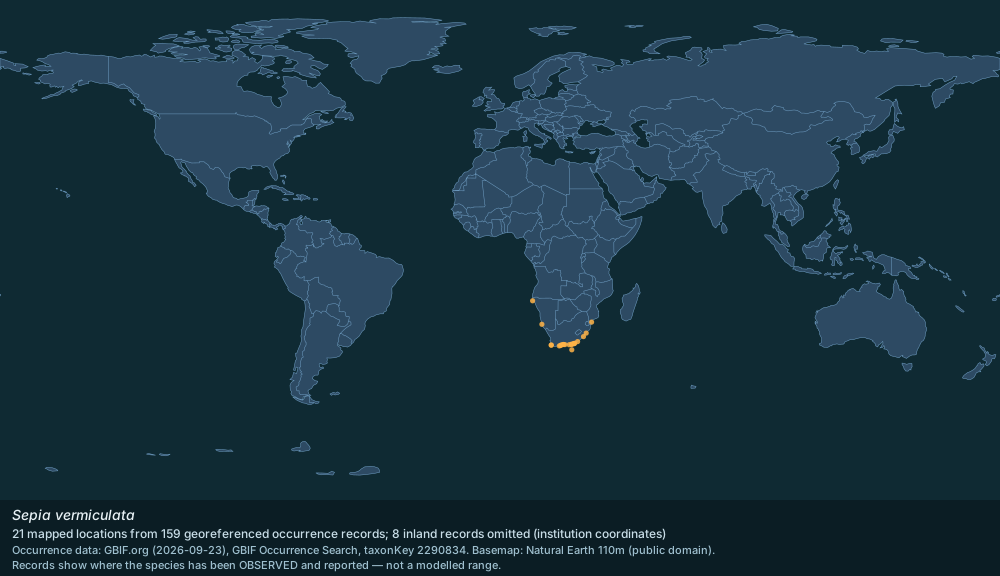
159 georeferenced occurrence records for Sepia vermiculata are published through GBIF from 4 countries or marine areas. The map above plots 21 distinct locations from a sample of 159 records, omitting 8 inland records that carry an institution's coordinates rather than a collection site; it shows where the species has been observed and reported, not a modelled range.
Most records by country or area: South Africa (155); Namibia (2); Angola (1); Mozambique (1).
Marine regions with a valid WoRMS distribution record: South Africa (country); South Africa; FAO fishing area 47; FAO fishing area 51; Cape of Good Hope; Agulhas Bank.
Source: GBIF Occurrence Search (taxonKey 2290834) — https://www.gbif.org/occurrence/search?taxon_key=2290834&has_coordinate=true (records CC0 / CC BY); WoRMS distribution records (MarineRegions) — https://www.marinespecies.org/aphia.php?p=taxdetails&id=225551 (CC BY 4.0); Natural Earth 110m basemap — https://www.naturalearthdata.com/ (public domain). Accessed 2026-09-23.
Conservation status (IUCN Red List)
The IUCN Red List assesses Sepia vermiculata Quoy & Gaimard, 1832 as Data Deficient (code DD). No trend, population estimate or threat analysis is given here, because none is available from this source without the Red List API; follow the source link for the full assessment, including its date.
Source: IUCN Red List of Threatened Species (taxon 162619) — https://www.iucnredlist.org/species/162619/0; GBIF IUCN Red List category endpoint (taxonKey 2290834) — https://api.gbif.org/v1/species/2290834/iucnRedListCategory. Accessed 2026-09-23.
Description and natural history (Wikipedia)
The South African common cuttlefish has an elongated body with ten arms bearing rows of suckers. Two arms are elongated tentacles used for catching prey. Paired lateral fins extend the whole length of the body. The upper surface of the body is smooth, with rippling bars of colour and the animal is usually well camouflaged.
This cuttlefish is found around the South African coast from Saldanha Bay to Algoa Bay, subtidally to at least 40m. Outside South Africa its range extends to central Mozambique and on the Saya-de-Malha Bank and the Indian Ocean islands of the Seychelles, Mauritius and Rodrigues.
This animal lives on reefs and feeds on shrimp and small fishes. A gas-filled internal shell, the cuttlebone, is used for buoyancy. The eggs are pea-like and black or white and are usually seen attached to sea fans. The animal is capable of rapid changes of colour for camouflage, threat displays or for communicating mating readiness. A male ready to mate will show dark brightly rippling colours as he approaches another cuttlefish. If the other cuttlefish is either a male cuttlefish or a non-receptive female, the other cuttlefish will also show dark brightly rippling colours as a threat display. If the other cuttlefish is a receptive female, her colours will remain pale and head-to-head mating will take place. It may also lift two arms above its head when disturbed, possibly as threat gesture.
It is the only southern African species of cuttlefish to enter lagoons and estuaries having been recorded in Langebaan Lagoon and Knysna Lagoon as well as the mouth of the Kowie River
Source: Wikipedia: Sepia vermiculata — https://en.wikipedia.org/wiki/Sepia_vermiculata (CC BY-SA 4.0). Accessed 2026-09-23.
Gallery
Spotted an error? Know more?
Reader corrections go straight into our review queue. Suggest an edit · How this site is sourced