
African cuttlefish (Sepia bertheloti)
Source-cited species reference: taxonomy from WoRMS, biology from SeaLifeBase, occurrence map from GBIF, conservation from IUCN Red List, description from Wikipedia.
Sepia bertheloti, the African cuttlefish, is a species of cuttlefish from the family Sepiidae which is found in the warmer waters of the eastern Atlantic Ocean off Africa.
- Scientific name
- Sepia bertheloti
- Authority
- A. d'Orbigny, 1835
- Family
- Sepiidae
- Order
- Sepiida
- Maximum length
- 18 cm
- Depth range
- 17–160 m
- Habitat zone
- benthic
- Iucn red list
- Data Deficient
- Gbif occurrence records
- 66
Classification (WoRMS)
Full classification as recorded by WoRMS: Kingdom: Animalia · Phylum: Mollusca · Class: Cephalopoda · Order: Sepiida · Family: Sepiidae · Genus: Sepia.
Accepted name: Sepia bertheloti · Authority: A. d'Orbigny, 1835 · Taxonomic status: accepted · AphiaID: 141442.
Synonyms and superseded combinations recorded for this taxon: Sepia (Acanthosepia) mercatoris Adam, 1937; Sepia verrucosa Lönnberg, 1896.
Source: World Register of Marine Species (WoRMS) — https://www.marinespecies.org/aphia.php?p=taxdetails&id=141442 (CC BY 4.0). Accessed 2026-09-23.
Biology and life history (SeaLifeBase)
Measured values published by SeaLifeBase for Sepia bertheloti. Only fields the database actually holds for this species are shown; these are database values, not aquarium guidance.
Maximum length: 18 cm · Depth range: 17–160 m · Habitat zone: benthic · Vulnerability index: 10 of 100 · Fishery importance: commercial.
SeaLifeBase notes: Maximum size for male/unsexed is 18 cm, mantle length (Ref. 104052). Minimum depth from Ref. 91331. Feeds on mollusks (including other cephalopods), crustaceans and small fishes (Ref. 275).
Source: SeaLifeBase species summary (SpecCode 57289) — https://www.sealifebase.se/summary/Sepia-bertheloti.html (CC BY-NC 3.0 — non-commercial use only). Accessed 2026-09-23.
Distribution and occurrence records (GBIF)
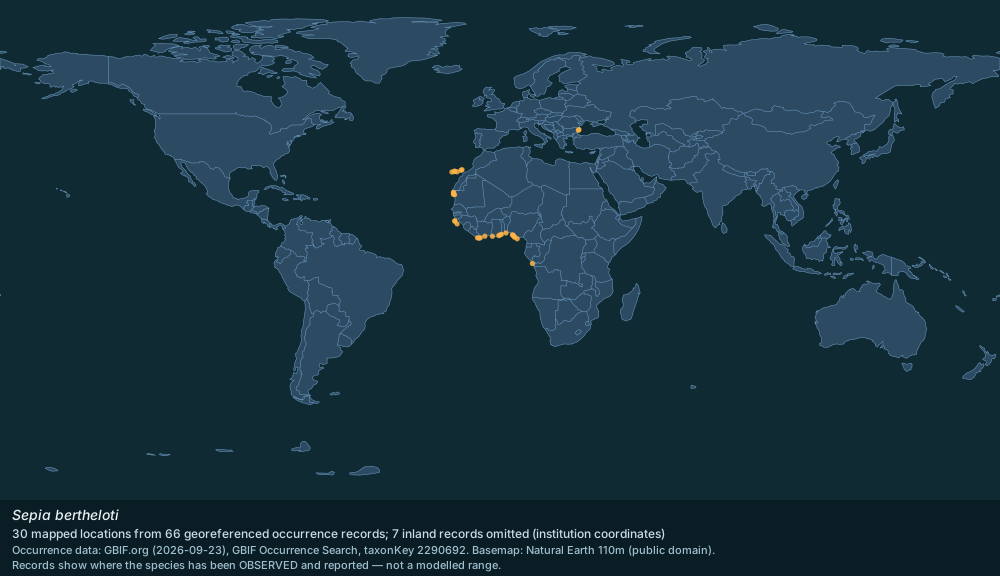
66 georeferenced occurrence records for Sepia bertheloti are published through GBIF from 14 countries or marine areas. The map above plots 30 distinct locations from a sample of 66 records, omitting 7 inland records that carry an institution's coordinates rather than a collection site; it shows where the species has been observed and reported, not a modelled range.
Most records by country or area: Spain (21); Mauritania (8); Nigeria (7); Angola (5); Ghana (5); Netherlands (4); Senegal (4); Côte d’Ivoire (3); Bulgaria (2); Guinea-Bissau (2); Liberia (2); Benin (1); Congo (1); Guinea (1).
Marine regions with a valid WoRMS distribution record: European waters (ERMS scope); Angolan Exclusive Economic Zone; East Atlantic; Eastern Central Atlantic; FAO fishing area 34; FAO fishing area 47; Tenerife; Belgian Coast; Moroccan Exclusive Economic Zone; South African Exclusive Economic Zone.
Source: GBIF Occurrence Search (taxonKey 2290692) — https://www.gbif.org/occurrence/search?taxon_key=2290692&has_coordinate=true (records CC0 / CC BY); WoRMS distribution records (MarineRegions) — https://www.marinespecies.org/aphia.php?p=taxdetails&id=141442 (CC BY 4.0); Natural Earth 110m basemap — https://www.naturalearthdata.com/ (public domain). Accessed 2026-09-23.
Conservation status (IUCN Red List)
The IUCN Red List assesses Sepia bertheloti d'Orbigny, 1835 (in Férussac & d'Orbigny 1834-1848) as Data Deficient (code DD). No trend, population estimate or threat analysis is given here, because none is available from this source without the Red List API; follow the source link for the full assessment, including its date.
Source: IUCN Red List of Threatened Species (taxon 162564) — https://www.iucnredlist.org/species/162564/0; GBIF IUCN Red List category endpoint (taxonKey 2290692) — https://api.gbif.org/v1/species/2290692/iucnRedListCategory. Accessed 2026-09-23.
Description and natural history (Wikipedia)
Sepia bertheloti grows to a mantle length of 175mm in males and 134mm in females. The dorsal anterior mantle margin forms a triangular lobe between the eyes. The wide fines have a wide gap between them at the rear.
suckers at the base, nine to thirteen rows of highly shrunken suckers in the middle part of the arm; these suckers are arranged in two dorsal and two ventral series which are laterally displaced and are separated by a gap. The suckers on the hectocotylus are covered by a well developed dorsal protective membrane. The tentacular club is straight and slender having five or six suckers in transverse rows in which a number of the suckers of the inner two or three rows are larger than rest. The cuttlebone is oblong in shape, outline roughly rectangular; tapering to a point anteriorly and rounded and blunt posteriorly. Its dorsal surface is evenly convex and covered with a sculpture of calcareous granulose arranged in a net like pattern which have their greatest concentration in the middle of the bone and at the long edges where they are arranged in irregular ridges parallel to the margin. The bone is most calcified at the rear and there is an indistinct dorsal median rib which broadens slightly towards the head end. The lateral and anterior margins of the cuttlebone are covered in chitin. On the dorsal part of the mantle there are a series of elongate papillae on either flank, situated around halfway along the base of the fins. It is purplish brown in colour with a zebra-like striping on the arms and an orange-red pigmented stripe which runs along their outer surface. The dorsal mantle has small spots, mainly towards the rear, and narrow, cream-coloured, broken lines running across it. The fins are pale and in the males there is a thin, shiny orange-pink stripe along the fin base of males which is bordered by a purplish band and one or two rows of many short bars which run along it.
Sepia bertheloti occurs along the western coast of Africa from Western Sahara south to Angola, it is also found off the Canary Islands.
Sepia bertheloti is found at depths of between 20m and 156m, being most numerous off the Canary Islands from depths of 70m-140m. At the Endeavour Bank they migrate to shallower waters on order to spawn in the summer and autumn. Their size distribution, as measured from animals caught by fisheries, shows a wider variation than for the sympatric Sepia officinalis during the summer. This wider variation suggests that either the spawning season is extended or at least some spawning happens continuously.
Sepia bertheloti is fished for by trawling off the Canary Islands and is commonly captured off the western Endeavour Bank. Catches are often mixed with Sepia hierredda and separate data is difficult to get, although data from Spanish trawlers off Western Sahara indicate that this species makes up 11% of the cuttlefish catch and the remaining 89% is S. hieradda. There are also fisheries for this species in Mauritania and Senegal.
The specific name honours the French malacologist Sabin Berthelot (1794-1880) who was French consul at Tenerife. The type specimen was taken off Tenerife and is held in the Muséum national d'Histoire naturelle.
Source: Wikipedia: Sepia bertheloti — https://en.wikipedia.org/wiki/Sepia_bertheloti (CC BY-SA 4.0). Accessed 2026-09-23.
Gallery
Spotted an error? Know more?
Reader corrections go straight into our review queue. Suggest an edit · How this site is sourced