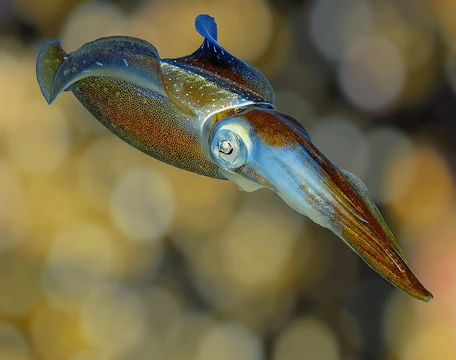
Common cuttlefish
One of the largest and best-known cuttlefish species.
Last updated

Diego Delso · via Wikipedia: Common cuttlefish · CC BY-SA 4.0
It is native to the eastern North Atlantic, English Channel, and Mediterranean Sea, often called the "European Cuttlefish"[1] The species Sepia officinalis, known as the common cuttlefish, attains a mantle length of up to 49 cm and a weight of up to 4 kg, though individuals from subtropical regions are smaller, rarely exceeding 30 cm in mantle length.[2][1] Sand and mud seabeds are the typical habitat for this species, which is also capable of living in brackish water.[3]
Scientific classification
Named by Linnaeus, 1758
Close relatives
Other species of Sepia with a Codexery entry.
- Sepia australis Sepia australis
- Sepia braggi Sepia braggi
- Sepia dollfusi Sepia dollfusi
- Sepia hedleyi Sepia hedleyi
- Sepia hierredda Sepia hierredda
- Sepia prashadi Sepia prashadi
- Sepia tuberculata Sepia tuberculata
- Sepia vermiculata Sepia vermiculata
Sources: Wikipedia taxobox: Common cuttlefish (CC BY-SA 4.0) · order, family and genus agree with WoRMS AphiaID 141444 (CC BY 4.0)
Conservation status
Least Concern (LC)
- LC▲ this species
- NT
- VU
- EN
- CR
- EW
- EX
Source: IUCN Red List assessment · GBIF copy of the Red List category
How big is it?
Largest length in the source, 0.49 m, next to a 1.8 m person.
Diagram: drawn by Codexery, schematic shapes to scale (not a likeness). Length: Wikipedia: Common cuttlefish
Where the common cuttlefish has been recorded
Each dot is a place where the species has been observed and reported (96,239 records, half-degree grid) — not a modelled range. 158 inland records left out (institution coordinates).
Map: drawn by Codexery. Data: GBIF occurrence search (records CC0 / CC BY) · Natural Earth basemap (public domain) · place coordinates: Wikipedia (CC BY-SA 4.0)
Last updated 2026-10-08 from the source article.
Key facts and history
Their diet includes crustaceans, small fish, molluscs, and sometimes other cuttlefish.[4][1] During breeding season, males display a black and white zebra pattern to attract females.[5][1] Females attach egg masses to seaweed or shells, and eggs incubate for 30 to 90 days depending on temperature.[5][1] Cuttlefish live up to 2 years, with many dying after spawning.[5]
The type specimen's collection location is recorded only as "Oceano", and the specimen itself is held by the Linnean Society of London.[6] Sepia officinalis migrates, residing in inshore waters during spring and summer for breeding, then relocating to depths between 100 and 200 m in autumn and winter.[2][1] Sexual maturity in cuttlefish is attained at an age ranging from 14 to 18 months.[5][1]
What the cited sources add
The Animal Diversity Web account notes that the home range for Sepia officinalis varies from 90 to 550 meters.[1] A 2008 BBC News report describes that cuttlefish embryos can peer out of their eggs and spot potential prey before hatching.[7] The Animal Diversity Web account states that cuttlefish play an important ecological role as consumers due to their broad diet and mobility.[8] It also notes that cuttlefish are believed to be abundant and face no threat of extinction.[8]
References
- Compton, "Sepia officinalis", Animal Diversity Web. facts only, no text reused. animaldiversity.org
- Wikipedia, "Common cuttlefish" (CC BY-SA 4.0), which cites: Compton, "Sepia officinalis", Animal Diversity Web; Reid, A., P. Jereb, & C.F.E. Roper (2005). "Family Sepiidae". In P. Jereb & C.F.E. Roper, eds. Cephalopods of the world. An annotated and illustrated catalogue ; Roper C.F.E., M.J. Sweeney & C.E. Nauen (1984). Cephalopods of the world. Food and Agriculture Organization, Rome, Italy. Vol. 3, p. 277. (we also read that source) en.wikipedia.org
- Wikipedia, "Common cuttlefish" (CC BY-SA 4.0), which cites: Helmut Debelius, "Marine Atlas: The Joint Aquarium Care of Invertebrates and Tropical Marine Fishes", Mergus, 1994, p. 798; "Ecology Summary - Sepia officinalis", sealifebase.ca (original not read by us) en.wikipedia.org
- Wikipedia, "Common cuttlefish" (CC BY-SA 4.0), which cites: "Sepia officinalis, The Common Cuttlefish – The Cephalopod Page", www.thecephalopodpage.org (we also read that source) en.wikipedia.org
- Wikipedia, "Common cuttlefish" (CC BY-SA 4.0), which cites: Compton, "Sepia officinalis", Animal Diversity Web; Barratt, I., "Sepia officinalis", 2012; "Species Fact Sheets Sepia officinalis (Linnaeus, 1758)", Food and Agriculture Organization of the United Nations (we also read that source) en.wikipedia.org
- Wikipedia, "Common cuttlefish" (CC BY-SA 4.0), which cites: Current Classification of Recent Cephalopoda (original not read by us) en.wikipedia.org
- Walker, M. (June 5, 2008). Cuttlefish spot target prey early. BBC News.. facts only, no text reused. news.bbc.co.uk
- "Sepia officinalis", Animal Diversity Web. facts only, no text reused. animaldiversity.org
Each numbered sentence above was checked against the source it cites before publication. Sentences citing Wikipedia adapt text from the English Wikipedia article Common cuttlefish (contributors), used under CC BY-SA 4.0; this entry is available under the same licence. Other sources were used for facts only; no text or images are copied from them.
More in Reef Cephalopods
Test yourself
Three questions drawn from this entry’s sources. Pick an answer to check it.
Answers checked against the source article
Sources
Compiled from Wikipedia and the sources listed below. Text from Wikipedia is available under CC BY-SA 4.0; this entry is adapted from it.
- Wikipedia: Common cuttlefish (CC BY-SA 4.0).
- Classification: the source article's taxobox; order, family and genus checked against WoRMS, the World Register of Marine Species (CC BY 4.0).
- Conservation status: IUCN Red List assessment.
- Occurrence records: GBIF (CC0 / CC BY). Basemap: Natural Earth (public domain).
- Word definitions: the Codexery glossary, each quoted from its Wikipedia article.
Spotted an error? Know more?
Reader corrections go straight into our review queue. Suggest an edit · How this site is sourced