
Pink cuttlefish (Rhombosepion orbignyanum)
Source-cited species reference: taxonomy from WoRMS, biology from SeaLifeBase, occurrence map from GBIF, conservation from IUCN Red List, description from Wikipedia.
Sepia orbignyana, the pink cuttlefish, is a species of small cuttlefish from the family Sepiidae. It is occurs in the temperate and tropical waters of the eastern Atlantic Ocean.
- Scientific name
- Rhombosepion orbignyanum
- Authority
- (A. Férussac, 1826)
- Family
- Sepiidae
- Order
- Sepiida
- Maximum length
- 9.6 cm
- Depth range
- 15–570 m
- Habitat zone
- demersal
- Iucn red list
- Data Deficient
- Gbif occurrence records
- 4,978
Classification (WoRMS)
Full classification as recorded by WoRMS: Kingdom: Animalia · Phylum: Mollusca · Class: Cephalopoda · Order: Sepiida · Family: Sepiidae · Genus: Rhombosepion.
Accepted name: Rhombosepion orbignyanum · Authority: (A. Férussac, 1826) · Taxonomic status: accepted · AphiaID: 1667212.
Synonyms and superseded combinations recorded for this taxon: Acanthosepion enoplon Rochebrune, 1884; Sepia orbigniana (A. Férussac, 1826); Sepia orbignyana A. Férussac, 1826.
Source: World Register of Marine Species (WoRMS) — https://www.marinespecies.org/aphia.php?p=taxdetails&id=1667212 (CC BY 4.0). Accessed 2026-09-23.
Biology and life history (SeaLifeBase)
Measured values published by SeaLifeBase for Rhombosepion orbignyanum. Only fields the database actually holds for this species are shown; these are database values, not aquarium guidance.
Maximum length: 9.6 cm · Depth range: 15–570 m · Habitat zone: demersal · Vulnerability index: 10 of 100 · Fishery importance: commercial.
SeaLifeBase notes: Inshore (Ref. 122891). A demersal (Ref. 1695), nektonic (Ref. 417), nektobenthic (Ref. 122890) species. Found over sandy and sandy-muddy bottoms (Ref. 1695) and detritus-rich continental shelf and slope (Ref. 417). In the Sea of Marmara, the species can occur in brackish waters. In Mediterranean waters, spawning period is likely continuous as males and females are usually found together throughout the year, with peaks in activity in spring and autumn. In Portuguese waters, predominance of mature individuals in spring is also reported. No record of onshore spawning migration. With the extended reproductive period, recruitment is also continuous but variable, with seasonal density peaks. Males mature at 6 or 7 months and females at 9 or 10 months. Eggs (7 to 8.5 mm maximum diameter and proportional to female size) are laid in clusters of 30 to 40 and are attached to sponges on muddy bottoms. Diet may consist of fish and cephalopods but mainly of crustaceans. One of the most abundant cephalopod species in some areas of the Mediterranean. Taken mainly as bycatch in trawl fisheries; marketed fresh and frozen along with S. elegans and small S. officinalis and constitutes a valuable resource locally. Intense fishing pressure on this resource is reported in the Sicilian Channel. Sympatric (and confused) with S. elegans Blainville, 1827 (Ref. 1695).
Source: SeaLifeBase species summary (SpecCode 57475) — https://www.sealifebase.se/summary/Rhombosepion-orbignyanum.html (CC BY-NC 3.0 — non-commercial use only). Accessed 2026-09-23.
Distribution and occurrence records (GBIF)
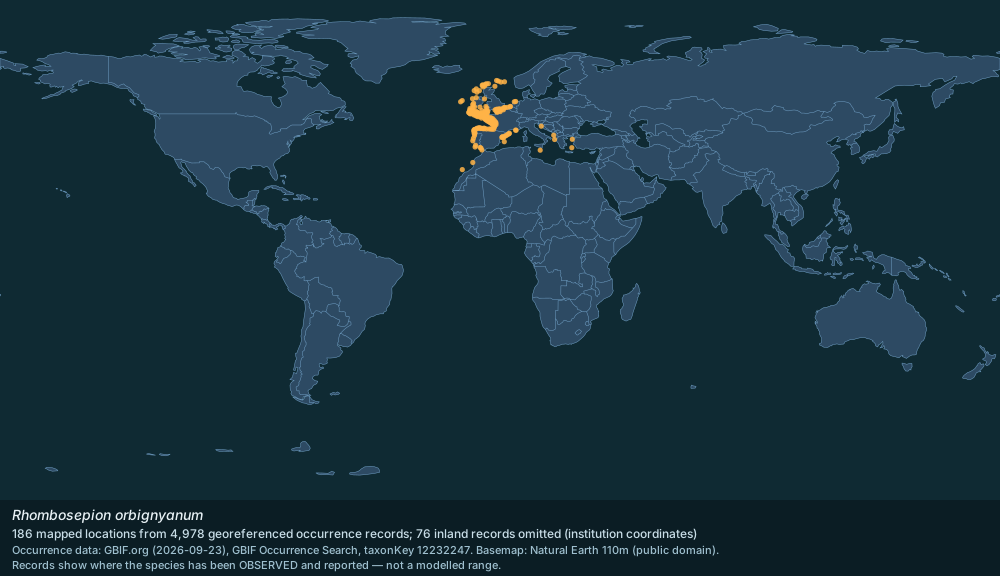
4,978 georeferenced occurrence records for Rhombosepion orbignyanum are published through GBIF from 23 countries or marine areas. The map above plots 186 distinct locations from a sample of 3,000 records, omitting 76 inland records that carry an institution's coordinates rather than a collection site; it shows where the species has been observed and reported, not a modelled range.
Most records by country or area: Spain (2,657); France (788); Netherlands (667); United Kingdom of Great Britain and Northern Ireland (307); Portugal (287).
The full country table, WoRMS marine regions and the sampling notes are on this species' Distribution page.
Source: GBIF Occurrence Search (taxonKey 12232247) — https://www.gbif.org/occurrence/search?taxon_key=12232247&has_coordinate=true (records CC0 / CC BY); WoRMS distribution records (MarineRegions) — https://www.marinespecies.org/aphia.php?p=taxdetails&id=1667212 (CC BY 4.0); Natural Earth 110m basemap — https://www.naturalearthdata.com/ (public domain). Accessed 2026-09-23.
Conservation status (IUCN Red List)
The IUCN Red List assesses Rhombosepion orbignyanum (Férussac, 1826) as Data Deficient (code DD). No trend, population estimate or threat analysis is given here, because none is available from this source without the Red List API; follow the source link for the full assessment, including its date.
Source: IUCN Red List of Threatened Species (taxon 162549) — https://www.iucnredlist.org/species/162549/0; GBIF IUCN Red List category endpoint (taxonKey 12232247) — https://api.gbif.org/v1/species/12232247/iucnRedListCategory. Accessed 2026-09-23.
Description and natural history (Wikipedia)
Sepia orbignyana is a fairly small cuttlefish, growing up to 12 cm in total length. The females are generally larger than the species' males; male mantle length up to 84mm and females' up to 120mm. It has a slim, oval body and relatively long arms, each having four rows of suckers. There is an obvious lobe of the dorsal mantle which projects between the eyes and there is a prominent tip at the posterior end of the mantle, which lies in the gap between the posterior ends of the fins. The tentacular club is short and has its suckers arranged in five–six rows, with the middle series having three to four greatly enlarged suckers. The hectocotylus is found on the left ventral arm and has one or two rows of suckers of normal size at the base, highly reduced suckers in the mid part and then normal size suckers towards the tip. The suckers on the hectocotylus are arranged in two dorsal and two ventral series each of which are laterally displaced to create a gap between them. Females have a single spermathecae situated medially on the ventral part of the buccal membrane. It is often coloured rose or orange on the dorsal surface which has a faint ridge.
The cuttlebone is long and thinly oblong in shape with a long posterior spine. having a width equal to one third of its length. and distinct lateral wings.
This species is largely sympatric with Sepia elegans, another relatively small species of cuttlefish but S. orbignyana can be identified from S. elegans by the fins almost reaching the very rear of the, and on having a higher number of suckers, over 100, on each tentacular club. The juveniles resemble tiny adults.
Sepia orbignyana occurs over a wide geographic distribution which extends from the Irish Sea, as far north as southwestern Scotland and English Channel south along the Atlantic coast of France, Spain and Portugal and into the Mediterranean Sea, where it is found throughout the sea, and south along the west coast of Africa as far as Angola. Off northwest Africa it is also found around the Sahara Seamounts. It is most abundant in the Sicilian Channel.
Sepia orbignyana is a demersal species that occurs at depths of 50m to 450m over detritus-rich or muddy substrates on the continental shelf or continental slope. It is often found in sympatry with S. elegans and S. officinalis but it seems to prefer to inhabit deeper parts of the sea than S. officinalis, and unlike that species it does not bury itself in the substrate. In the Sea of Marmara it can be found in brackish water. In the Mediterranean spawning probably occurs continuously and adults of both sexes are present in similar numbers throughout the year, although breeding activity is thought to peak in the warmer months. In the Atlantic adults predominate in the spring off Portugal. There are no records of movements towards the coasts to spawn. Females grow faster than males and reach larger sizes In the Mediterranean males attain maturity at around 35mm in mantle length and at age 6–7 months while for females maturity is reached at a mantle length of 65mm and at the age of nine to ten months. The males have about 100 spermatophores and the females bear around 400 eggs. As the female increases in size so doe the diameter of the eggs she carries, reaching a maximum diameter of 7 to 8.5 mm. The eggs are laid in clusters of 30 to 40 which adhere to sponges growing on muddy bottoms. The diet of S. orbignyana is predominantly made up of crustaceans, with fish and cephalopods making up a minor part of the diet.
Sepia orbignyana sometimes caught in high numbers as bycatch in trawls in parts of the Mediterranean Sea and in west African fisheries. It is also a quarry species in targeted fisheries such as in the Sicilian Channel. The catch is sold in local markets in either frozen or fresh form. In the south-western Adriatic multi-species trawl fishery it, together with S. elegans, is taken as bycatch and in the 2000s the catch greatly reduced, the reduction being blamed on overfishing.
The specific name of Sepia orbignyana honours the French malacologist Alcide d'Orbigny. being the editor of the Annales des Sciences Naturelles at the time André Étienne d'Audebert de Férussac published his description of the species, in 1826, from a type specimen collected at La Rochelle. The type is held at the Museum National d'Histoire Naturelle in Paris.
Source: Wikipedia: Sepia orbignyana — https://en.wikipedia.org/wiki/Sepia_orbignyana (CC BY-SA 4.0). Accessed 2026-09-23.
Gallery
Related in Pink cuttlefish
Links follow this subject's own source article.
Elsewhere in Pink cuttlefish
Spotted an error? Know more?
Reader corrections go straight into our review queue. Suggest an edit · How this site is sourced