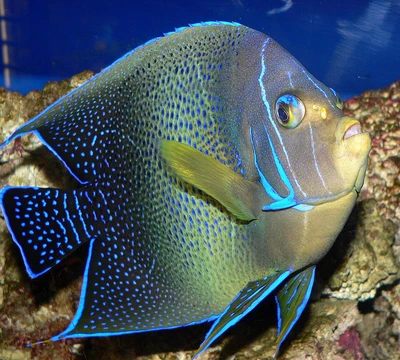
Semicircle angelfish (Pomacanthus semicirculatus)
Source-cited species reference: taxonomy from WoRMS, biology from FishBase, occurrence map from GBIF, conservation from IUCN Red List, description from Wikipedia.

Cliff from Arlington, Virginia, USA · CC BY 2.0
Pomacanthus semicirculatus, also known as the semicircled angelfish, Koran angelfish, blue angelfish, zebra angelfish or half-circled angelfish, is a species of ray-finned fish, a marine angelfish, in the family Pomacanthidae. It is found in the Indo-West Pacific Ocean. It occasionally makes its way into the aquarium trade.
- Scientific name
- Pomacanthus semicirculatus
- Authority
- (Cuvier, 1831)
- Family
- Pomacanthidae
- Order
- Acanthuriformes
- Maximum length
- 40 cm
- Depth range
- 1–40 m
- Habitat zone
- reef-associated
- Iucn red list
- Least Concern
- Gbif occurrence records
- 2,801
A Dramatic Metamorphosis in Color and Form
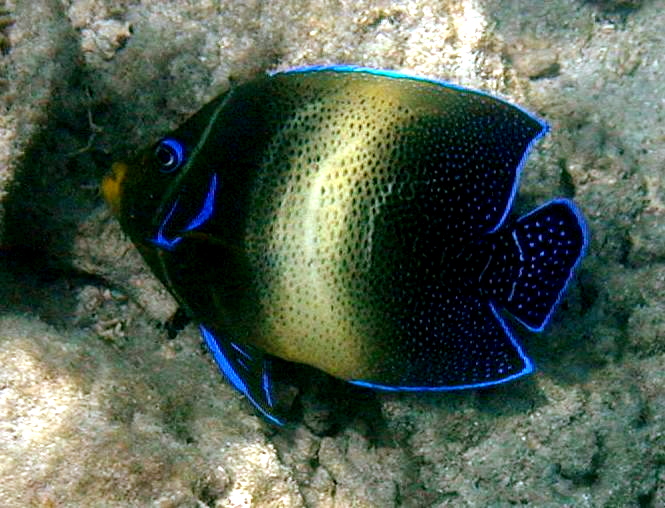
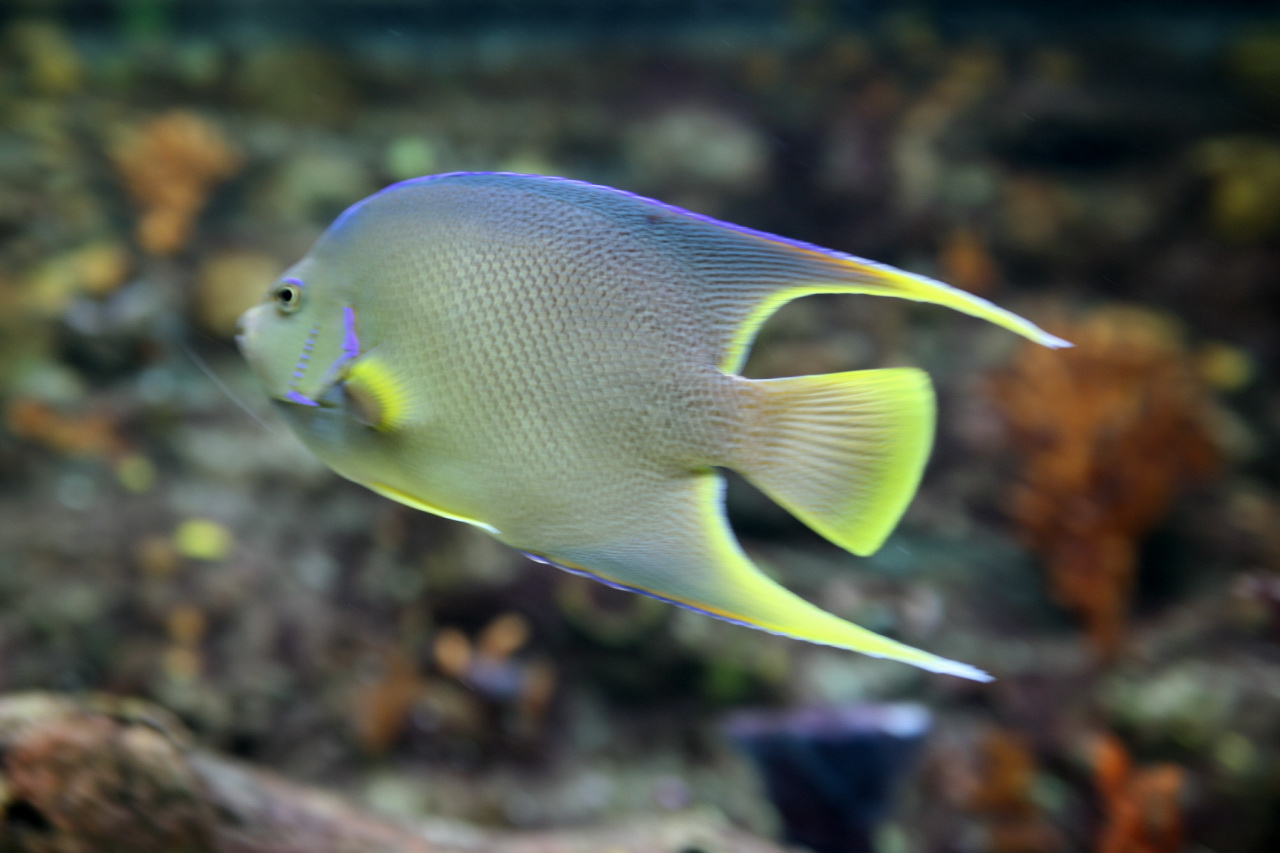
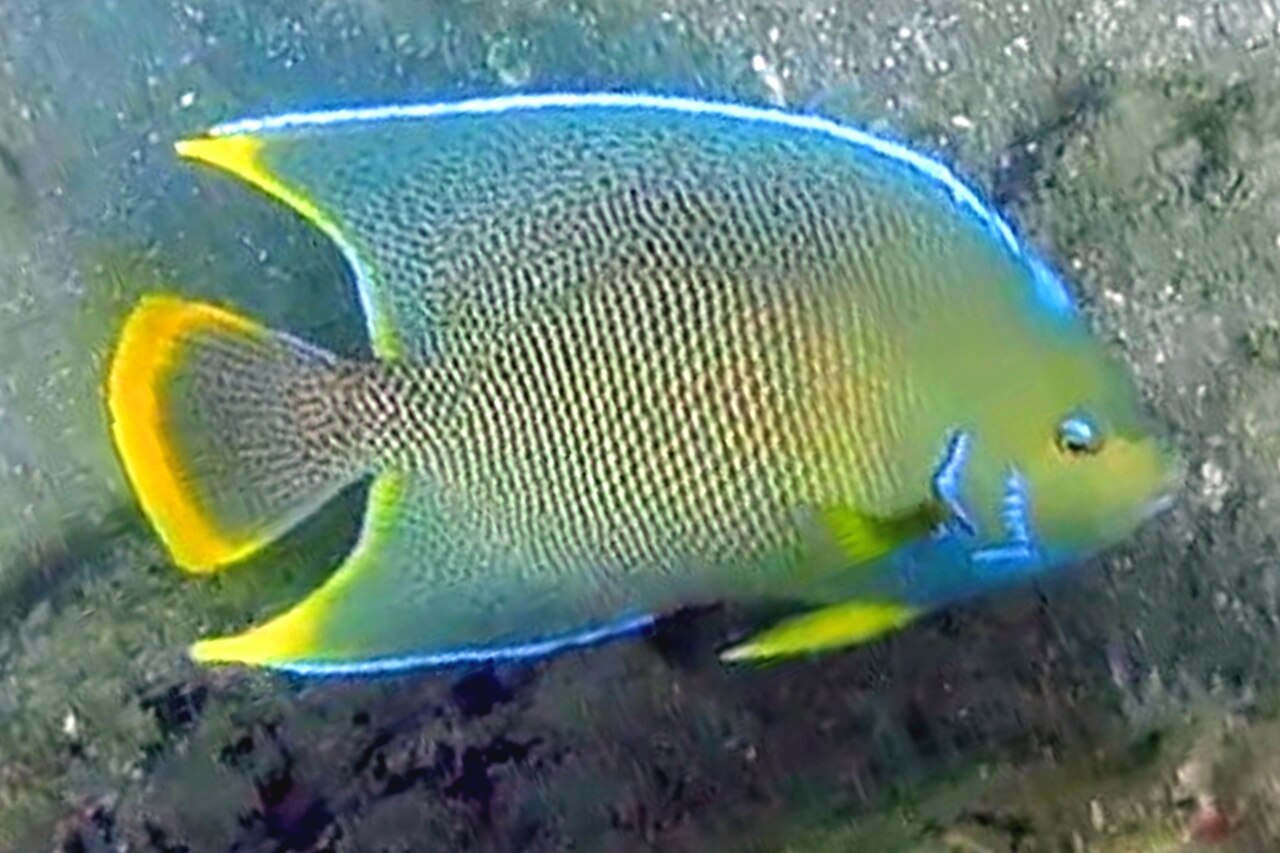
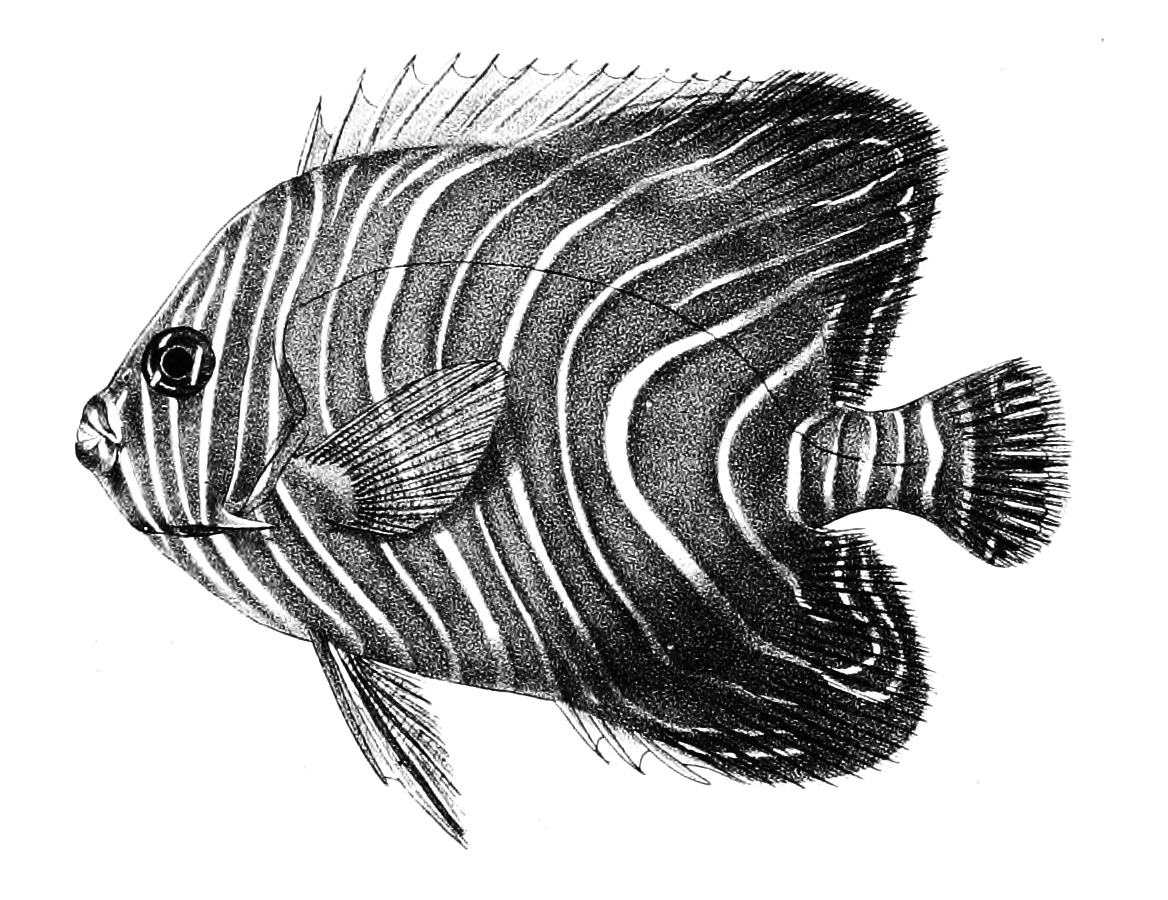
The semicircle angelfish undergoes one of the most striking visual transformations among marine fish. Juveniles present as bold blue-black bodies streaked with narrow white lines running from head to tail. Near the head these stripes are relatively straight, but as they approach the tail base they curve into increasingly pronounced arcs — the very feature that gives the species its name. Once the fish reaches between 8 and 16 centimetres in length, it gradually shifts into its adult palette: a brownish-green body dusted with blue-edged scales that create a speckled effect across the body and tail. Every fin except the plain yellow pectorals gains a blue border, and elongated filamentous extensions sprout from the dorsal and anal fins. The adult dorsal fin carries 13 spines alongside 20 to 23 soft rays, while the anal fin holds 3 spines and 18 to 22 soft rays. At full maturity the fish can reach 40 centimetres in total length.
An Extraordinary Indo-Pacific Reach
The semicircle angelfish enjoys one of the broadest distributions among its angelfish relatives, spanning the entire Indo-West Pacific. On its western edge the species ranges along Africa's eastern seaboard, from the southern Red Sea coast of Sudan all the way down to South Africa. From there its range sweeps eastward across both the Indian and Pacific Oceans, reaching Fiji, Tonga, and Samoa. To the north it extends as far as southern Japan, and to the south it reaches Australian waters. Within Australia's exclusive economic zone the fish is widespread, occurring from the Houtman Abrolhos off Western Australia, around the coastline, and as far south on the eastern seaboard as Sydney, with juveniles pushing even farther south to Merimbula. The species also inhabits Christmas Island, the Cocos (Keeling) Islands, and Lord Howe Island in the Tasman Sea. More recently, sporadic sightings have been recorded off Florida's east coast since 1999 and at Oahu, Hawaii, since 2005.
Life on Sheltered Reefs
The semicircle angelfish inhabits sheltered coral reefs at depths ranging from just 1 metre to as deep as 40 metres. Its diet consists of algae, tunicates, and sponges, making it an important grazer within reef ecosystems. Socially, the species is not a schooling fish; it is typically encountered either as a solitary individual or in pairs. Juveniles are notably timid and very difficult to approach, preferring shallow, well-sheltered areas where they can retreat quickly. Adults, by contrast, gravitate toward coastal reefs with rich coral growth that offers abundant hiding places. They have even been recorded living among wrecks, suggesting a degree of habitat flexibility. The species belongs to the family Pomacanthidae and the genus Pomacanthus, a group well known for the dramatic differences between life stages. The semicircle angelfish is also encountered in the aquarium trade, where it is a recognized presence among hobbyists.
Naming, History, and Taxonomic Debate
The semicircle angelfish was first formally described in 1831 by the French anatomist Georges Cuvier, who assigned it the name Holacanthus semicirculatus. Cuvier designated the type locality as Timor, Bourou, Waigeo in Indonesia, and Port Praslin on New Ireland Island in the Bismarck Archipelago of Papua New Guinea. The specific epithet semicirculatus, meaning "semicircular," was chosen to reference the distinctive curved blue-and-white lines on the rear of the juvenile body — markings that disappear entirely once the fish matures. Over the years, taxonomic placement has shifted; the species is now recognized under the genus Pomacanthus, and some authorities further assign it to the subgenus Arusetta. Common names for this fish vary widely, including Koran angelfish, blue angelfish, zebra angelfish, and half-circled angelfish, reflecting the diversity of its appearance across life stages.
Gallery
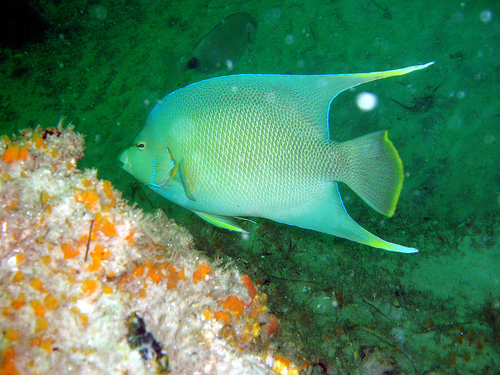
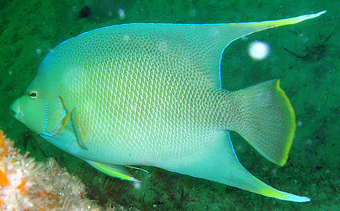
Related in Semicircle angelfish
Links follow this subject's own source article.
Elsewhere in Semicircle angelfish
Spotted an error? Know more?
Reader corrections go straight into our review queue. Suggest an edit · How this site is sourced