Where Semicircle angelfish has been recorded
GBIF occurrence records for Pomacanthus semicirculatus, mapped and tabulated by country.

2,801 georeferenced occurrence records with coordinates are published for Pomacanthus semicirculatus through GBIF, from 40 countries or marine areas. This page maps those records and lists where they come from. Occurrence records reflect where people have looked as well as where the species lives, so well-surveyed coastlines are over-represented.
- Georeferenced records
- 2,801
- Countries / areas
- 40
- Mapped locations
- 366
- Records sampled for the map
- 2,801
- Inland records omitted
- 70
- Gbif taxonkey
- 2396399
A Dramatic Metamorphosis of Color and Form
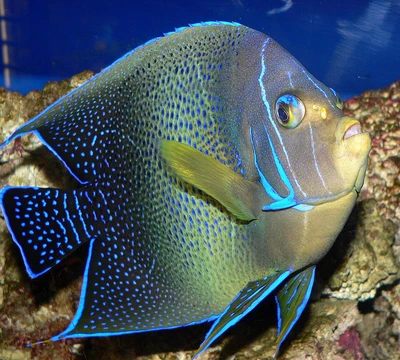
The semicircle angelfish presents one of the most striking visual transformations among marine reef fish. Juveniles appear as bold blue-black bodies streaked with narrow white lines that run from head to tail. Near the head these stripes hold a relatively straight course, but as they travel toward the tail base they sweep into increasingly pronounced curves — the very feature that gives the species its scientific name. Once a young fish reaches somewhere between eight and sixteen centimetres in length, it gradually sheds this striped pattern and assumes its adult palette. The mature form is a muted brownish-green canvas overlaid with a fine blue speckle, produced by blue-edged scales across the body and caudal region. Every fin carries a blue border, with the sole exception of the pectoral fins, which remain a clean, unmarked yellow. The dorsal and anal fins extend into long, thread-like filaments, adding an almost ornamental flourish. At full size the species can reach forty centimetres, with a dorsal fin armed by thirteen spines and twenty to twenty-three soft rays, and an anal fin bearing three spines over eighteen to twenty-two soft rays.
A Vast Indo-Pacific Footprint
The semicircle angelfish commands one of the broadest continuous ranges of any reef-dwelling marine species. Along the eastern African shoreline its distribution stretches from the southern reaches of the Red Sea near Sudan all the way down to the waters off South Africa. From there the range sweeps eastward across both the Indian and Pacific Oceans, touching Fiji, Tonga, and Samoa. To the north it reaches as far as southern Japan, and to the south it extends into Australian waters. Within the Australian Exclusive Economic Zone the species is widespread, occurring from the Houtman Abrolhos off Western Australia, following the coastline around to Sydney on the east, with juveniles pushing even farther south to Merimbula. Isolated records also place it at Christmas Island, the Cocos (Keeling) Islands, and Lord Howe Island in the Tasman Sea. Perhaps most intriguingly, sporadic sightings have been documented off the east coast of Florida since 1999 and at Oahu, Hawaii, since 2005 — brief appearances far outside the species' established Indo-Pacific home.
Reef Life and Foraging Habits
In its natural habitat the semicircle angelfish inhabits sheltered coral reefs at depths ranging from just one metre down to roughly forty metres. Its diet consists of algae, tunicates, and sponges, making it a valuable grazer within reef ecosystems. Young fish are notably timid and resistant to close approach, favouring shallow, well-protected areas where they can retreat quickly. Adults, by contrast, show a clear preference for coastal reefs boasting dense coral growth, which provides the numerous crevices and hiding spots the species relies upon. Socially, the semicircle angelfish is neither a schooling fish nor a strictly solitary one; it is most often encountered either as a pair or as a single individual patrolling its chosen patch of reef. Adults have also been recorded foraging around shipwrecks, suggesting a willingness to exploit artificial structures that mimic the complex topography of natural coral. The species occupies the family Pomacanthidae and is classified as a ray-finned marine angelfish, placing it among the most recognizable and colourful inhabitants of tropical reef environments.
Naming, Classification, and the Aquarium Trade
The species was first formally described in 1831 by the French anatomist Georges Cuvier, who placed it under the name Holacanthus semicirculatus. The type localities he cited were Timor, Bourou, and Waigeo in present-day Indonesia, along with Port Praslin on New Ireland Island in the Bismarck Archipelago of Papua New Guinea. The specific epithet semicirculatus translates simply as "semicircular," a direct nod to the gracefully curved blue-and-white lines that adorn the rear of juvenile fish — markings that disappear entirely once the fish matures. Taxonomically, some authorities assign the species to the subgenus Arusetta within Pomacanthus, reflecting ongoing refinements in angelfish systematics. Beyond the scientific literature, the fish is known by a colourful roster of common names, including semicircled angelfish, Koran angelfish, blue angelfish, zebra angelfish, and half-circled angelfish. In the aquarium trade the semicircle angelfish is frequently encountered, though it remains a relatively occasional addition to home aquaria rather than a ubiquitous staple.
Related in Semicircle angelfish
Links follow this subject's own source article.
Elsewhere in Semicircle angelfish
Spotted an error? Know more?
Reader corrections go straight into our review queue. Suggest an edit · How this site is sourced