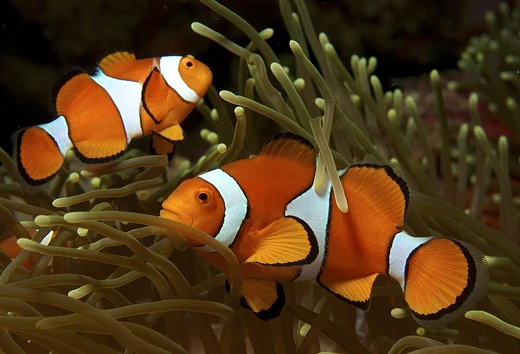
Pink skunk clownfish (Amphiprion perideraion)
Source-cited species reference: taxonomy from WoRMS, biology from FishBase, occurrence map from GBIF, conservation from IUCN Red List, description from Wikipedia.

Jenny (JennyHuang) from Taipei · CC BY 2.0
The pink skunk clownfish (Amphiprion perideraion), also known as the pink anemonefish, is a species of anemonefish that is widespread from northern Australia through the Malay Archipelago and Melanesia. Like all anemonefishes, it forms a symbiotic mutualism with sea anemones and is unaffected by the stinging tentacles of the host. It is a sequential hermaphrodite with a strict size-based dominance hierarchy; the female is largest, the breeding male is second largest, and the male nonbreeders get progressively smaller as the hierarchy descends. They exhibit protandry, meaning the breeding male changes to female if the sole breeding female dies, with the largest nonbreeder becoming the breeding male.
- Scientific name
- Amphiprion perideraion
- Authority
- Bleeker, 1855
- Family
- Pomacentridae
- Order
- Ovalentaria incertae sedis
- Maximum length
- 10 cm
- Depth range
- 1–38 m
- Habitat zone
- reef-associated
- Iucn red list
- Least Concern
- Gbif occurrence records
- 3,363
Social Hierarchy and Reproductive Strategy
The pink skunk clownfish operates within a rigid social framework governed entirely by body size. Every member of a group occupies a fixed rank, with the breeding female at the top, the breeding male in second position, and a cascade of progressively smaller nonbreeding males filling out the lower rungs. This arrangement is not merely behavioral but tied directly to the species' reproductive mode: it is a protandrous sequential hermaphrodite. In practical terms, every individual begins life as a male, and the single breeding male holds the capacity to transform into a female should the current dominant female die. When that transition occurs, the largest remaining nonbreeder steps up into the breeding-male role, and the hierarchy reorganizes around the new female. This size-locked, rank-driven system ensures that reproductive duties are always assigned to the most developed individuals, a strategy that has allowed the species to persist across its broad Indo-Pacific range without the need for complex territorial disputes over mating rights.
Appearance and Species Identification
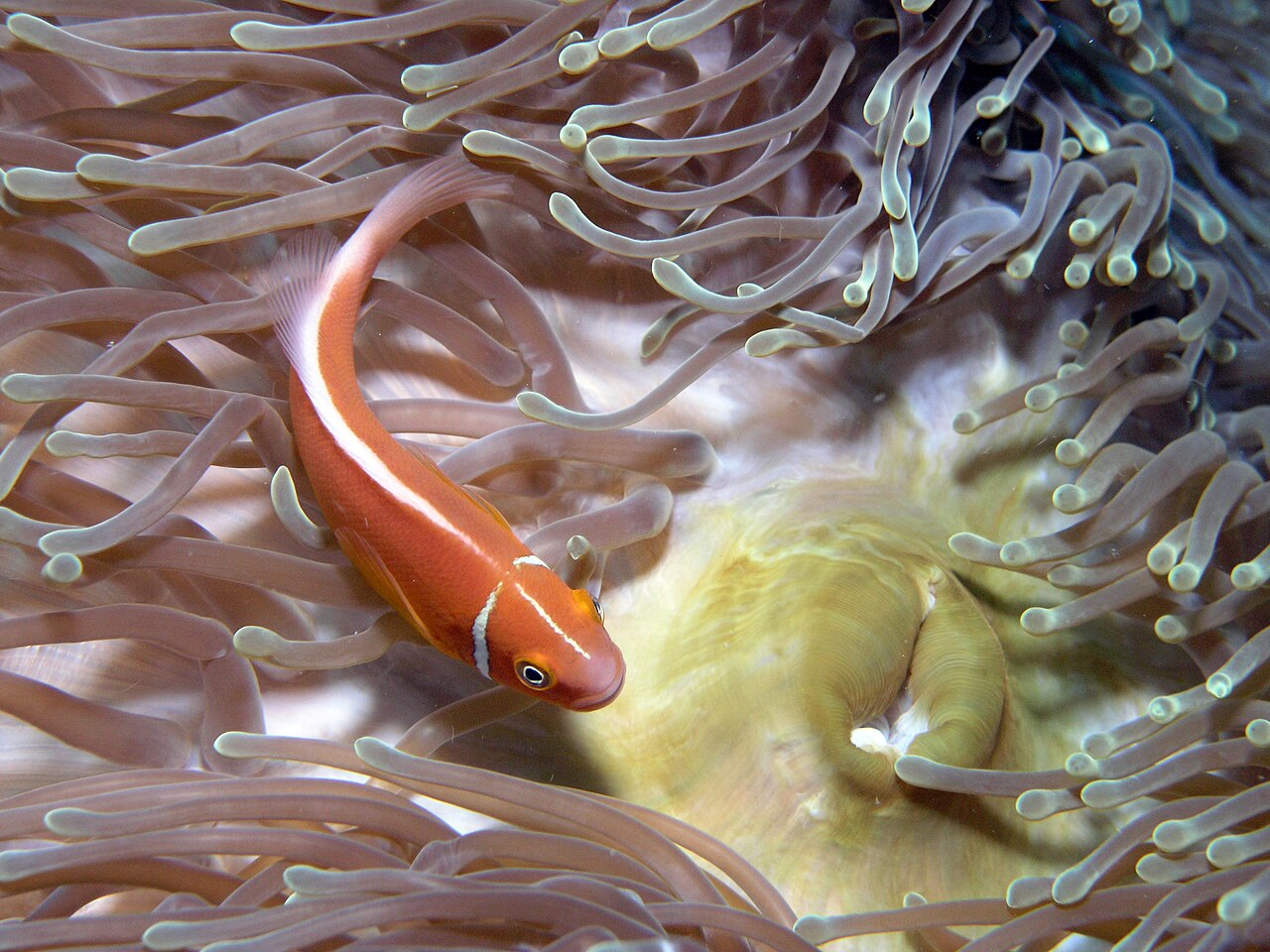
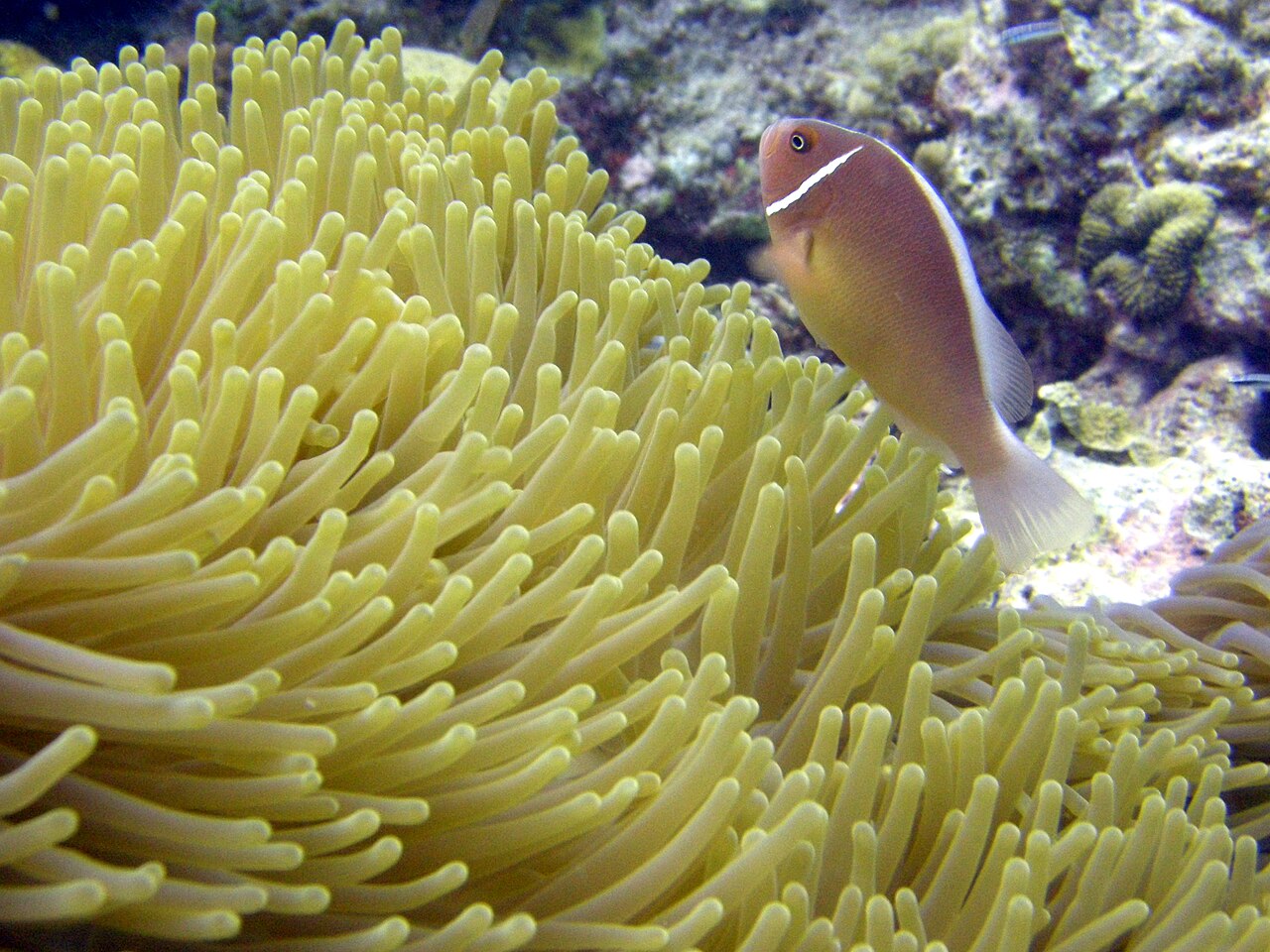
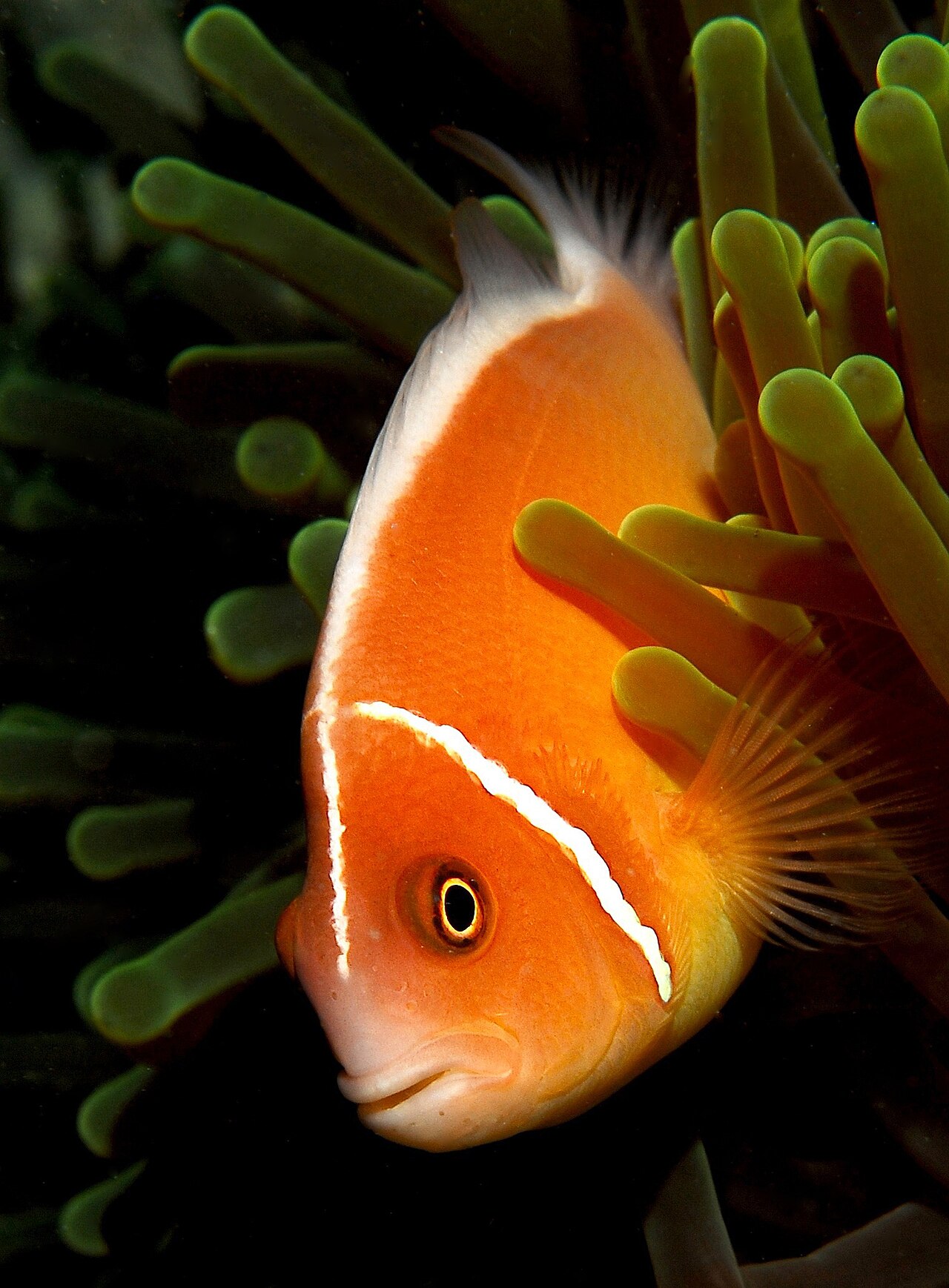
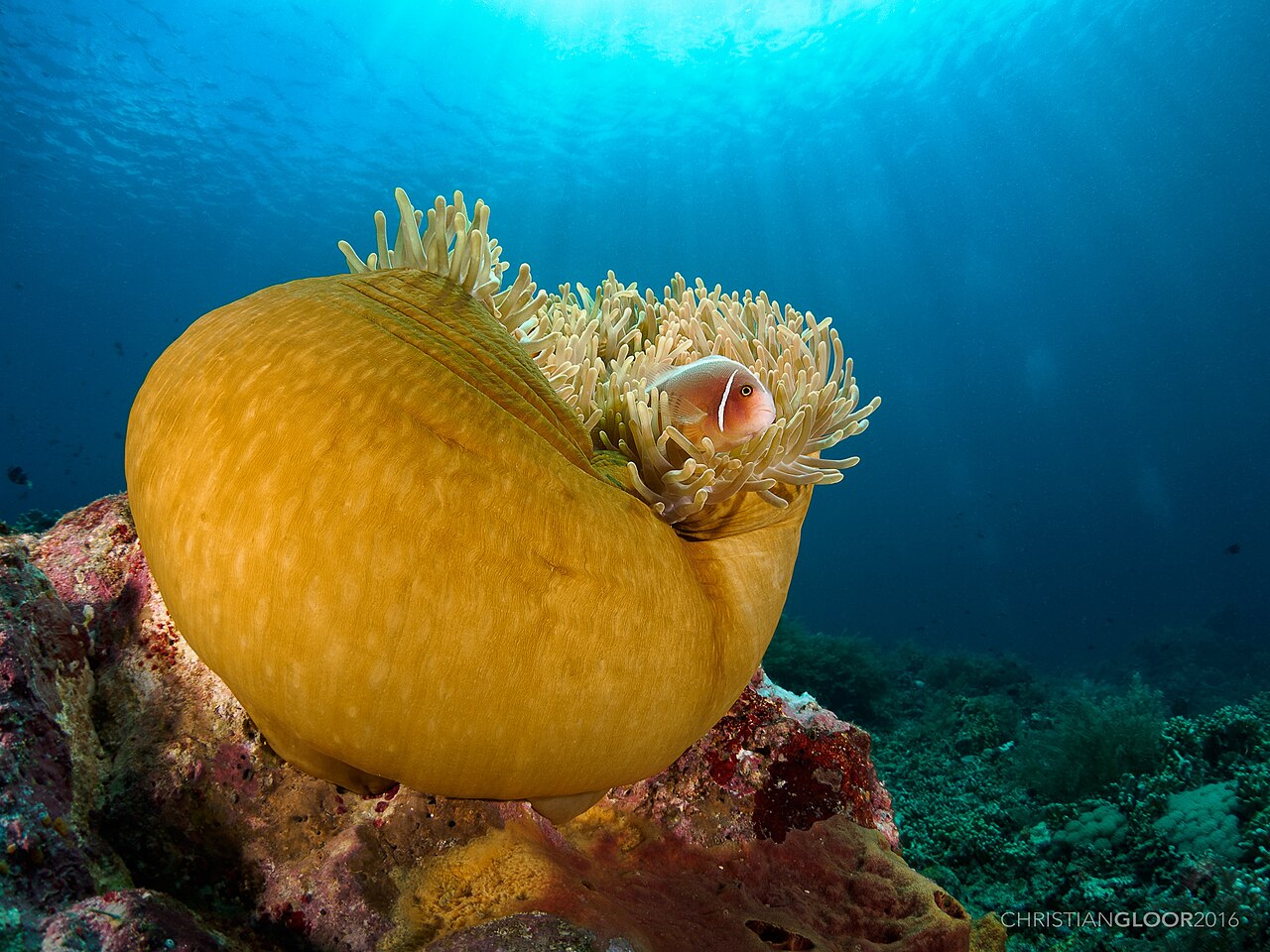
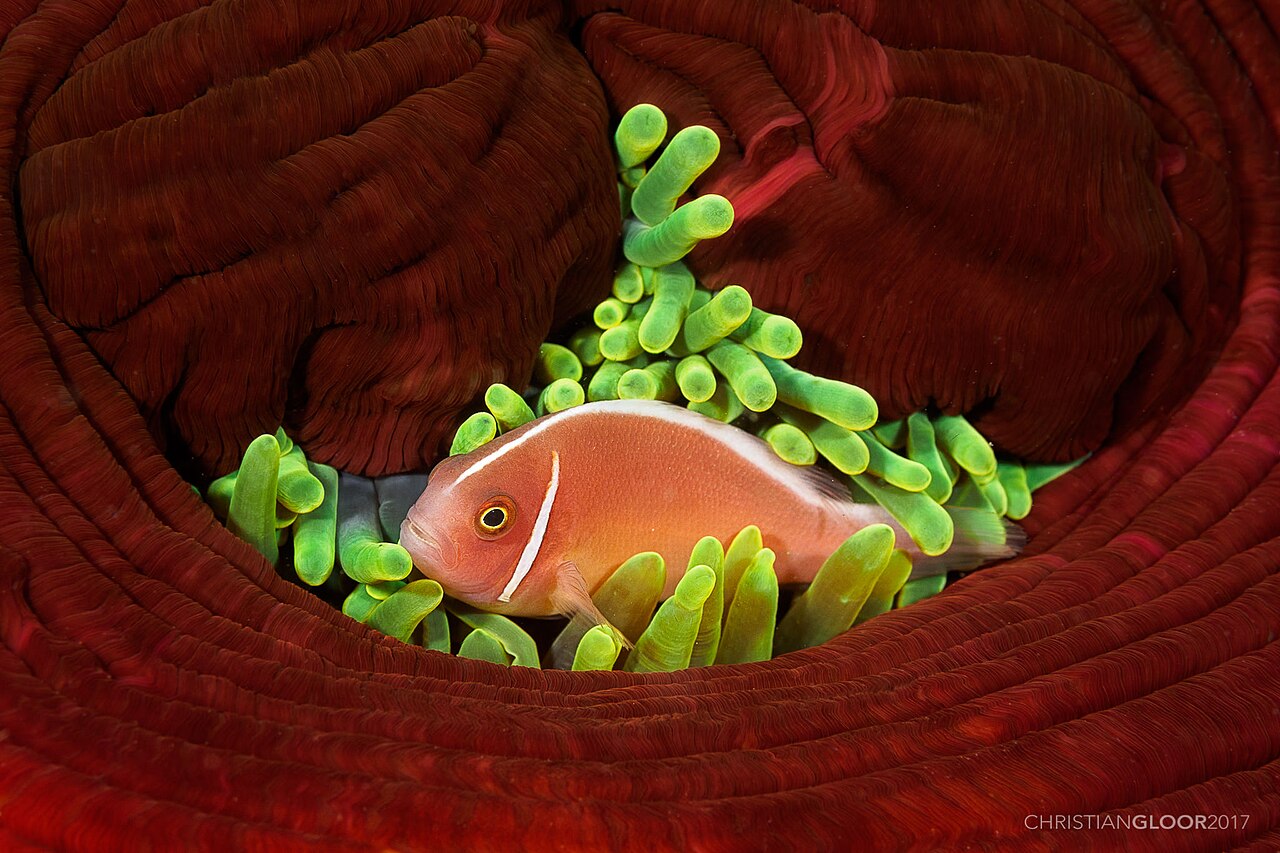
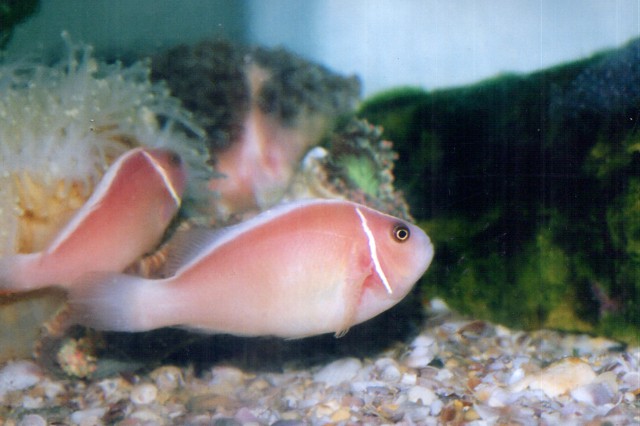
At first glance, the pink skunk clownfish is unmistakable: its body ranges from soft pink to warm peach, and two bold white markings set it apart from most of its relatives. A horizontal stripe runs the length of the dorsal ridge—a trait shared across the entire skunk complex—while a vertical white bar sits just behind the eye. Together, that dorsal stripe plus head-bar combination is the key field mark separating it from look-alikes. Species such as A. akallopisos, A. sandaracinos, and A. pacificus are missing the head bar entirely, and A. nigripes swaps the dorsal stripe for a black belly with dark pelvic and anal fins. The hybrid A. leucokranos can be confused with the species, but its head bar is noticeably broader and its dorsal stripe falls short of the full ridge length. Despite its striking coloration, the pink skunk clownfish shows no geographic, sex-linked, or host-dependent color variation, a rarity among anemonefish. It is also one of the smallest members of the family, with females topping out at roughly ten centimeters, far below the eighteen-centimeter maximum reached by the largest anemonefish species.
Range, Depth, and Anemone Partnerships
The pink skunk clownfish enjoys one of the broadest distributions in the anemonefish family, stretching from the Great Barrier Reef and Tonga in the west Pacific northward to Japan's Ryukyu Islands, and across the eastern Indian Ocean from Ningaloo Reef and the Rowley Shoals through the Scott and Ashmore Reefs, the Cocos and Christmas Islands, all the way to Sumatra. It favors reef lagoons and outer reef slopes. Long assumed to occupy only the shallow band between three and twenty meters, the species has recently been documented by autonomous underwater vehicle surveys at Viper Reef and Hydrographers Passage in the central Great Barrier Reef at depths of fifty to sixty-five meters, revealing a far deeper tolerance than previously recognized. It is one of only two anemonefish species—alongside A. clarkii—recorded on both the east and west coasts of Australia. In terms of anemone choice, it is a generalist, accepting four of the ten known host anemones, and it has even been observed sharing a single anemone with other clownfish species, an unusual arrangement for the group.
Feeding Ecology and Conservation Outlook
Among all anemonefish, the pink skunk clownfish stands alone in its dietary preference: it is the only species in the family that feeds primarily on algae. Its natural menu also includes zooplankton such as diatoms and copepods, benthic worms, tunicates, and other algal material, but the emphasis on plant matter distinguishes it ecologically from every other member of the group. In captivity, hobbyists have successfully raised the species by offering brine shrimp, mysis shrimp, chopped shellfish, and dried algae, and it has been bred in aquarium conditions. On the conservation front, the outlook mirrors that of its coral-reef neighbors. Its host anemones harbor zooxanthellae and are susceptible to bleaching driven by rising water temperatures and ocean acidification. The global ornamental fish trade adds further pressure on local populations and their genetic diversity. Notably, the species was not assessed in the 2012 IUCN Red List release, leaving a gap in formal threat evaluation despite these mounting environmental and commercial pressures.
Gallery
Related in Pink skunk clownfish
Links follow this subject's own source article.
Elsewhere in Pink skunk clownfish
Spotted an error? Know more?
Reader corrections go straight into our review queue. Suggest an edit · How this site is sourced