Where Pink skunk clownfish has been recorded
GBIF occurrence records for Amphiprion perideraion, mapped and tabulated by country.

3,363 georeferenced occurrence records with coordinates are published for Amphiprion perideraion through GBIF, from 36 countries or marine areas. This page maps those records and lists where they come from. Occurrence records reflect where people have looked as well as where the species lives, so well-surveyed coastlines are over-represented.
- Georeferenced records
- 3,363
- Countries / areas
- 36
- Mapped locations
- 356
- Records sampled for the map
- 3,000
- Inland records omitted
- 36
- Gbif taxonkey
- 5212059
The Anemone Partnership
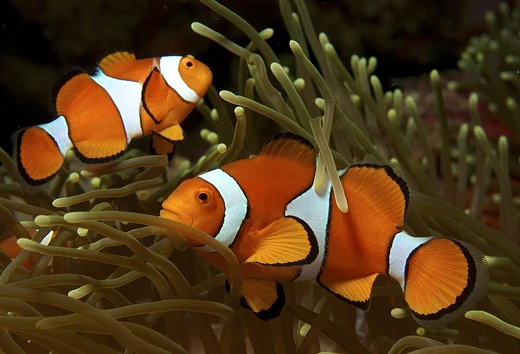
Few partnerships in the marine world are as tightly interwoven as the one between clownfish and their sea anemone hosts. The anemone provides a living fortress: its stinging tentacles deter most predators, yet the clownfish moves through them unharmed, using the structure as shelter and a safe nursery. In return, the small damselfish acts as a bodyguard, driving away anemone-eating fish that would otherwise strip the host of its tissue. The clownfish also serves as a maintenance crew, fanning the anemone's tentacles to keep water circulating and clearing debris from its surface. Even the fish's waste plays a role, luring in beneficial microorganisms that enrich the local ecosystem around the anemone. This exchange—protection for services—means neither partner thrives without the other, making the relationship one of the clearest examples of mutualism in tropical reef systems across the Indo-Pacific.
A Society That Rewrites Its Own Rules
Clownfish live in tightly structured groups where every individual knows its place, and that place is determined almost entirely by size. At the top sits the breeding female, the largest member of the group, followed by the breeding male, and then a ranked line of non-breeding individuals ordered from largest to smallest. What makes this hierarchy extraordinary is its fluidity. If the dominant female dies or leaves, the breeding male does not simply claim the empty space—he undergoes a complete sex change, transforming into a female and assuming her role at the apex. The remaining members then shift upward in the queue, each stepping into the position vacated by the one above. This orderly promotion ensures that reproduction never halts for long, and the group's social architecture is rebuilt within a matter of days rather than collapsing into chaos. The system turns what might seem like a rigid caste structure into a remarkably resilient one.
A Lineage Forged in Ancient Waters
The evolutionary story of clownfish stretches back roughly 35 million years, to the late Eocene, when their lineage split from other living damselfishes. The most recent common ancestor of all extant species is estimated at around 10.5 million years ago, in the Early Miocene, and a 2014 study traced the group's geographic origins to the warm waters of the Malay Archipelago. For millions of years the lineage expanded slowly, but beginning about five million years ago, diversification accelerated dramatically. Two waves of adaptive radiation followed: the first centered on the Malay Archipelago, the second in the western Indian Ocean. Genetic records reveal extensive interbreeding among species throughout this history, blurring the boundaries between lineages. Perhaps most strikingly, the choice of anemone host appears to have been a key driver of speciation. Because different anemone species occupy distinct habitats, fish tied to different hosts became ecologically isolated, gradually diverging into new species over time.
Popularity, Pressure, and Survival
The bright coloration and social charm of clownfish have made them icons of the marine world, a status cemented for millions of viewers by the 2003 Disney/Pixar film Finding Nemo. That cultural visibility translates directly into commercial demand: the ocellaris clownfish ranks among the most commonly traded marine species in the aquarium industry. For decades, a large share of captive specimens were harvested from the wild, and this sustained collection has contributed to measurable population declines in affected reef areas. Conservation efforts have shown promise—clownfish populations are notably more abundant in marine protected areas where collecting is prohibited, demonstrating that legal safeguards can reverse damage. Yet the threats extend well beyond human collection. Global warming is driving ocean temperature increases and acidification, both of which stress coral reef ecosystems and, by extension, the anemone-dependent clownfish that rely on healthy reef habitats for survival.
Related in Pink skunk clownfish
Links follow this subject's own source article.
Elsewhere in Pink skunk clownfish
Spotted an error? Know more?
Reader corrections go straight into our review queue. Suggest an edit · How this site is sourced