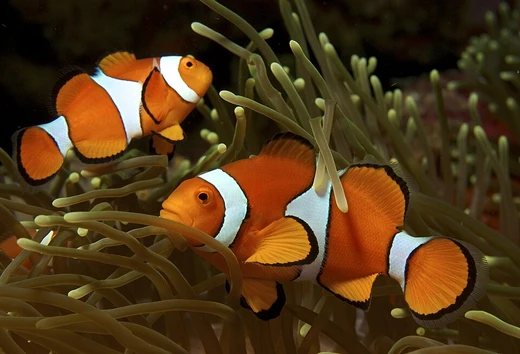
Allard's clownfish (Amphiprion allardi)
Source-cited species reference: taxonomy from WoRMS, biology from FishBase, occurrence map from GBIF, conservation from IUCN Red List, description from Wikipedia.

Fernando Losada Rodríguez · CC BY-SA 4.0
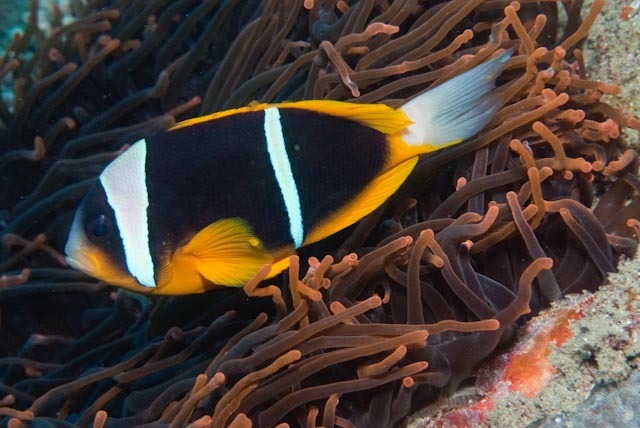
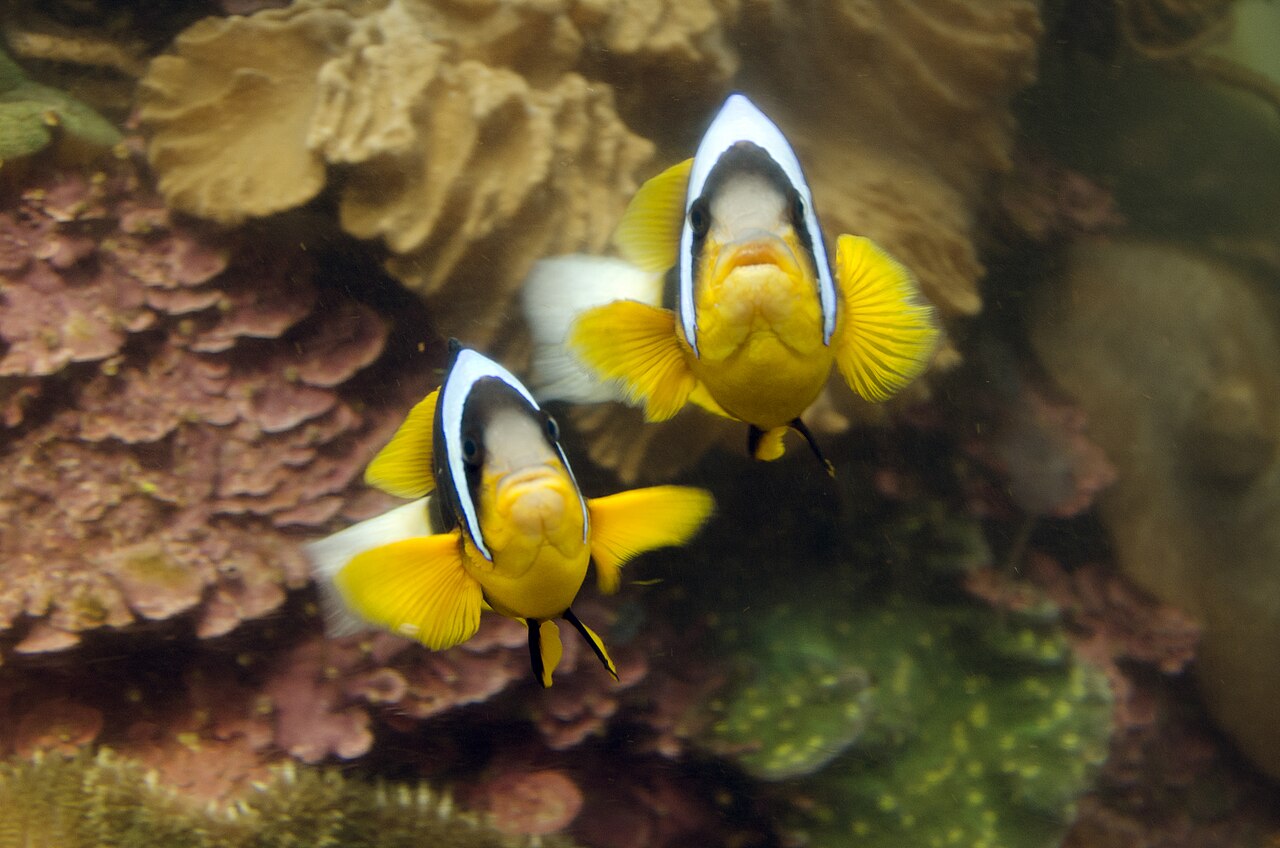
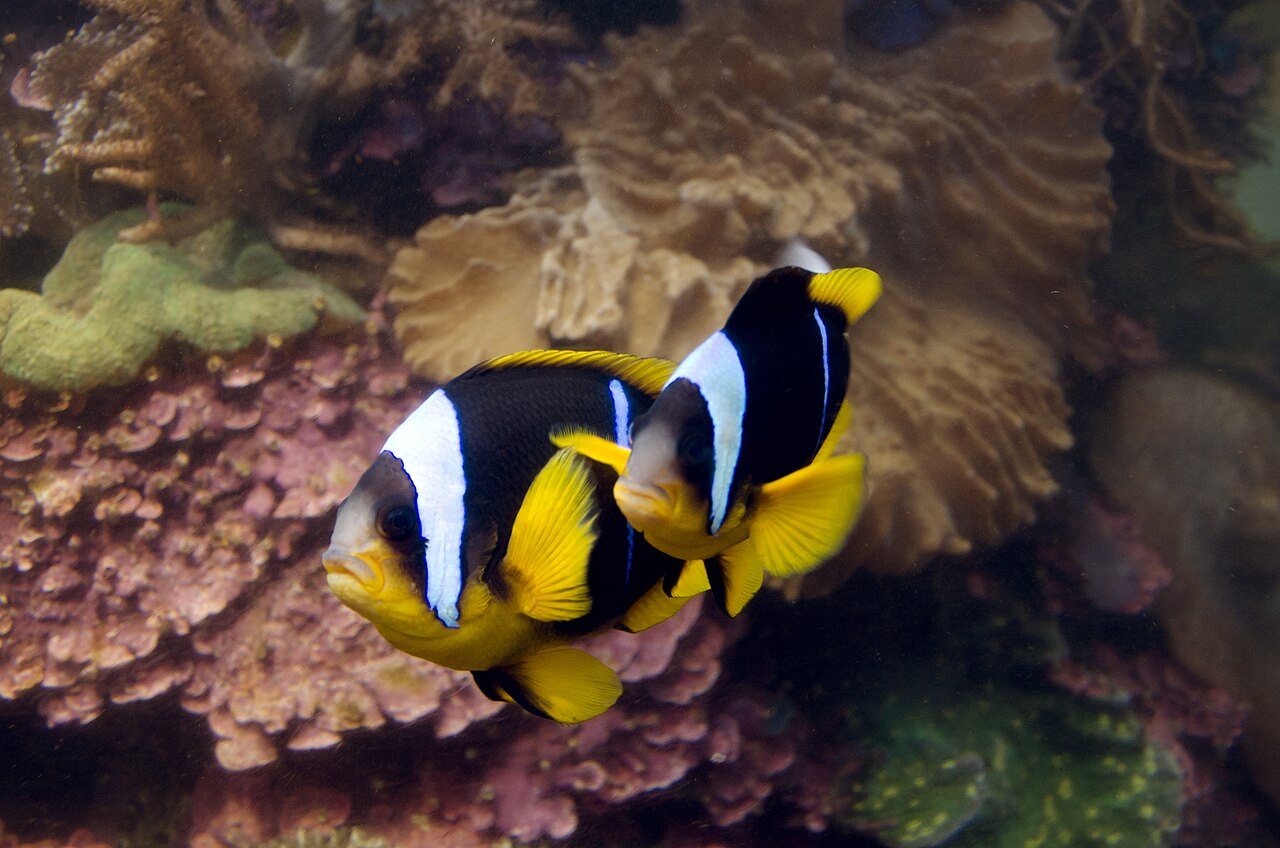
Allard's clownfish or Allard's anemonefish (Amphiprion allardi) is a marine fish belonging to the family Pomacentridae, the clownfishes and damselfishes, from the western Indian Ocean off the coast of East Africa and the Mascarenes.
- Scientific name
- Amphiprion allardi
- Authority
- Klausewitz, 1970
- Family
- Pomacentridae
- Order
- Ovalentaria incertae sedis
- Maximum length
- 15 cm
- Depth range
- 1–30 m
- Habitat zone
- reef-associated
- Iucn red list
- Least Concern
- Gbif occurrence records
- 424
The Anemone Bond
Allard's clownfish, like every member of the genus Amphiprion, is locked into one of the ocean's most celebrated partnerships: a mutualistic relationship with sea anemones. The fish depend on the anemone's stinging tentacles as a living fortress, gaining shelter and a reliable shield against predatory species that would otherwise make life on a coral reef far more dangerous. In exchange, the clownfish acts as a vigilant bodyguard, driving away anemone-eating fish that might strip the host of its tissue. Beyond simple defense, the small fish actively maintains its anemone's health by fanning water across the tentacles and cleaning debris, while its metabolic waste draws in beneficial microorganisms that enrich the anemone's immediate environment. This exchange—protection for upkeep—means neither partner thrives without the other. For Allard's clownfish, finding a suitable anemone host is not a casual choice; it is the single most important ecological decision of its life, shaping where it feeds, breeds, and ultimately survives in the warm, tropical waters of the Indo-Pacific coral reefs.
A Hierarchy That Rewrites Itself
Within a single anemone, Allard's clownfish live in a tightly ordered social group headed by a breeding female, followed by a breeding male, and then a line of non-breeding individuals ranked strictly by body size. The largest female always sits at the top, and the smallest members of the group may be only six to fifteen millimetres long. This size-based pecking order is not static; it is a living mechanism that reshuffles itself whenever the dominant female vanishes. In that moment, the breeding male undergoes a complete sex change, transforming into the new female and assuming her reproductive role. Every other individual in the group then shifts one rank upward, closing the gap left behind. Reproduction itself is a simple division of labour: the female lays her eggs on a rock close to the anemone, and the male fertilises them. Once the young hatch, they drift out into the open ocean as free-swimming larvae, spending a period at sea before eventually settling onto the seabed and beginning the search for an anemone of their own.
Thirty-Five Million Years of Divergence
The lineage that would become Allard's clownfish split from other living damselfishes roughly thirty-five million years ago during the late Eocene, making the genus one of the older branches within the family Pomacentridae. The most recent common ancestor of all extant clownfish species is estimated at about ten and a half million years ago, in the Early Miocene. A 2014 study traced the origin of the group to the waters surrounding the Malay Archipelago, and from there the lineage underwent a notable acceleration in speciation around five million years ago, producing two major adaptive radiations: one centred on the Malay Archipelago and a later wave in the western Indian Ocean. Crucially, speciation in this group appears tightly coupled to the diversity of sea anemone hosts available in different habitats, meaning that ecological separation driven by host preference has been a primary engine of new species formation. Genetic evidence also reveals substantial interbreeding among species throughout their evolutionary history, blurring the boundaries between lineages. The genus name Amphiprion, meaning 'saw on both sides,' was coined in 1801, and the taxonomic status of the maroon clownfish's former genus Premnas was finally resolved in 2021 when phylogenetic analyses confirmed it belongs within Amphiprion.
Between the Tank and the Tide
Allard's clownfish shares with its relatives a visual appeal—bold vertical bars set against a warm-toned background—that has made the genus one of the most recognisable groups of marine fish in popular culture. The 2003 Disney/Pixar film Finding Nemo cemented that image for a global audience, and the aquarium trade has long prized these small, social fish for home and public displays. Yet the very popularity that drives demand has created a serious conservation problem: many clownfish sold in aquaria are harvested directly from the wild, and this collection pressure has contributed to measurable population declines in some areas. Research consistently shows that clownfish populations are more abundant within marine protected areas where collecting is prohibited, underscoring the impact of unregulated harvesting. Beyond direct removal, the species faces broader environmental threats. Global warming is driving both ocean warming and acidification, conditions that stress the coral reef ecosystems and the sea anemone hosts on which every clownfish depends. As an omnivore that feeds largely on plankton, Allard's clownfish is embedded in a food web that shifts as water chemistry changes, making long-term population stability increasingly uncertain.
Gallery
Frequently Asked Questions
What is Allard's clownfish (Amphiprion allardi)?
Allard's clownfish, also called Allard's anemonefish, is a small marine species of clownfish native to the western Indian Ocean. It was first formally described by Klausewitz in 1970.
Where does Allard's clownfish (Amphiprion allardi) live in the wild?
This species is found along the coastlines of East Africa and the Mascarene Islands in the western Indian Ocean. It typically occupies shallow to moderate depths, ranging from about 1 to 30 meters below the surface.
How big does Allard's clownfish (Amphiprion allardi) get?
Adults of this species reach a maximum total length of roughly 15 centimeters, placing it in the smaller-to-mid range among its clownfish relatives.
What family and order does Allard's clownfish (Amphiprion allardi) belong to?
It is placed in the family Pomacentridae, the group that includes both clownfishes and damselfishes. At the order level it is listed under Ovalentaria incertae sedis, a designation that reflects unresolved higher-level classification.
What makes Allard's clownfish (Amphiprion allardi) distinct from other clownfish species?
Its range is confined to the western Indian Ocean off East Africa and the Mascarenes, setting it apart from more broadly distributed clownfish relatives. Klausewitz's 1970 description formally recognized it as a separate species within that regional assemblage.
Spotted an error? Know more?
Reader corrections go straight into our review queue. Suggest an edit · How this site is sourced