Peppered maskray (Neotrygon picta)
Source-cited species reference: taxonomy from WoRMS, biology from FishBase, occurrence map from GBIF, conservation from IUCN Red List, description from Wikipedia.
Last updated

CSIRO National Fish Collection · via Wikipedia: Peppered maskray · CC BY 3.0 au
The peppered maskray (Neotrygon picta) or speckled maskray, is a species of stingray in the family Dasyatidae, found in shallow waters off northeastern Australia. This small, thin-bodied ray attains a maximum width of 32 cm. It has a diamond-shaped pectoral fin disc with a row of tiny thorns along the midline, and a relatively short, whip-like tail with both upper and lower fin folds. Its upper surface has a speckled color pattern consisting of black spots and brownish reticulations on a light yellow to brown background.
Scientific classification
- KingdomAnimalia
- PhylumChordata
- ClassChondrichthyes
- SubclassElasmobranchii
- OrderMyliobatiformes
- FamilyDasyatidae
- GenusNeotrygon
- SpeciesNeotrygon picta
Named by Last & W. T. White, 2008
Close relatives
Other species of Neotrygon with a Codexery entry.
- Neotrygon australiae Neotrygon australiae
- Neotrygon orientalis Neotrygon orientalis
- Ningaloo maskray Neotrygon ningalooensis
- Plain maskray Neotrygon annotata
Sources: Wikipedia taxobox: Peppered maskray (CC BY-SA 4.0) · order, family and genus agree with WoRMS AphiaID 398332 (CC BY 4.0)
Conservation status
Least Concern (LC)
- LC▲ this species
- NT
- VU
- EN
- CR
- EW
- EX
Source: IUCN Red List assessment · GBIF copy of the Red List category
How big is it?
Largest length in the source, 0.24 m, next to a 1.8 m person.
Diagram: drawn by Codexery, schematic shapes to scale (not a likeness). Length: Wikipedia: Peppered maskray
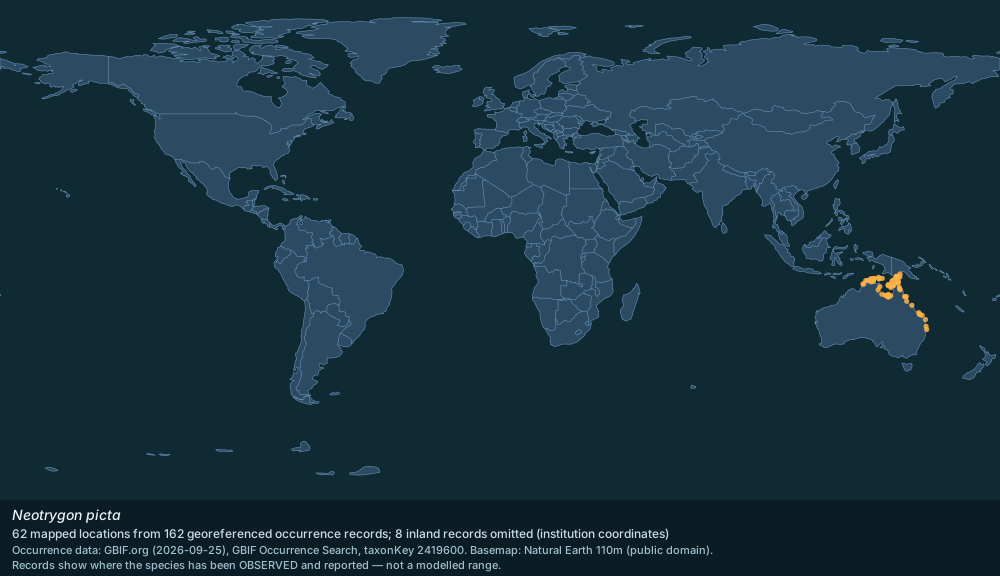
Where the peppered maskray (neotrygon picta) has been recorded
Each dot is a place where the species has been observed and reported (162 records, half-degree grid) — not a modelled range. 8 inland records left out (institution coordinates).
Map: drawn by Codexery. Data: GBIF occurrence search (records CC0 / CC BY) · Natural Earth basemap (public domain) · place coordinates: Wikipedia (CC BY-SA 4.0)
Classification (WoRMS)
Full classification as recorded by WoRMS: Kingdom: Animalia · Phylum: Chordata · Class: Elasmobranchii · Order: Myliobatiformes · Family: Dasyatidae · Genus: Neotrygon.
Accepted name: Neotrygon picta · Authority: Last & White, 2008 · Taxonomic status: accepted · AphiaID: 398332.
Source: World Register of Marine Species (WoRMS) — https://www.marinespecies.org/aphia.php?p=taxdetails&id=398332 (CC BY 4.0). Accessed 2026-09-25.
Biology and life history (FishBase)
Measured values published by FishBase for Neotrygon picta. Only fields the database actually holds for this species are shown; these are database values, not aquarium guidance.
Maximum length: 24 cm · Depth range: 5–96 m · Habitat zone: benthopelagic · Body shape: other · Vulnerability index: 40.1 of 100 · Aquarium trade: never/rarely.
FishBase notes: Size of new-born specimens 90-105 mm DW (Ref. 76964).
Source: FishBase species summary (SpecCode 64150) — https://www.fishbase.se/summary/Neotrygon-picta.html (CC BY-NC 3.0 — non-commercial use only). Accessed 2026-09-25.
Distribution and occurrence records (GBIF)
162 georeferenced occurrence records for Neotrygon picta are published through GBIF from 3 countries or marine areas. The map above plots 62 distinct locations from a sample of 162 records, omitting 8 inland records that carry an institution's coordinates rather than a collection site; it shows where the species has been observed and reported, not a modelled range.
Most records by country or area: Australia (155); Malaysia (4); Papua New Guinea (3).
Source: GBIF Occurrence Search (taxonKey 2419600) — https://www.gbif.org/occurrence/search?taxon_key=2419600&has_coordinate=true (records CC0 / CC BY); WoRMS distribution records (MarineRegions) — https://www.marinespecies.org/aphia.php?p=taxdetails&id=398332 (CC BY 4.0); Natural Earth 110m basemap — https://www.naturalearthdata.com/ (public domain). Accessed 2026-09-25.
Conservation status (IUCN Red List)
The IUCN Red List assesses Neotrygon picta Last & White, 2008 as Least Concern (code LC). No trend, population estimate or threat analysis is given here, because none is available from this source without the Red List API; follow the source link for the full assessment, including its date.
Source: IUCN Red List of Threatened Species (taxon 195464) — https://www.iucnredlist.org/species/195464/0; GBIF IUCN Red List category endpoint (taxonKey 2419600) — https://api.gbif.org/v1/species/2419600/iucnRedListCategory. Accessed 2026-09-25.
Description and natural history (Wikipedia)
Favoring soft-bottomed habitats, the peppered maskray is a bottom-dwelling predator consuming mainly crustaceans (particularly caridean shrimp) and polychaete worms. It is viviparous, with litter sizes of one to three.
Human interactions
The females supply their developing young with histotroph ("uterine milk") during gestation. Although the peppered maskray is a frequent bycatch of bottom trawl fisheries, it is still common and significant portions of its population appear to lie within unfished waters. As a result, the International Union for Conservation of Nature (IUCN) has assessed it as Least Concern.
Taxonomy and phylogeny
Once thought to be a color morph of the painted maskray (N. leylandi), the peppered maskray was recognized as a distinct species based on molecular data collected for the Barcode of Life project. It was described by Peter Last and William White in a 2008 Commonwealth Scientific and Industrial Research Organisation (CSIRO) publication. Their account was based on 13 specimens; of these, a female 24 cm across caught off Rockhampton, Queensland was designated as the holotype.
The specific epithet picta is derived from the Latin pictus ("painted" or "colored"). Phylogenetic analysis using mitochondrial and nuclear DNA has found that the peppered and painted maskrays are sister species. The two are estimated to have diverged c. 10 Ma, during the Miocene.
Description
The peppered maskray has a thin, diamond-shaped pectoral fin disc roughly 1.2 times wider than long, with slightly concave leading margins and narrowly rounded outer corners. The snout forms an obtuse angle and has a pointed tip. The small, closely spaced eyes are followed by crescent-shaped spiracles.
The nostrils are elongated and have a skirt-shaped curtain of skin between them; the posterior margin of the curtain is fringed and forms two lobes. The small mouth is surrounded by papillae and bears prominent furrows at the corners. There are two papillae on the floor of the mouth.
The teeth number 33–38 rows in the upper jaw and 31–40 rows in the lower; the teeth are small and vary from pointed to blunt. The five pairs of gill slits are S-shaped. The pelvic fins are medium-sized and triangular with angular corners.
The whip-like tail measures 1.0–1.3 times as long as the disc and bears slender stinging spines on the upper surface; smaller rays usually have one sting, larger rays two. The tail is moderately broad and flattened at the base, becoming very thin behind the sting. Both upper and lower fin folds are present past the sting, with the upper fold shorter than the lower. There are up to 22 small, closely spaced thorns along the midline of the back behind the spiracles; otherwise, the skin is mostly smooth.
This species is light yellow to brown above, with a darker reticulated pattern that may vary from faint to obvious, all overlaid by numerous black spots. Like other Neotrygon species, there is a dark marking across the eyes that resembles a mask.
The tail has a pattern of saddles or bands behind the sting; the tip is white and the ventral fin fold darkens to almost black posteriorly. The underside is plain white. This species reaches 32 cm across.
Distribution and habitat
The range of the peppered maskray extends along the coast of northeastern Australia, from at least the Wessel Islands off Northern Territory to Hervey Bay in Queensland; the western boundary of its range is uncertain. It may also be found off New Guinea, though this is unconfirmed.
This species is extremely common in some areas, such as the Gulf of Carpentaria. A benthic fish, it is usually found on the inner continental shelf in water less than 25 m deep, but may occur down to 100 m. It favors habitats with sandy or other fine substrate.
The peppered maskray prefers to pick prey from the surface of the substrate, as opposed to digging for them. Caridean shrimp are by far the most important food source. It also consumes polychaete worms and amphipods, and rarely penaeid prawns, molluscs, and small bony fishes. Compared to smaller rays, larger rays have a more varied diet that incorporates a greater proportion of polychaete worms.
Reproduction in the peppered maskray is viviparous; like other stingrays, the developing embryos are initially nourished by yolk and later by histotroph ("uterine milk") provided by the mother. Mature females have a single functional ovary and uterus, on the left side. Females give birth to litters of one to three pups, probably once per year.
The newborns are 9 - 11 cm across. Males and females reach sexual maturity at around 17 and 18 cm across respectively. The maximum lifespan is at least 11 years for males and 18 years for females.
The peppered maskray lacks economic value and is discarded by fisheries. It is often caught incidentally in bottom trawls, and due to its small size does not benefit from Turtle Exclusion Devices. In particular, this species accounts for approximately 4.5% of the total catch of the Northern Prawn Fishery (NPF) in the Gulf of Carpentaria. Over half of the rays caught by the NPF, including almost all the males, are fatally crushed within the trawl.
Despite this mortality, the NPF is not believed to have negatively affected the local population because its operational area does not include the waters where this species is most abundant. The peppered maskray is also caught frequently in scallop trawls operated by the Queensland East Coast Trawl Fishery. Elsewhere in its range, fishing pressure is relatively light due to external factors such as fuel prices. The International Union for Conservation of Nature (IUCN) has listed this species under Least Concern, because it remains common and its range includes several Marine Protected Areas.
Source: Wikipedia: Peppered maskray — https://en.wikipedia.org/wiki/Peppered_maskray (CC BY-SA 4.0). Accessed 2026-09-25.
Test yourself
Three questions drawn from this entry’s sources. Pick an answer to check it.
Answers checked against the source article
Sources
Compiled from Wikipedia and the sources listed below. Text from Wikipedia is available under CC BY-SA 4.0; this entry is adapted from it.
- Wikipedia: Peppered maskray (CC BY-SA 4.0).
- Classification: the source article's taxobox; order, family and genus checked against WoRMS, the World Register of Marine Species (CC BY 4.0).
- Conservation status: IUCN Red List assessment.
- Occurrence records: GBIF (CC0 / CC BY). Basemap: Natural Earth (public domain).
- Biology values: FishBase species summary (CC BY-NC 3.0, non-commercial).
- Word definitions: the , each quoted from its Wikipedia article.
Spotted an error? Know more?
Reader corrections go straight into our review queue. Suggest an edit · How this site is sourced