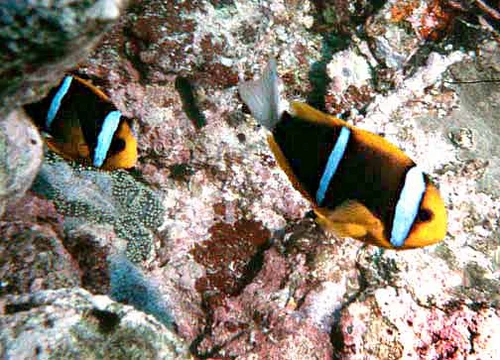
Orange-fin anemonefish (Amphiprion chrysopterus)
Source-cited species reference: taxonomy from WoRMS, biology from FishBase, occurrence map from GBIF, conservation from IUCN Red List, description from Wikipedia.

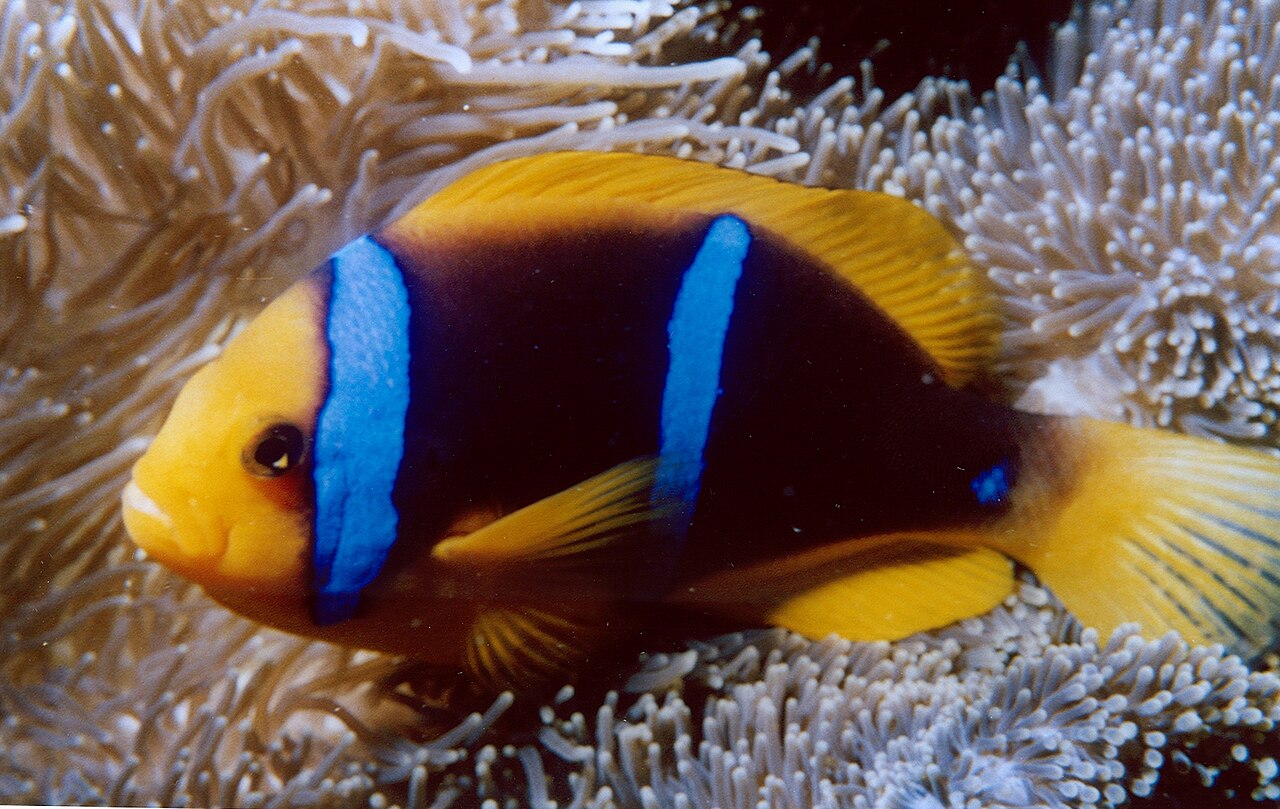
Dr. Dwayne Meadows, NOAA/NMFS/OPR · Public domain
The orange-fin anemonefish (Amphiprion chrysopterus) is a marine fish belonging to the family Pomacentridae, the clownfishes and damselfishes, found in the Western Pacific north of the Great Barrier Reef from the surface to 20 m, to include the Pacific Ocean between Queensland, Australia, and New Guinea to the Marshall and Tuamotus Islands. It can grow to 17 cm in length.
- Scientific name
- Amphiprion chrysopterus
- Authority
- Cuvier, 1830
- Family
- Pomacentridae
- Order
- Ovalentaria incertae sedis
- Maximum length
- 17 cm
- Depth range
- 0–40 m
- Habitat zone
- reef-associated
- Iucn red list
- Least Concern
- Gbif occurrence records
- 1,943
Taxonomic Identity and Phylogenetic Standing
The orange-fin anemonefish (Amphiprion chrysopterus) occupies a distinctive position within the clownfish lineage. The genus Amphiprion was established in 1801 by Marcus Elieser Bloch and Johann Gottlob Theaenus Schneider, its name drawn from Greek roots meaning 'on both sides' and 'saw,' a nod to the saw-shaped edges along the gill covering and beneath the eyes shared by all members. A 2014 phylogenetic study identified the orange-fin anemonefish as a single-species clade, a status it shares with the wide-band anemonefish, setting it apart from larger multi-species complexes such as percula or polymnus. In 2025, taxonomists formally described the Polynesian anemonefish (A. maohiensis) as a new species, a fish long regarded as merely a colour morph of the orange-fin anemonefish. This reclassification highlights how subtle chromatic variation can mask true species boundaries. The broader clownfish lineage diverged from other damselfishes roughly 35 million years ago during the late Eocene, with the most recent common ancestor of all living species dating to approximately 10.5 million years ago in the Early Miocene.
Symbiotic Ecology and Social Reproduction
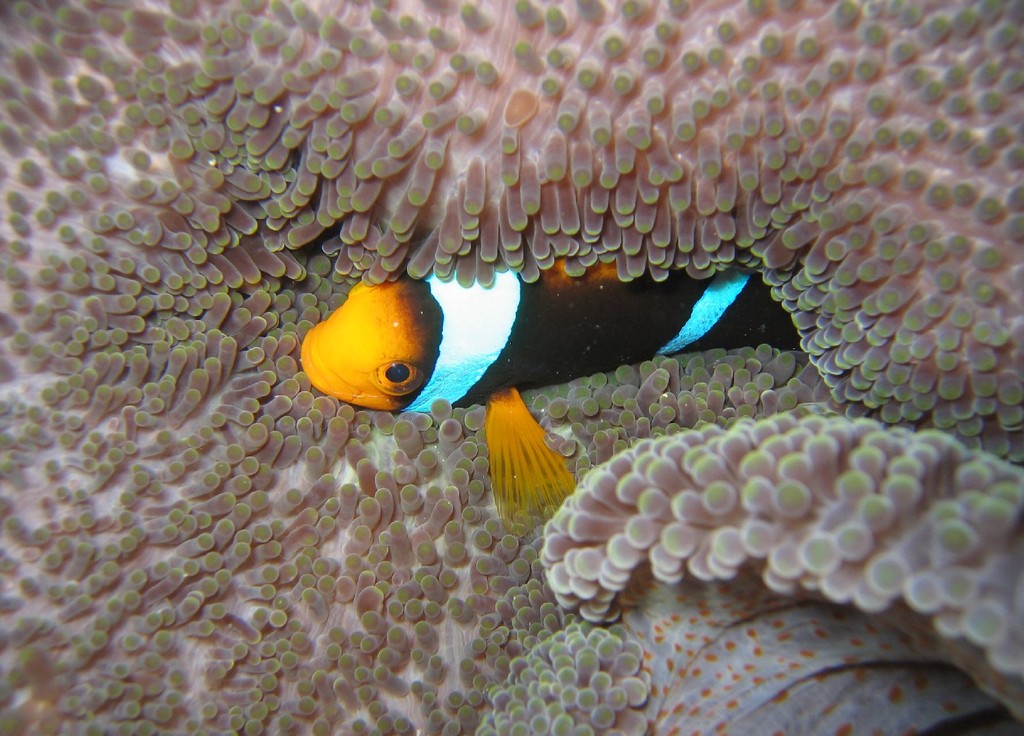
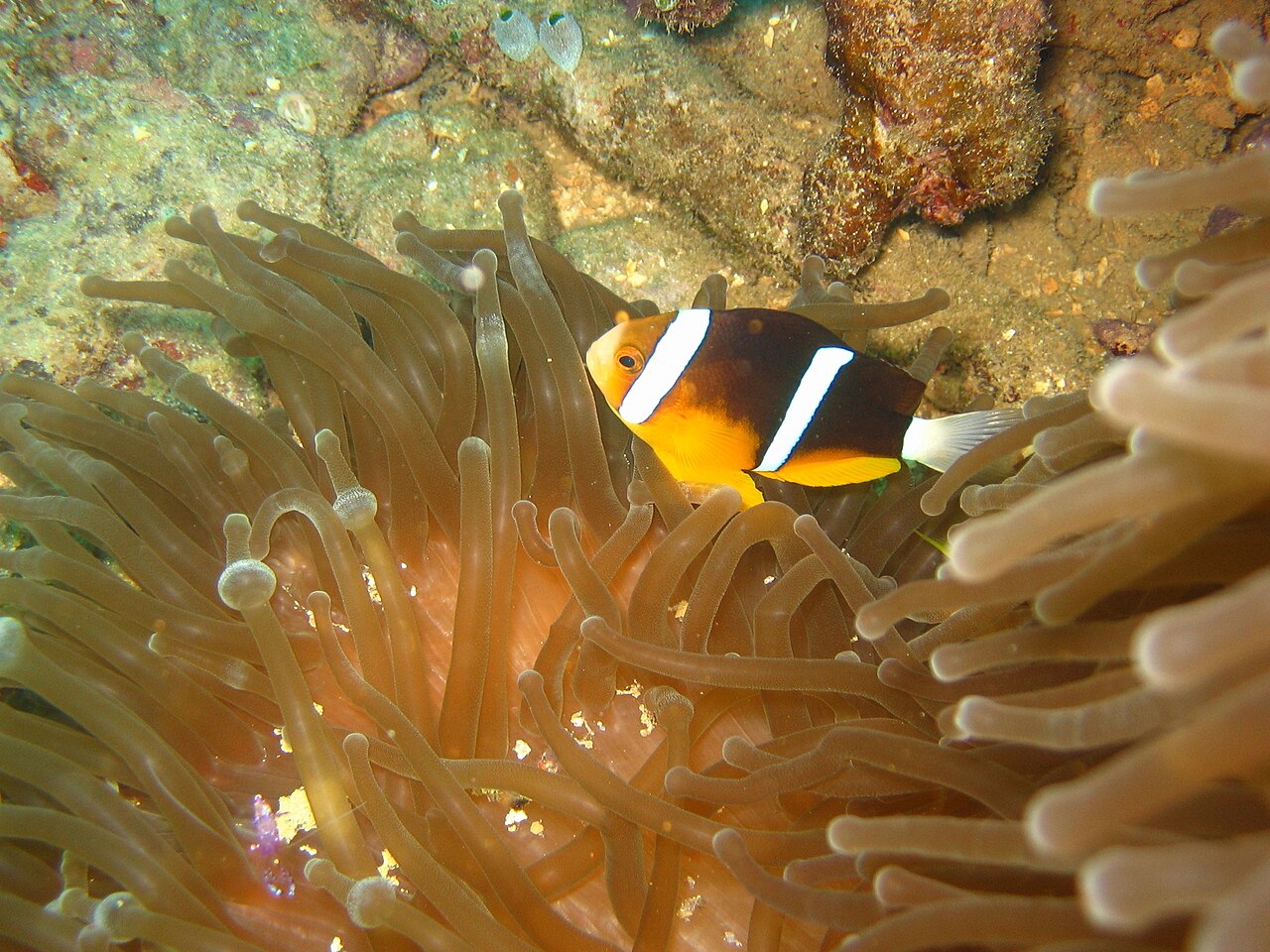
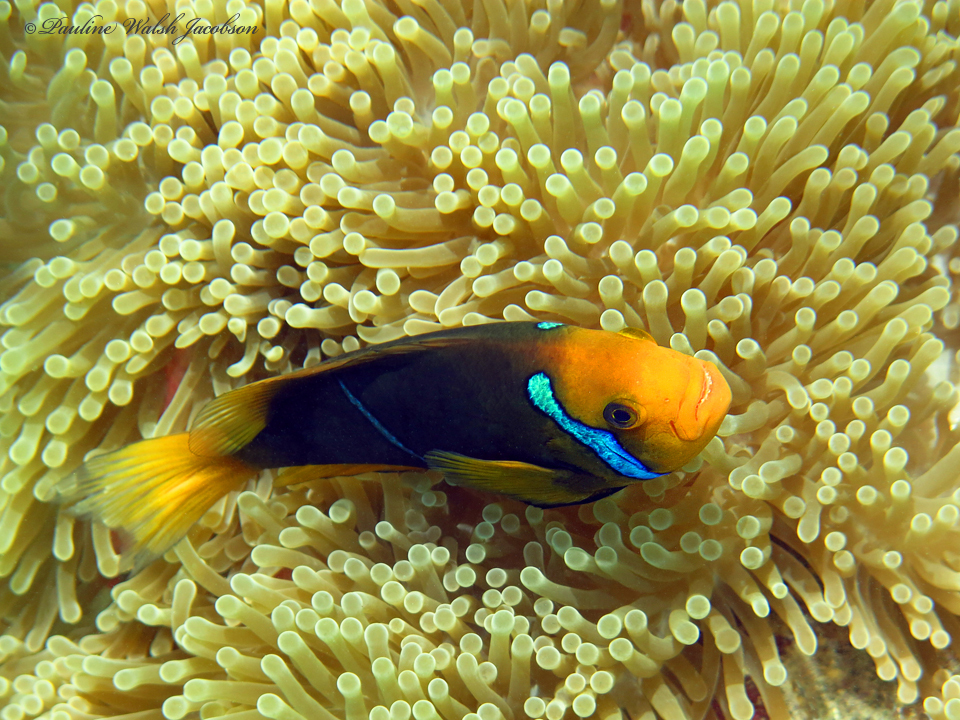
Like all clownfish, the orange-fin anemonefish depends on a mutually beneficial partnership with sea anemones for survival in the warm, tropical Indo-Pacific coral reefs it inhabits. The anemone provides shelter and defence against predators, while the fish in turn wards off anemone-eating species, fans the tentacles, and attracts beneficial microorganisms through its waste. These fish are omnivorous, drawing most of their nutrition from plankton. Socially, they form groups led by a breeding female at the top of a strict size-based dominance hierarchy, followed by the breeding male and then non-breeding individuals in descending order. Should the female vanish, the breeding male undergoes a sex change to assume her role, and the remaining members shift upward. Reproduction involves the female depositing eggs on a rock adjacent to their anemone, with the male providing fertilisation. Once hatched, the young disperse as larvae into the open ocean before eventually settling on the seafloor and searching for a suitable anemone host as juveniles.
Morphology and Sensory Capabilities
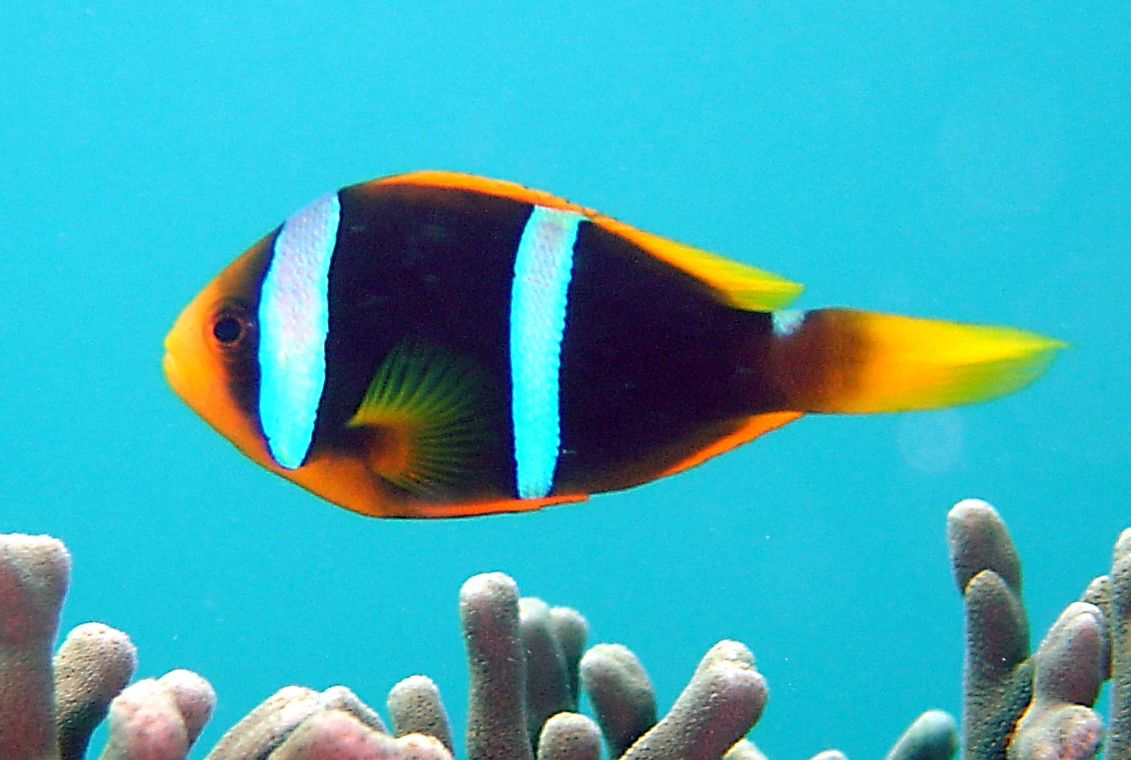
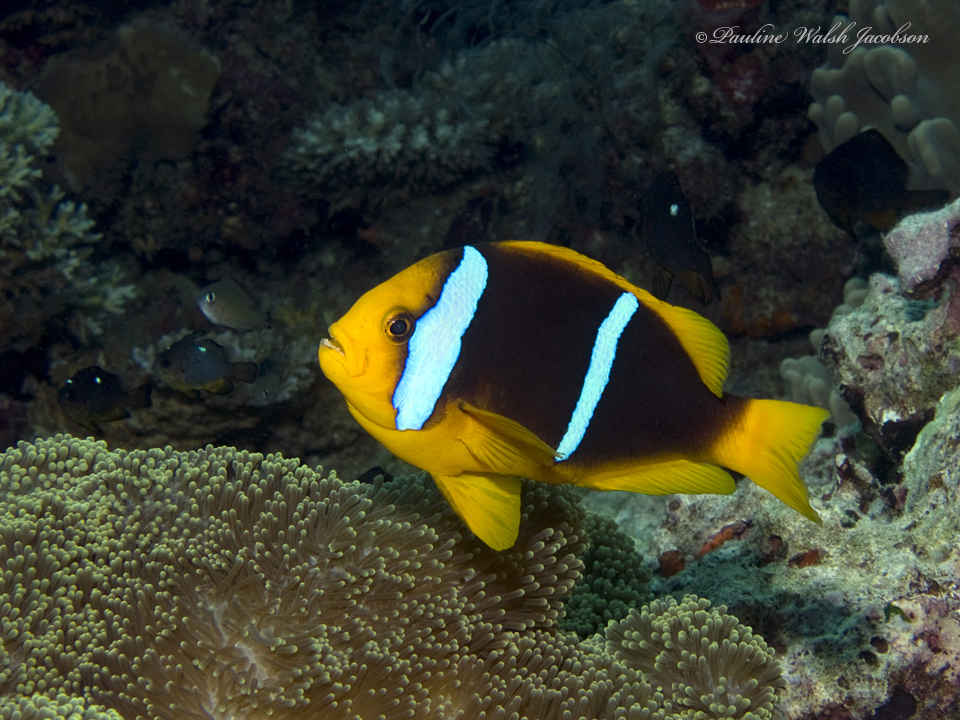
The orange-fin anemonefish displays the hallmark clownfish colouration: a background of red, orange, yellow, brown, or black overlaid with up to three white vertical bars edged in black. Its body shape ranges from oval to streamlined, with a rounded head that lacks scales between the snout and eyes. The dorsal fin bears ten spines followed by fourteen to twenty soft rays, while the pectoral fins carry fifteen to twenty-one rays. What makes these fish particularly remarkable is their sensory equipment. Their eyes, positioned on the sides of the head, are also visible from the front, suggesting a degree of binocular vision. Small gaps between the iris and lens admit additional light, and the fish can perceive both visible colour and ultraviolet wavelengths. Their olfactory system features an arrow-shaped organ positioned along the midline of the nasal cavity, often bearing fork-like extra flaps—a trait unique among fish. Hearing appears tuned to relatively low frequencies in the range of 75 to 900 hertz.
Evolutionary Origins and Speciation Drivers
The evolutionary story of the orange-fin anemonefish is rooted in the waters of the Malay Archipelago, where a 2014 study placed the origin of the entire clownfish lineage. After diverging from other damselfishes around 35 million years ago, the group experienced a notable acceleration in species diversification beginning roughly 5 million years ago, driven by two major adaptive radiations—one centred on the Malay Archipelago and a later one in the western Indian Ocean. Genetic evidence reveals substantial interbreeding among clownfish species throughout their evolutionary history, blurring the lines between what we now recognise as distinct taxa. Crucially, speciation in this genus has been linked to the diversity of sea anemone hosts, which occupy different habitats and thereby drive ecological separation among fish populations. The orange-fin anemonefish's status as a single-species clade, as identified in a 2014 study, reflects this pattern of host-associated divergence. The 2025 description of the Polynesian anemonefish, long confused with a morph of A. chrysopterus, further illustrates how anemone-dependent ecology can obscure or reveal species boundaries over time.
Gallery
Related in Orange-fin anemonefish
Links follow this subject's own source article.
Elsewhere in Orange-fin anemonefish
Spotted an error? Know more?
Reader corrections go straight into our review queue. Suggest an edit · How this site is sourced