Where Orange-fin anemonefish has been recorded
GBIF occurrence records for Amphiprion chrysopterus, mapped and tabulated by country.

1,943 georeferenced occurrence records with coordinates are published for Amphiprion chrysopterus through GBIF, from 26 countries or marine areas. This page maps those records and lists where they come from. Occurrence records reflect where people have looked as well as where the species lives, so well-surveyed coastlines are over-represented.
- Georeferenced records
- 1,943
- Countries / areas
- 26
- Mapped locations
- 240
- Records sampled for the map
- 1,943
- Inland records omitted
- 10
- Gbif taxonkey
- 5212076
Taxonomic Identity and Classification History
The orange-fin anemonefish belongs to the genus Amphiprion, a name coined in 1801 by Marcus Elieser Bloch and Johann Gottlob Theaenus Schneider, drawn from Greek roots meaning "on both sides" and "saw" — a nod to the saw-shaped edges running along the gill covering and beneath the eyes that every member of this group shares. Within the damselfish family Pomacentridae, clownfish were elevated to their own subfamily Amphiprioninae by Gerald R. Allen in 1975, although a 2009 genetic study proposed relocating them under the subfamily Pomacentrinae as a new tribe, Amphiprionini. The orange-fin anemonefish occupies a distinctive taxonomic niche: a 2014 phylogenetic analysis identified it as a single-species clade, distinguishing it from larger multi-species complexes such as percula or polymnus. In 2025 the picture shifted once more when the Polynesian anemonefish (A. maohiensis) was formally described as a separate species, having long been treated as nothing more than a colour variant of the orange-fin anemonefish. That reclassification highlights just how visually similar these two species are and underscores the continuing refinement of clownfish systematics.
The Anemone Partnership
The orange-fin anemonefish, like every member of its genus, is bound to sea anemones through a mutually beneficial partnership that shapes nearly every aspect of its life. The fish relies on the anemone for shelter and protection against predators, a refuge that is central to its survival on coral reefs. In exchange, the anemonefish acts as both guardian and caretaker: it drives off anemone-eating fish, fans the anemone's tissues, and keeps its surface clean. Its metabolic waste even draws beneficial microorganisms toward the host. This bond reaches far beyond daily interactions into deep evolutionary time. Genetic evidence indicates that clownfish speciation has been driven in part by association with different anemone host species occupying distinct habitats, producing ecological separation between populations. The orange-fin anemonefish's standing as a single-species clade in phylogenetic analyses may mirror this tight co-evolutionary link. Juveniles, after drifting as larvae in open water, must locate and commit to a suitable anemone host, making the partnership a lifelong dependency.
Social Order and Reproductive Strategy
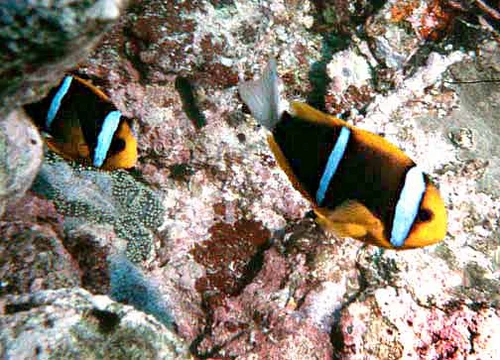
Within a group of orange-fin anemonefish, social structure follows a strict size-based dominance hierarchy. The breeding female occupies the top position, followed by the breeding male, and then non-breeding individuals arranged in descending order of size. Crucially, this ranking is not permanent: if the dominant female dies or vanishes, the breeding male undergoes a sex change to assume her role, and the remaining members shift upward in the hierarchy. Reproduction occurs on a rock surface near the anemone, where the female lays her eggs and the male fertilises them. After hatching, the young abandon the reef entirely, drifting as free-swimming larvae in the open ocean before eventually settling on the seafloor and searching for an anemone host to join. The orange-fin anemonefish, like all members of its genus, is omnivorous and feeds primarily on plankton. Females are consistently larger than males, and the smallest individuals in a group measure only six to fifteen millimetres in length.
Conservation Pressures in a Warming Ocean
The orange-fin anemonefish, alongside its congeners, confronts growing pressure from the global aquarium trade. The ocellaris clownfish ranks among the most commonly traded marine species, and many captive specimens have been harvested directly from the wild, contributing to measurable population declines. The orange-fin anemonefish's striking colouration — a coloured background crossed by white vertical bars outlined in black — makes it visually appealing to hobbyists and the commercial market alike. Populations are notably more abundant in marine protected areas where collection is prohibited, suggesting that legal safeguards can offset the damage of overharvesting. Beyond direct exploitation, broader environmental threats intensify: global warming drives ocean warming and acidification, conditions that stress the coral reef ecosystems and the anemone hosts on which these fish depend. The clownfish lineage, which originated in the waters of the Malay Archipelago roughly thirty-five million years ago and diversified through two major adaptive radiations, now faces a rapidly shifting Indo-Pacific environment that may challenge its long-term resilience.
Related in Orange-fin anemonefish
Links follow this subject's own source article.
Elsewhere in Orange-fin anemonefish
Spotted an error? Know more?
Reader corrections go straight into our review queue. Suggest an edit · How this site is sourced