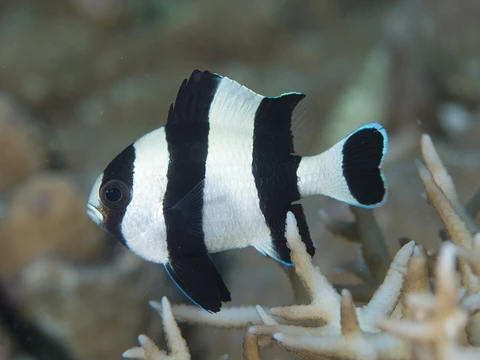
Blacktail humbug (Dascyllus melanurus)
Source-cited species reference: taxonomy from WoRMS, biology from FishBase, occurrence map from GBIF, conservation from IUCN Red List, description from Wikipedia.

Dascyllus melanurus, known commonly as the four stripe damselfish, blacktail dascyllus, humbug damselfish, blacktail damselfish, and blacktail humbug, is a species of fish in the family Pomacentridae. It is native to the western Pacific Ocean. It is sometimes kept as an aquarium pet.
- Scientific name
- Dascyllus melanurus
- Authority
- Bleeker, 1854
- Family
- Pomacentridae
- Order
- Ovalentaria incertae sedis
- Maximum length
- 8 cm
- Depth range
- 1–68 m
- Habitat zone
- reef-associated
- Iucn red list
- Least Concern
- Gbif occurrence records
- 555
Classification (WoRMS)
Full classification as recorded by WoRMS: Kingdom: Animalia · Phylum: Chordata · Class: Teleostei · Order: Ovalentaria incertae sedis · Family: Pomacentridae · Genus: Dascyllus.
Accepted name: Dascyllus melanurus · Authority: Bleeker, 1854 · Taxonomic status: accepted · AphiaID: 278451.
Synonyms and superseded combinations recorded for this taxon: Dascullus melanurus Bleeker, 1854; Pomacentrus onyx De Vis, 1884.
Source: World Register of Marine Species (WoRMS) — https://www.marinespecies.org/aphia.php?p=taxdetails&id=278451 (CC BY 4.0). Accessed 2026-09-23.
Biology and life history (FishBase)
Measured values published by FishBase for Dascyllus melanurus. Only fields the database actually holds for this species are shown; these are database values, not aquarium guidance.
Maximum length: 8 cm · Depth range: 1–68 m · Habitat zone: reef-associated · Body shape: short and / or deep · Vulnerability index: 10 of 100 · Fishery importance: commercial · Aquarium trade: commercial.
FishBase notes: Schooling species, adults inhabit sheltered lagoons, harbors and inlets. Also in somewhat open substrates with outcrops of Acropora corals (Ref. 48636). Often associated with small coral heads. Feed on a variety of plankton, including larval shrimps and crabs, algae, ostracods, amphipods, pelagic tunicates, copepods, and fish eggs. Oviparous, distinct pairing during breeding (Ref. 205). Eggs are demersal and adhere to the substrate (Ref. 205). Males guard and aerate the eggs (Ref. 205). Diurnal species (Ref. 54980; 113699).
Source: FishBase species summary (SpecCode 5111) — https://www.fishbase.se/summary/Dascyllus-melanurus.html (CC BY-NC 3.0 — non-commercial use only). Accessed 2026-09-23.
Distribution and occurrence records (GBIF)
555 georeferenced occurrence records for Dascyllus melanurus are published through GBIF from 17 countries or marine areas. The map above plots 132 distinct locations from a sample of 555 records, omitting 31 inland records that carry an institution's coordinates rather than a collection site; it shows where the species has been observed and reported, not a modelled range.
Most records by country or area: Indonesia (186); Papua New Guinea (103); Philippines (79); Malaysia (58); Australia (47); Solomon Islands (33); Vanuatu (11); Palau (7); United States of America (7); New Caledonia (6); Micronesia (Federated States of) (5); Timor-Leste (4); Chinese Taipei (4); Brunei Darussalam (2); China (1).
Marine regions with a valid WoRMS distribution record: Chinese Exclusive Economic Zone.
Source: GBIF Occurrence Search (taxonKey 5212037) — https://www.gbif.org/occurrence/search?taxon_key=5212037&has_coordinate=true (records CC0 / CC BY); WoRMS distribution records (MarineRegions) — https://www.marinespecies.org/aphia.php?p=taxdetails&id=278451 (CC BY 4.0); Natural Earth 110m basemap — https://www.naturalearthdata.com/ (public domain). Accessed 2026-09-23.
Conservation status (IUCN Red List)
The IUCN Red List assesses Dascyllus melanurus Bleeker, 1854 as Least Concern (code LC). No trend, population estimate or threat analysis is given here, because none is available from this source without the Red List API; follow the source link for the full assessment, including its date.
Source: IUCN Red List of Threatened Species (taxon 188497) — https://www.iucnredlist.org/species/188497/0; GBIF IUCN Red List category endpoint (taxonKey 5212037) — https://api.gbif.org/v1/species/5212037/iucnRedListCategory. Accessed 2026-09-23.
Description and natural history (Wikipedia)
The four striped damselfish is commonly found in Indo-Australian Archipelago and western Caroline Islands including Indonesia, Philippines, New Guinea, and the northern Great Barrier Reef of Australia. They are found at depths down to 33 feet, and it is associated with isolated coral heads in sheltered inshore habitats. Like all damselfish, they can be territorial and aggressive, especially as they get older. Four-striped Damselfish typically grow to about three or four inches. The less common species name is Dascyllus melanurus. They are also omnivores, eating anything ranging from algae to small fish or shrimp. Three alternating black and white vertical bands make up the body coloration with a fourth black band ending at the tail.
It travels in schools. It feeds on fish eggs, crustacean larvae, algae, ostracods, amphipods, copepods, and tunicates.
Juvenile school size can be up to 25. Sometimes, a juvenile would like to live alone. Adult is very aggressive and territorial.
Source: Wikipedia: Dascyllus melanurus — https://en.wikipedia.org/wiki/Dascyllus_melanurus (CC BY-SA 4.0). Accessed 2026-09-23.
Spotted an error? Know more?
Reader corrections go straight into our review queue. Suggest an edit · How this site is sourced