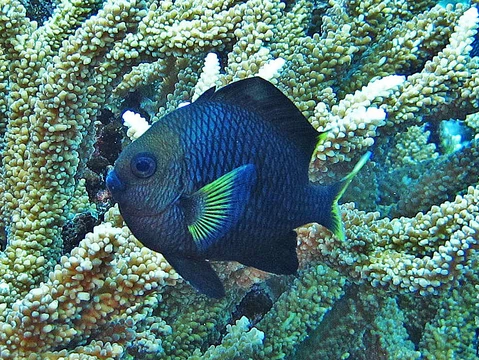
Yellowtail dascyllus (Dascyllus flavicaudus)
Source-cited species reference: taxonomy from WoRMS, biology from FishBase, occurrence map from GBIF, conservation from IUCN Red List, description from Wikipedia.

Dascyllus flavicaudus, common name yellowtail dascyllus, is a Damselfish belonging to the family Pomacentridae.
- Scientific name
- Dascyllus flavicaudus
- Authority
- Randall & Allen, 1977
- Family
- Pomacentridae
- Order
- Ovalentaria incertae sedis
- Maximum length
- 12 cm
- Depth range
- 3–40 m
- Habitat zone
- reef-associated
- Iucn red list
- Least Concern
- Gbif occurrence records
- 816
Classification (WoRMS)
Full classification as recorded by WoRMS: Kingdom: Animalia · Phylum: Chordata · Class: Teleostei · Order: Ovalentaria incertae sedis · Family: Pomacentridae · Genus: Dascyllus.
Accepted name: Dascyllus flavicaudus · Authority: Randall & Allen, 1977 · Taxonomic status: accepted · AphiaID: 278450.
Source: World Register of Marine Species (WoRMS) — https://www.marinespecies.org/aphia.php?p=taxdetails&id=278450 (CC BY 4.0). Accessed 2026-09-23.
Biology and life history (FishBase)
Measured values published by FishBase for Dascyllus flavicaudus. Only fields the database actually holds for this species are shown; these are database values, not aquarium guidance.
Maximum length: 12 cm · Depth range: 3–40 m · Habitat zone: reef-associated · Body shape: short and / or deep · Vulnerability index: 10 of 100 · Fishery importance: commercial · Aquarium trade: commercial.
FishBase notes: Adults inhabit coral and rocky reefs (Ref. 7247). A protogynous hermaphrodite (Ref. 55367). Feeds on zooplanktons (Ref. 89972). Oviparous, distinct pairing during breeding (Ref. 205). Eggs are demersal and adhere to the substrate (Ref. 205). Males guard and aerate the eggs (Ref. 205). Diurnal species (Ref. 54980; 113699).
Source: FishBase species summary (SpecCode 11972) — https://www.fishbase.se/summary/Dascyllus-flavicaudus.html (CC BY-NC 3.0 — non-commercial use only). Accessed 2026-09-23.
Distribution and occurrence records (GBIF)
816 georeferenced occurrence records for Dascyllus flavicaudus are published through GBIF from 10 countries or marine areas. The map above plots 43 distinct locations from a sample of 816 records, omitting 2 inland records that carry an institution's coordinates rather than a collection site; it shows where the species has been observed and reported, not a modelled range.
Most records by country or area: French Polynesia (787); Cook Islands (13); Fiji (4); Philippines (4); China (2); New Caledonia (2); Pitcairn (1); Palau (1); Chinese Taipei (1); Wallis and Futuna (1).
Source: GBIF Occurrence Search (taxonKey 5212050) — https://www.gbif.org/occurrence/search?taxon_key=5212050&has_coordinate=true (records CC0 / CC BY); WoRMS distribution records (MarineRegions) — https://www.marinespecies.org/aphia.php?p=taxdetails&id=278450 (CC BY 4.0); Natural Earth 110m basemap — https://www.naturalearthdata.com/ (public domain). Accessed 2026-09-23.
Conservation status (IUCN Red List)
The IUCN Red List assesses Dascyllus flavicaudus Randall & Allen, 1977 as Least Concern (code LC). No trend, population estimate or threat analysis is given here, because none is available from this source without the Red List API; follow the source link for the full assessment, including its date.
Source: IUCN Red List of Threatened Species (taxon 188446) — https://www.iucnredlist.org/species/188446/0; GBIF IUCN Red List category endpoint (taxonKey 5212050) — https://api.gbif.org/v1/species/5212050/iucnRedListCategory. Accessed 2026-09-23.
Description and natural history (Wikipedia)
These damselfish can be found in the Eastern Central Pacific, in the southeastern Oceania, including Society Islands, Tuamoto Islands, Pitcairn Islands, and Rapa Nui. It occasionally makes its way into the aquarium trade.
This tropical species is reef-associated and non-migratory. It occurs in coral and rocky reefs at depths of 3 to 40 m.
Dascyllus flavicaudus can grow to a size of 12 cm in length. These fishes have a very high body, with a ratio of 1 / 1.4-1.6 (body height / body length).
With the exception of the yellowish to yellowish-white tail and the bright rear portion of the dorsal fin, their body is dark, blackish-brown to blackish-bluish. The dark edges of the scales make a net drawing. They show 12 dorsal spines, 15-16 dorsal soft rays, 2 anal spines and 13-14 anal soft rays. During matings time the males usually turn a shade or two darker, sometimes with white spots.
These fishes have just one of at least two distinct sexes in any one individual organism (Gonochorism). They are oviparous and non-functional hermaphrodite. They mainly feed on copepods, other small planktonic crustaceans and algae. Adults form a permanent harem, with one male and several females close to coral heads. They are substrate spawners and stick their spawn in a cave or hidden niche. Males guard and aerate the eggs that adhere to the substrate.
Source: Wikipedia: Dascyllus flavicaudus — https://en.wikipedia.org/wiki/Dascyllus_flavicaudus (CC BY-SA 4.0). Accessed 2026-09-23.
Spotted an error? Know more?
Reader corrections go straight into our review queue. Suggest an edit · How this site is sourced