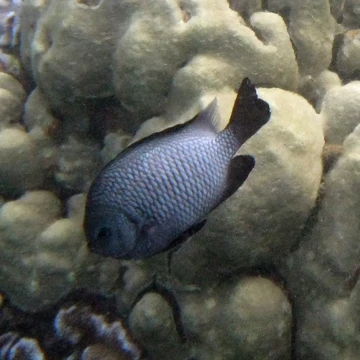
Hawaiian dascyllus (Dascyllus albisella)
Source-cited species reference: taxonomy from WoRMS, biology from FishBase, occurrence map from GBIF, conservation from IUCN Red List, description from Wikipedia.

Dascyllus albisella commonly known as the Hawaiian dascyllus, Hawaiian domino, Domino damselfish, or white-spotted damsel is a marine fish found in the Eastern Central Pacific.
- Scientific name
- Dascyllus albisella
- Authority
- Gill, 1862
- Family
- Pomacentridae
- Order
- Ovalentaria incertae sedis
- Maximum length
- 13 cm
- Depth range
- 1–50 m
- Habitat zone
- reef-associated
- Iucn red list
- Least Concern
- Gbif occurrence records
- 3,937
Classification (WoRMS)
Full classification as recorded by WoRMS: Kingdom: Animalia · Phylum: Chordata · Class: Teleostei · Order: Ovalentaria incertae sedis · Family: Pomacentridae · Genus: Dascyllus.
Accepted name: Dascyllus albisella · Authority: Gill, 1862 · Taxonomic status: accepted · AphiaID: 278448.
Synonyms and superseded combinations recorded for this taxon: Dascyllus edmondsoni Pietschmann, 1934.
Source: World Register of Marine Species (WoRMS) — https://www.marinespecies.org/aphia.php?p=taxdetails&id=278448 (CC BY 4.0). Accessed 2026-09-23.
Biology and life history (FishBase)
Measured values published by FishBase for Dascyllus albisella. Only fields the database actually holds for this species are shown; these are database values, not aquarium guidance.
Maximum length: 13 cm · Depth range: 1–50 m · Habitat zone: reef-associated · Body shape: short and / or deep · Vulnerability index: 10 of 100 · Fishery importance: commercial · Aquarium trade: commercial.
FishBase notes: Adults are found in very shallow, protected water, over coral and rocky bottoms. Young often sheltering among the branches of Pocillopora ; occasionally commensal with the anemone Marcanthia cookei (Ref. 9710). Benthopelagic (Ref. 58302). Peak spawning from May to August. Age-at-maturity estimated at one year. Feed on zooplankton, benthic invertebrates, and algae (Ref. 9710). Oviparous, distinct pairing during breeding (Ref. 205). Eggs are demersal and adhere to the substrate (Ref. 205). Males guard and aerate the eggs (Ref. 205). Have been reared in captivity (Ref. 35412).
Source: FishBase species summary (SpecCode 7816) — https://www.fishbase.se/summary/Dascyllus-albisella.html (CC BY-NC 3.0 — non-commercial use only). Accessed 2026-09-23.
Distribution and occurrence records (GBIF)
3,937 georeferenced occurrence records for Dascyllus albisella are published through GBIF from 3 countries or marine areas. The map above plots 32 distinct locations from a sample of 3,000 records, omitting 9 inland records that carry an institution's coordinates rather than a collection site; it shows where the species has been observed and reported, not a modelled range.
Most records by country or area: United States of America (3,529); United States Minor Outlying Islands (407); Micronesia (Federated States of) (1).
The full country table, WoRMS marine regions and the sampling notes are on this species' Distribution page.
Source: GBIF Occurrence Search (taxonKey 5212038) — https://www.gbif.org/occurrence/search?taxon_key=5212038&has_coordinate=true (records CC0 / CC BY); WoRMS distribution records (MarineRegions) — https://www.marinespecies.org/aphia.php?p=taxdetails&id=278448 (CC BY 4.0); Natural Earth 110m basemap — https://www.naturalearthdata.com/ (public domain). Accessed 2026-09-23.
Conservation status (IUCN Red List)
The IUCN Red List assesses Dascyllus albisella Gill, 1862 as Least Concern (code LC). No trend, population estimate or threat analysis is given here, because none is available from this source without the Red List API; follow the source link for the full assessment, including its date.
Source: IUCN Red List of Threatened Species (taxon 188345) — https://www.iucnredlist.org/species/188345/0; GBIF IUCN Red List category endpoint (taxonKey 5212038) — https://api.gbif.org/v1/species/5212038/iucnRedListCategory. Accessed 2026-09-23.
Description and natural history (Wikipedia)
Length up to 12.5 cm, dark gray to black, but centers of scales on body are whitish.
Associated with coral reefs, most usually in shallow, protected waters.
swim in shallow water surface to 20 feet below in small openings.
The species is found around the Hawaiian Islands and Johnston Island.
Dascyllus albisella are a relatively passive species that spends most of their time foraging. Normally, males are the more aggressive of the two genders as they are the ones that usually exhibit parental care.
While male aggressiveness is expected, males exhibit sole care of the offspring unlike most animals. This is due to the uniparental nature of Dascyllus albisella. This does not indicate that the females are not present whatsoever. Nor does this show that the females only have a duty to lay the eggs. In cases where the male is not present, females may develop more aggressiveness depending on the situation.
As we can see, females do not desert the nest after mating. Females that are larger are more likely to defend the nest in the absence of the male than smaller females. That being said, the nest is defended most frequently by females that were born at that nest.
This does not apply to all the females. Some females, even when raised at the nest will not defend the nest regardless. This increased aggressiveness is more favored towards the larger females, however the correlation isn't terribly strong between size and nest defense. There is only a tendency for larger fish to defend. In another case when both parents are present, the female will display increased aggressiveness when predation levels increase. Females have a tendency to only display aggressiveness when said female's eggs are in danger.
Dascyllus albisella displays aggression by making chirping sounds. There is a difference in the chirping that Dascyllus albisella utilizes towards their own versus other organisms. Females tend to produce aggressive sounds when a male is chased by other female fish. Towards their own species, they make a popping sound that is composed of multiple pulses. In addition, they make these aggressive sounds when chasing juveniles. Towards other species, Dascyllus albisella will make a one and two pulse.
Dascyllus albisella are also known to hold territories. A territory holder will interact aggressively only when other fish attempt to enter its domain. A territory holder will tolerate most of the fish entering its territory. However, a few fish will be chased away immediately.
Dascyllus albisella interact with each other at an early age as well. The younger fish are referred to as juveniles. In these juvenile interactions we see that Dascyllus albisella form a size based linear dominance. As one can expect, the aggressive scuffles are between larger fish and smaller fish. This behavior most likely establishes the hierarchy early on. This is further reinforced by the observation that growth is less in lower status fish or in larger groups. For larger groups this is most likely that the fish in the group are keeping each other smaller due to the hierarchy, as a result, they retard their growth.
We see that these fish will settle in a group during settling season and said fish will stay in their group even if they chance upon a better group, which shows that Dascyllus albisella aren't that aggressive in their choice of group.
Source: Wikipedia: Dascyllus albisella — https://en.wikipedia.org/wiki/Dascyllus_albisella (CC BY-SA 4.0). Accessed 2026-09-23.
Related in Hawaiian dascyllus
Links follow this subject's own source article.
Elsewhere in Hawaiian dascyllus
Spotted an error? Know more?
Reader corrections go straight into our review queue. Suggest an edit · How this site is sourced