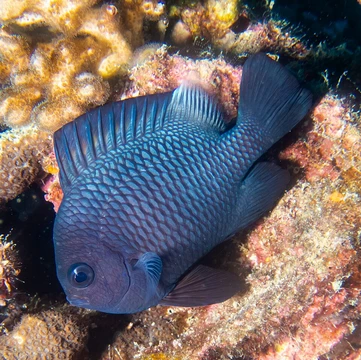
Threespot dascyllus (Dascyllus trimaculatus)
Source-cited species reference: taxonomy from WoRMS, biology from FishBase, occurrence map from GBIF, conservation from IUCN Red List, description from Wikipedia.

The threespot dascyllus (Dascyllus trimaculatus), also known as the domino damsel or simply domino, is a species of damselfish from the family Pomacentridae. It is native to the Indo-Pacific from the Red Sea and East Africa, to the Pitcairn Islands, southern Japan, and Australia, and can also be found in some parts of the Philippines.
- Scientific name
- Dascyllus trimaculatus
- Authority
- (Rüppell, 1829)
- Family
- Pomacentridae
- Order
- Ovalentaria incertae sedis
- Maximum length
- 14 cm
- Depth range
- 0–55 m
- Habitat zone
- reef-associated
- Iucn red list
- Least Concern
- Gbif occurrence records
- 8,869
Classification (WoRMS)
Full classification as recorded by WoRMS: Kingdom: Animalia · Phylum: Chordata · Class: Teleostei · Order: Ovalentaria incertae sedis · Family: Pomacentridae · Genus: Dascyllus.
Accepted name: Dascyllus trimaculatus · Authority: (Rüppell, 1829) · Taxonomic status: accepted · AphiaID: 212846.
Synonyms and superseded combinations recorded for this taxon: Dascyllus axillaris Smith, 1935; Dascyllus niger Bleeker, 1847; Dascyllus trimaculatum (Rüppell, 1829); Dascyllus unicolor Bennett, 1831; Pomacentrus nuchalis Anonymous [Bennett], 1830; Pomacentrus trimaculatus Rüppell, 1829; Sparus nigricans Gronow, 1854.
Source: World Register of Marine Species (WoRMS) — https://www.marinespecies.org/aphia.php?p=taxdetails&id=212846 (CC BY 4.0). Accessed 2026-09-23.
Biology and life history (FishBase)
Measured values published by FishBase for Dascyllus trimaculatus. Only fields the database actually holds for this species are shown; these are database values, not aquarium guidance.
Maximum length: 14 cm · Depth range: 0–55 m · Habitat zone: reef-associated · Body shape: short and / or deep · Vulnerability index: 10 of 100 · Fishery importance: minor commercial · Aquarium trade: commercial.
FishBase notes: Adults inhabit coral and rocky reefs, juveniles often commensal with large sea anemones, sea urchins, or small coral heads (Ref. 4391, 48636). They occur in small to large aggregations. Stomach contents include algae, copepods, and other planktonic crustaceans (Ref. 7247). Oviparous, distinct pairing during breeding (Ref. 205). Eggs are demersal and adhere to the substrate (Ref. 205). Males guard and aerate the eggs (Ref. 205). Diurnal species (Ref. 54980; 120737). Minimum depth reported taken from Ref. 128797.
Source: FishBase species summary (SpecCode 5112) — https://www.fishbase.se/summary/Dascyllus-trimaculatus.html (CC BY-NC 3.0 — non-commercial use only). Accessed 2026-09-23.
Distribution and occurrence records (GBIF)
8,869 georeferenced occurrence records for Dascyllus trimaculatus are published through GBIF from 66 countries or marine areas. The map above plots 386 distinct locations from a sample of 3,000 records, omitting 53 inland records that carry an institution's coordinates rather than a collection site; it shows where the species has been observed and reported, not a modelled range.
Most records by country or area: Australia (2,146); French Polynesia (701); Indonesia (642); Philippines (564); Egypt (507).
The full country table, WoRMS marine regions and the sampling notes are on this species' Distribution page.
Source: GBIF Occurrence Search (taxonKey 5212031) — https://www.gbif.org/occurrence/search?taxon_key=5212031&has_coordinate=true (records CC0 / CC BY); WoRMS distribution records (MarineRegions) — https://www.marinespecies.org/aphia.php?p=taxdetails&id=212846 (CC BY 4.0); Natural Earth 110m basemap — https://www.naturalearthdata.com/ (public domain). Accessed 2026-09-23.
Conservation status (IUCN Red List)
The IUCN Red List assesses Dascyllus trimaculatus (Rüppell, 1829) as Least Concern (code LC). No trend, population estimate or threat analysis is given here, because none is available from this source without the Red List API; follow the source link for the full assessment, including its date.
Source: IUCN Red List of Threatened Species (taxon 188339) — https://www.iucnredlist.org/species/188339/0; GBIF IUCN Red List category endpoint (taxonKey 5212031) — https://api.gbif.org/v1/species/5212031/iucnRedListCategory. Accessed 2026-09-23.
Description and natural history (Wikipedia)
Dascyllus trimaculatus is one of four species in its namesake D. trimaculatus species complex. The other three species in this complex are D. albisella, D. strasburgi, and D. auripinnis. D. trimaculatus and D. auripinnis are parapatric (their ranges overlap in the Northern Cook Islands), but the four species are otherwise all allopatric. The D. trimaculatus complex diverged from the D. reticulatus complex 3.9 million years ago, in the Pleistocene.
Mitochondrial genome analysis found that D. trimaculatus itself can be split into three populations: Indian Ocean, southern French Polynesia, and West-Central Pacific. D. auripinnis has been found to clade with the West-Central Pacific population of D. trimaculatus, which raises some doubts as to the former's validity. Fish described as D. trimaculatus in Fiji have yellow pelvic and anal fins, and streaks of orange in the dorsal and caudal fins. These physically appear intermediate between D. trimaculatus and D. auripinnis; genomic analysis shows that they are a result of introgression of D. auripinnis into D. trimaculatus through repeated backcrossing.
Trimaculatus, meaning "three-spotted", refers to the fish's three white spots. This accounts also for the common name "domino".
Its grey to black body has two lateral white spots and one between the eyes like domino hence the name; the threespot dascyllus grows up to 13 cm in length. Coloration is somewhat variable; the spot on the forehead may be absent and the lateral spots very much reduced. It feeds on algae, copepods and other planktonic crustaceans.
Generally, adults are found in small groups around coral heads or large rocks. Juveniles may be found associated with large sea anemones or sheltering between the spines of diadema sea urchins or branching corals. This species may be found to depths of 55 m.
Like other species in the D. trimaculatus species complex, D. trimaculatus recognizes conspecifics using sound.
Juveniles may co-habit their hosted anemones with certain species of clownfish, although more aggressive clownfish species may refuse to share anemones.
Symbiosis with anemones is also seen in every other species of the D. trimaculatus species complex.
During the juvenile period, they live with the sea anemone. They grow fast and can grow up to 14 cm in length in a large fish tank.
Source: Wikipedia: Threespot dascyllus — https://en.wikipedia.org/wiki/Threespot_dascyllus (CC BY-SA 4.0). Accessed 2026-09-23.
Related in Threespot dascyllus
Links follow this subject's own source article.
Elsewhere in Threespot dascyllus
Spotted an error? Know more?
Reader corrections go straight into our review queue. Suggest an edit · How this site is sourced