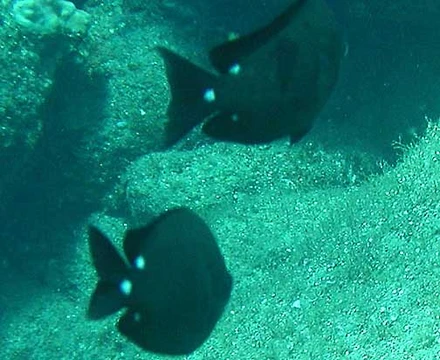
Threespot chromis (Chromis verater)
Source-cited species reference: taxonomy from WoRMS, biology from FishBase, occurrence map from GBIF, conservation from IUCN Red List, description from Wikipedia.

Chromis verater, commonly known as threespot chromis, is a species of damselfish endemic to Hawaii. The species is planktivorous.
- Scientific name
- Chromis verater
- Authority
- Jordan & Metz, 1912
- Family
- Pomacentridae
- Order
- Ovalentaria incertae sedis
- Maximum length
- 16 cm
- Depth range
- 6–160 m
- Habitat zone
- reef-associated
- Iucn red list
- Least Concern
- Gbif occurrence records
- 1,190
Classification (WoRMS)
Full classification as recorded by WoRMS: Kingdom: Animalia · Phylum: Chordata · Class: Teleostei · Order: Ovalentaria incertae sedis · Family: Pomacentridae · Genus: Chromis.
Accepted name: Chromis verater · Authority: Jordan & Metz, 1912 · Taxonomic status: accepted · AphiaID: 273759.
Synonyms and superseded combinations recorded for this taxon: Chromis verator Jordan & Metz, 1912.
Source: World Register of Marine Species (WoRMS) — https://www.marinespecies.org/aphia.php?p=taxdetails&id=273759 (CC BY 4.0). Accessed 2026-09-23.
Biology and life history (FishBase)
Measured values published by FishBase for Chromis verater. Only fields the database actually holds for this species are shown; these are database values, not aquarium guidance.
Maximum length: 16 cm · Depth range: 6–160 m · Habitat zone: reef-associated · Body shape: short and / or deep · Vulnerability index: 11.6 of 100 · Fishery importance: commercial · Aquarium trade: commercial.
FishBase notes: Adults form large aggregations high above the bottom in rocky areas around caves and ledges (Ref. 7247). Benthopelagic (Ref. 58302). Collected from 183 m. Spawn from December to June (Ref. 7247). Oviparous, distinct pairing during breeding (Ref. 205). Eggs are demersal and adhere to the substrate (Ref. 205). Males guard and aerate the eggs (Ref. 205).
Source: FishBase species summary (SpecCode 7819) — https://www.fishbase.se/summary/Chromis-verater.html (CC BY-NC 3.0 — non-commercial use only). Accessed 2026-09-23.
Distribution and occurrence records (GBIF)
1,190 georeferenced occurrence records for Chromis verater are published through GBIF from 2 countries or marine areas. The map above plots 30 distinct locations from a sample of 1,190 records, omitting 8 inland records that carry an institution's coordinates rather than a collection site; it shows where the species has been observed and reported, not a modelled range.
Most records by country or area: United States of America (1,065); United States Minor Outlying Islands (125).
The full country table, WoRMS marine regions and the sampling notes are on this species' Distribution page.
Source: GBIF Occurrence Search (taxonKey 5212186) — https://www.gbif.org/occurrence/search?taxon_key=5212186&has_coordinate=true (records CC0 / CC BY); WoRMS distribution records (MarineRegions) — https://www.marinespecies.org/aphia.php?p=taxdetails&id=273759 (CC BY 4.0); Natural Earth 110m basemap — https://www.naturalearthdata.com/ (public domain). Accessed 2026-09-23.
Conservation status (IUCN Red List)
The IUCN Red List assesses Chromis verater Jordan & Metz, 1912 as Least Concern (code LC). No trend, population estimate or threat analysis is given here, because none is available from this source without the Red List API; follow the source link for the full assessment, including its date.
Source: IUCN Red List of Threatened Species (taxon 188422) — https://www.iucnredlist.org/species/188422/0; GBIF IUCN Red List category endpoint (taxonKey 5212186) — https://api.gbif.org/v1/species/5212186/iucnRedListCategory. Accessed 2026-09-23.
Description and natural history (Wikipedia)
The threespot chromis is usually dark gray or black with three white spots: one above, one below, and one on the bottom of the tail. Specifically, the three white spots are located on the rear base of the dorsal fin, the rear base of the anal fin, and at the mid-base of the caudal fin. This species is able to lighten or darken its spots which could also disappear. This species has a lower body condition and weight-at-length in mesophotic sites compared to shallow reef sites. However, at times it can turn almost entirely silver-gray. During spawning season, the male species tend to lighten their bodies while their fins are dark, resembling a pattern of Hawaiian Dascyllus.
You can see the threespot chromis at almost any beach on the island. These species tend to live in rocky bottom areas around caves with a depth between 20 and 500 feet but are usually seen at slightly over 100 feet. The species' behavior determines their habitat preference. To care for these fishes, they should be given wide-open swimming areas. The threespot chromis is locally common along ledges where they're exposed to the current where it feeds on zooplankton.
The threespot chromis can be displayed in a commercial aquarium. To care for these fishes, they should be given wide-open swimming areas. If in an aquarium, provide caves and ledges for shelter, this species probably prefers a low-lit aquarium.
Source: Wikipedia: Chromis verater — https://en.wikipedia.org/wiki/Chromis_verater (CC BY-SA 4.0). Accessed 2026-09-23.
Frequently Asked Questions
What is the Threespot chromis (Chromis verater)?
It is a small damselfish found exclusively in Hawaiian waters, first formally described by ichthyologists Jordan and Metz in 1912. The species belongs to the family Pomacentridae and is classified under the order Ovalentaria incertae sedis.
Where can I find the Threespot chromis in the wild?
This species is endemic to the Hawaiian archipelago, so you will not encounter it in any other ocean or reef system. It occupies a remarkably broad depth band, ranging from just 6 meters down to 160 meters.
What does the Threespot chromis eat?
It is a planktivore, meaning its diet is made up of tiny drifting organisms such as zooplankton and phytoplankton that it picks out of the surrounding water column.
How large does a Threespot chromis grow?
Adults reach a maximum total length of roughly 16 centimeters, placing it in the modest size range for a member of the damselfish family.
Why is the Threespot chromis notable to fish enthusiasts?
Its strict endemism to Hawaii makes it a living symbol of the region's unique marine biodiversity, and its ability to thrive across a 154-meter depth span is impressive for a species of its size.
Related in Threespot chromis
Links follow this subject's own source article.
Elsewhere in Threespot chromis
Spotted an error? Know more?
Reader corrections go straight into our review queue. Suggest an edit · How this site is sourced