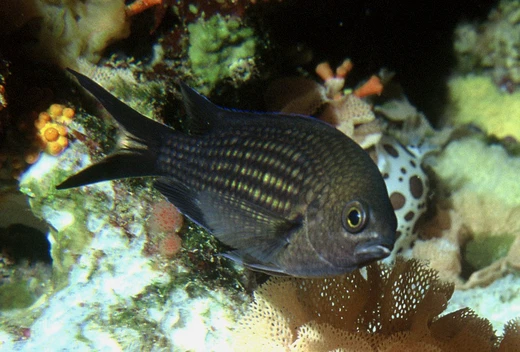
Black-axil chromis (Chromis atripectoralis)
Source-cited species reference: taxonomy from WoRMS, biology from FishBase, occurrence map from GBIF, conservation from IUCN Red List, description from Wikipedia.

The black-axil chromis (Chromis atripectoralis), also known as the blackfin chromis or blue-green puller, is a damselfish from the tropical Indo-Pacific. This fish can reach almost 12 cm in length. It inhabits lagoons and reefs after settlement in the late-larval stage, and often occurs in large numbers, feeding above Acropora corals. This fish mostly feeds upon copepods, amphipods, and zoea.
- Scientific name
- Chromis atripectoralis
- Authority
- Welander & Schultz, 1951
- Family
- Pomacentridae
- Order
- Ovalentaria incertae sedis
- Maximum length
- 12 cm
- Depth range
- 1–29 m
- Habitat zone
- reef-associated
- Iucn red list
- Least Concern
- Gbif occurrence records
- 5,491
Classification (WoRMS)
Full classification as recorded by WoRMS: Kingdom: Animalia · Phylum: Chordata · Class: Teleostei · Order: Ovalentaria incertae sedis · Family: Pomacentridae · Genus: Chromis.
Accepted name: Chromis atripectoralis · Authority: Welander & Schultz, 1951 · Taxonomic status: accepted · AphiaID: 212812.
Source: World Register of Marine Species (WoRMS) — https://www.marinespecies.org/aphia.php?p=taxdetails&id=212812 (CC BY 4.0). Accessed 2026-09-23.
Biology and life history (FishBase)
Measured values published by FishBase for Chromis atripectoralis. Only fields the database actually holds for this species are shown; these are database values, not aquarium guidance.
Maximum length: 12 cm · Depth range: 1–29 m · Habitat zone: reef-associated · Body shape: short and / or deep · Vulnerability index: 10 of 100 · Fishery importance: subsistence fisheries · Aquarium trade: commercial.
FishBase notes: Adults inhabit clear lagoons, passages, and seaward reef slopes, in thickets of live or dead coral. They occur in large aggregations feeding above staghorn Acropora corals (Ref. 9710). Stomach contents of individuals examined included mainly copepods, amphipods, and zoea. Diurnal species (Ref. 54980; 113699). Oviparous, distinct pairing during breeding (Ref. 205). Eggs are demersal and adhere to the substrate (Ref. 205). Males guard and aerate the eggs (Ref. 205).
Source: FishBase species summary (SpecCode 5450) — https://www.fishbase.se/summary/Chromis-atripectoralis.html (CC BY-NC 3.0 — non-commercial use only). Accessed 2026-09-23.
Distribution and occurrence records (GBIF)
5,491 georeferenced occurrence records for Chromis atripectoralis are published through GBIF from 44 countries or marine areas. The map above plots 284 distinct locations from a sample of 3,000 records, omitting 24 inland records that carry an institution's coordinates rather than a collection site; it shows where the species has been observed and reported, not a modelled range.
Most records by country or area: Australia (4,328); French Polynesia (220); Tonga (186); Fiji (160); Indonesia (128).
The full country table, WoRMS marine regions and the sampling notes are on this species' Distribution page.
Source: GBIF Occurrence Search (taxonKey 5212173) — https://www.gbif.org/occurrence/search?taxon_key=5212173&has_coordinate=true (records CC0 / CC BY); WoRMS distribution records (MarineRegions) — https://www.marinespecies.org/aphia.php?p=taxdetails&id=212812 (CC BY 4.0); Natural Earth 110m basemap — https://www.naturalearthdata.com/ (public domain). Accessed 2026-09-23.
Conservation status (IUCN Red List)
The IUCN Red List assesses Chromis atripectoralis Welander & Schultz, 1951 as Least Concern (code LC). No trend, population estimate or threat analysis is given here, because none is available from this source without the Red List API; follow the source link for the full assessment, including its date.
Source: IUCN Red List of Threatened Species (taxon 188544) — https://www.iucnredlist.org/species/188544/0; GBIF IUCN Red List category endpoint (taxonKey 5212173) — https://api.gbif.org/v1/species/5212173/iucnRedListCategory. Accessed 2026-09-23.
Description and natural history (Wikipedia)
This fish is often confused with its sibling species Chromis viridis.
C. atripectoralis is a blue-green damselfish that grows to a maximum length of twelve centimeters. The head and dorsal side of the fish is blue-green, while the belly is white to white-gray. C. atripectoralis has both an inner and an outer row of conical, widely spaced teeth.
C. atripectoralis is the sibling species of the blue-green damselfish C. viridis based on their mitochondrial genome. C. atripectoralis is often confused with C. viridis because the two species have a similar body shape and blue-green coloration. The two species can be differentiated by the color pattern of their fins. The pectoral fin axil of C. atripectoralis is black, whereas the upper base of the pectoral fin of C. viridis appears dusky due to the presence of black dots. Additionally, the two sibling species have different, but overlapping, numbers of pectoral rays. C. atripectoralis has 18-20 pectoral rays, while C. viridis has 17-19.
The range of C. atripectoralis spans the Indian and south Pacific Oceans from the east African coasts to French Polynesia, and the damselfish can also be found as far north as the Ryukyu Islands of Japan in the north Pacific. The habitat of C. atripectoralis overlaps with that of its sibling species C. viridis, although C. viridis can additionally be found in the Red Sea.
C. atripectoralis resides in coral reefs. As adults, C. atripectoralis shows a preference for branching corals, although the species can also be found in plate, sub massive, massive, encrusting, soft, and dead corals. Juveniles exhibit a preference for living in both branching and plate corals, although they have been found in sub massive corals as well. Adults may live in rubble or pavement as well, while juveniles have only been found to live in consolidated pavement. Loss of the coral reef niche is correlated with a decline in C. atripectoralis populations, as this species is highly specialized to live in reefs.
C. atripectoralis can tolerate higher water temperatures relative to cardinalfish that occupy the same habitat. C. atripectoralis does exhibit a reduction in aerobic scope across the high water temperature range of 29 °C to 33 °C; however the fish can still aerobically respire at a rate greater than half of its aerobic scope under normal conditions. The relatively high thermotolerance of C. atripectoralis may allow it to live at latitudes closer to the equator and to resist extinction as global ocean temperatures rise.
Larval behavior and settlement to coral reefs
C. atripectoralis is an oviparous species whose eggs are laid into the water to hatch at a later time. The late-stage larvae of C. atripectoralis reside in the pelagic zone and exhibit a swimming speed range of 21.6 to 25.2 centimeters per second. The late-stage larvae exhibit directionality in their swimming, although there is more variation in directionality in leeward trajectories than in windward trajectories. Additionally, the late-stage larvae of C. atripectoralis exhibit greater variation in their swimming directionality during afternoons with cloudy conditions than in sunny conditions. This suggests that the larvae may use a solar compass to guide their movements. The overall swimming directionality of late-stage C. atripectoralis appears to be southeast in the morning and south-southwest in the afternoon, regardless of where the nearest shore is located. The east-west component of C. atripectoralis larval swimming observed indicates that the larvae move actively rather than floating passively with the current, as the larvae were studied in an area with a north-south current.
C. atripectoralis larva can differentiate biological sounds coming from coral reefs from other, non-biological sounds and alter their behavior in response to the biological sounds. There is currently no evidence that C. atripectoralis larva can localize the source of biological sounds, but it is possible that the larvae's ability to identify nocturnal reef noises may function in combination with other methods, such as a solar compass, to facilitate their success in settling to a coral reef.
Source: Wikipedia: Chromis atripectoralis — https://en.wikipedia.org/wiki/Chromis_atripectoralis (CC BY-SA 4.0). Accessed 2026-09-23.
Frequently Asked Questions
What is the Black-axil chromis (Chromis atripectoralis)?
It is a small damselfish native to tropical waters across the Indo-Pacific region. The species, first described by Welander and Schultz in 1951, belongs to the family Pomacentridae and is also commonly called the blackfin chromis or blue-green puller.
How big does a Black-axil chromis get and how deep can it be found?
Adults can grow to nearly 12 cm in total length. They are typically encountered between 1 and 29 meters depth in lagoon and reef environments.
Where does the Black-axil chromis live and how does it behave in groups?
After completing its larval stage, the fish settles into lagoon and reef habitats where it is frequently seen in very large aggregations. It tends to hover and feed above Acropora coral colonies rather than hiding among them.
What does a Black-axil chromis eat?
Its diet is dominated by tiny crustaceans, specifically copepods, amphipods, and zoea (the early larval stage of crabs and lobsters). These small invertebrates make up the bulk of what it consumes in its reef habitat.
Why do fans and reef enthusiasts care about the Black-axil chromis?
Its habit of forming dense, visible schools above Acropora reefs makes it a striking sight for divers and a useful indicator of healthy coral-lagoon ecosystems. It also serves as a well-documented example of the damselfish family's diversity in Indo-Pacific reef communities.
Related in Black-axil chromis
Links follow this subject's own source article.
Elsewhere in Black-axil chromis
Spotted an error? Know more?
Reader corrections go straight into our review queue. Suggest an edit · How this site is sourced