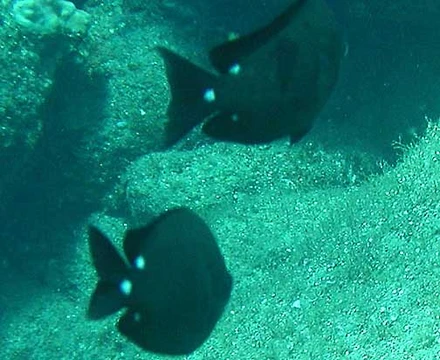
Where Threespot chromis has been recorded
GBIF occurrence records for Chromis verater, mapped and tabulated by country.

1,190 georeferenced occurrence records with coordinates are published for Chromis verater through GBIF, from 2 countries or marine areas. This page maps those records and lists where they come from. Occurrence records reflect where people have looked as well as where the species lives, so well-surveyed coastlines are over-represented.
- Georeferenced records
- 1,190
- Countries / areas
- 2
- Mapped locations
- 30
- Records sampled for the map
- 1,190
- Inland records omitted
- 8
- Gbif taxonkey
- 5212186
Geographic Setting and Range
The Threespot chromis has been documented within the waters of the Persian Gulf, a body of water that serves as a penetration of the Indian Ocean. This semi-enclosed sea is bordered by a remarkable collection of nations: Kuwait, Iran, Iraq, Qatar, Saudi Arabia, the United Arab Emirates, and an exclave belonging to the sultanate of Oman. The presence of this damselfish species across such a geographically and politically diverse coastline underscores the breadth of the region's marine biodiversity. The Persian Gulf's unique position as a narrow extension of the larger Indian Ocean creates a distinct aquatic environment where species like the Threespot chromis establish themselves. Recording this fish from these particular waters places it within a well-studied but ecologically significant marine community that spans multiple national jurisdictions. The documentation of its occurrence here contributes to our understanding of how damselfish species distribute themselves across the coastal and territorial waters of this strategically important gulf.
Taxonomic Placement and Classification
Within the comprehensive catalog of Persian Gulf fish species, the Threespot chromis is situated among the damselfish group, a category that the reference list groups under a heading that tentatively associates it with blenniform lineages. The entire list follows a phylogenetic ordering, meaning species are arranged according to their evolutionary relationships rather than alphabetical or arbitrary sequences. Taxonomic assignments in this record aim to comply with the current nomenclature as maintained by FishBase, the widely referenced online database of fish species. Where earlier classifications have become outdated due to taxonomic splits, reclassifications, or synonymy updates, the list reflects these corrections. This careful attention to modern taxonomy ensures that the Threespot chromis is placed accurately within the broader ray-finned fish framework, alongside other groups ranging from eels and herrings to wrasses, parrotfishes, and perchlike species. The phylogenetic structure of the list provides context for understanding how this particular damselfish relates to the dozens of other fish families documented in these waters.
Scientific Documentation and Research Heritage
The recording of the Threespot chromis in Persian Gulf waters is part of a long and layered scientific tradition documenting the region's marine life. The foundational reference for this list draws heavily on the IUCN Red List of Threatened Species, while also incorporating data from FishBase's species records for the Persian Gulf. The research lineage stretches back to 1948, when Bolster published his work on edible fish in the Persian and Oman Gulfs through the U.S. Fish and Wildlife Service. More recent contributions include Assadi's 1997 atlas of Persian Gulf and Sea of Oman fishes, and the 2019 annotated checklist by Eagderi, Fricke, Esmaeili, and Jalili, which specifically addresses diversity and conservation status. Amani Al-Zaidan's work on Kuwait's common commercial species caught in coastal territorial waters adds a regional fisheries perspective. Khalil Ibrahim Abdullah Hussein's compilation of Kuwait fish further enriches the local knowledge base. Together, these sources span nearly eight decades of ichthyological inquiry into these waters.
Conservation Context and Human Interaction
The inclusion of the Threespot chromis in the Persian Gulf fish record is not merely a taxonomic exercise; it carries implications for conservation and human interaction with marine ecosystems. The list explicitly notes each species' relationship with humans where relevant, and the overarching framework is informed by the IUCN Red List of Threatened Species, a global authority on conservation status. The 2019 annotated checklist by Eagderi and colleagues specifically addresses conservation status alongside diversity, signaling that the presence of species like this damselfish in the gulf is monitored within a broader conservation lens. The Persian Gulf's proximity to densely populated coastal nations—Kuwait, Iran, Iraq, Qatar, Saudi Arabia, the UAE, and Oman's exclave—means that human activities in these waters directly shape the conditions under which species like the Threespot chromis persist. The documentation of its occurrence here, alongside locally used common names, bridges scientific classification with the practical knowledge of communities who have interacted with these fish for generations.
Frequently Asked Questions
How many georeferenced records does Where Threespot chromis has been recorded include?
The page compiles 1,190 coordinate-tagged occurrence records for Chromis verater, and all of them were sampled when generating the visual map.
What countries or marine areas does Where Threespot chromis has been recorded span?
Records for this species come from just two countries or marine areas, reflecting its relatively narrow known range.
Why does Where Threespot chromis has been recorded show only 30 mapped locations instead of 1,190 dots?
The 1,190 individual records cluster around 30 distinct geographic points, so the map displays those 30 locations rather than plotting every single observation separately.
Where does Where Threespot chromis has been recorded source its data from?
Every record on the page is pulled from the GBIF (Global Biodiversity Information Facility) database, specifically under taxon key 5212186 for Chromis verater.
Why are 8 records excluded from Where Threespot chromis has been recorded's map?
Those eight entries were dropped because their coordinates placed them inland, which is biologically implausible for a reef-dwelling fish and most likely reflects a data-entry or geocoding error.
Related in Threespot chromis
Links follow this subject's own source article.
Elsewhere in Threespot chromis
Spotted an error? Know more?
Reader corrections go straight into our review queue. Suggest an edit · How this site is sourced