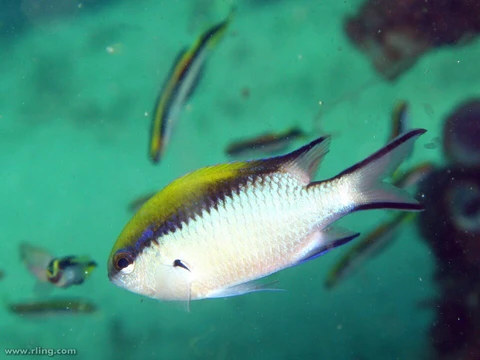
Barrier reef chromis (Chromis nitida)
Source-cited species reference: taxonomy from WoRMS, biology from FishBase, occurrence map from GBIF, conservation from IUCN Red List, description from Wikipedia.

The Barrier Reef chromis (Chromis nitida), also known as the yellowback puller or shining puller, is a species of damselfish in the family Pomacentridae native to the east coast of Australia. It is a small fish with a yellowish-brown dorsal surface separated by a dark stripe from its silvery flanks and underside.
- Scientific name
- Chromis nitida
- Authority
- (Whitley, 1928)
- Family
- Pomacentridae
- Order
- Ovalentaria incertae sedis
- Maximum length
- 8.899999618530273 cm
- Depth range
- 2–40 m
- Habitat zone
- reef-associated
- Iucn red list
- Least Concern
- Gbif occurrence records
- 1,881
Classification (WoRMS)
Full classification as recorded by WoRMS: Kingdom: Animalia · Phylum: Chordata · Class: Teleostei · Order: Ovalentaria incertae sedis · Family: Pomacentridae · Genus: Chromis.
Accepted name: Chromis nitida · Authority: (Whitley, 1928) · Taxonomic status: accepted · AphiaID: 273744.
Synonyms and superseded combinations recorded for this taxon: Tetradrachmum nitidum Whitley, 1928.
Source: World Register of Marine Species (WoRMS) — https://www.marinespecies.org/aphia.php?p=taxdetails&id=273744 (CC BY 4.0). Accessed 2026-09-23.
Biology and life history (FishBase)
Measured values published by FishBase for Chromis nitida. Only fields the database actually holds for this species are shown; these are database values, not aquarium guidance.
Maximum length: 8.899999618530273 cm · Depth range: 2–40 m · Habitat zone: reef-associated · Body shape: fusiform / normal · Vulnerability index: 10 of 100.
FishBase notes: Adults occur in small to large midwater aggregations on the outer edge of certain reefs in rich coralliferous areas in 5 to 25 meters. Juveniles and occasionally adults sometimes occur in lagoons (Ref. 7247). Oviparous, distinct pairing during breeding (Ref. 205). Eggs are demersal and adhere to the substrate (Ref. 205). Males guard and aerate the eggs (Ref. 205). Diurnal species (Ref. 54980; 113699).
Source: FishBase species summary (SpecCode 9225) — https://www.fishbase.se/summary/Chromis-nitida.html (CC BY-NC 3.0 — non-commercial use only). Accessed 2026-09-23.
Distribution and occurrence records (GBIF)
1,881 georeferenced occurrence records for Chromis nitida are published through GBIF from 4 countries or marine areas. The map above plots 70 distinct locations from a sample of 1,881 records, omitting 10 inland records that carry an institution's coordinates rather than a collection site; it shows where the species has been observed and reported, not a modelled range.
Most records by country or area: Australia (1,878); New Caledonia (1); Philippines (1); Solomon Islands (1).
The full country table, WoRMS marine regions and the sampling notes are on this species' Distribution page.
Source: GBIF Occurrence Search (taxonKey 5212150) — https://www.gbif.org/occurrence/search?taxon_key=5212150&has_coordinate=true (records CC0 / CC BY); WoRMS distribution records (MarineRegions) — https://www.marinespecies.org/aphia.php?p=taxdetails&id=273744 (CC BY 4.0); Natural Earth 110m basemap — https://www.naturalearthdata.com/ (public domain). Accessed 2026-09-23.
Conservation status (IUCN Red List)
The IUCN Red List assesses Chromis nitida (Whitley, 1928) as Least Concern (code LC). No trend, population estimate or threat analysis is given here, because none is available from this source without the Red List API; follow the source link for the full assessment, including its date.
Source: IUCN Red List of Threatened Species (taxon 188355) — https://www.iucnredlist.org/species/188355/0; GBIF IUCN Red List category endpoint (taxonKey 5212150) — https://api.gbif.org/v1/species/5212150/iucnRedListCategory. Accessed 2026-09-23.
Description and natural history (Wikipedia)
The yellowback puller grows to a maximum length of about 9 cm. The single dorsal fin has thirteen spines and eleven to thirteen soft rays and the anal fin has two spines and ten or eleven soft rays. This fish has a dark diagonal line running from the eye to the posterior end of the dorsal fin. Above this line it is yellowish-brown and below it is silvery. The upper and lower edges of the deeply forked tail fin are black.
The yellowback puller is native to the subtropical east coast of Australia. Its range extends from northern Queensland to southern New South Wales and includes Lord Howe Island. It is found at depths between 5 and 25 m on the outer side of coral-rich rocky reefs and in estuaries. Young fish sometimes inhabit lagoons, as do some adults.
The yellowback puller is a shoaling species and often found in association with the black-axil chromis (Chromis atripectoralis). It feeds on algae, zooplankton and small invertebrates. It forms pairs in the breeding season. The eggs are adhesive and stick to the seabed where the male guards them and keeps them aerated.
The yellowback puller is sometimes parasitised by the isopod crustacean Anilocra pomacentri. The size of the parasite and the fish seems to be correlated indicating that the manca (juvenile isopod) attaches at an early stage in the life of the fish and that both grow simultaneously.
The yellowback puller is suitable to be kept in a reef aquarium where it can be fed on brine shrimps and mysid shrimps. Being a shoaling fish, it should be kept in a small group, and being non-aggressive, it mixes well with other species of fish.
Source: Wikipedia: Chromis nitida — https://en.wikipedia.org/wiki/Chromis_nitida (CC BY-SA 4.0). Accessed 2026-09-23.
Frequently Asked Questions
What is the Barrier reef chromis (Chromis nitida)?
It is a small damselfish native to Australia's eastern coastline, also called the yellowback puller or shining puller. The species was formally described by Whitley in 1928 and belongs to the family Pomacentridae.
What does a Barrier reef chromis look like?
Its upper body is a warm yellowish-brown, set off from the silvery flanks and belly by a bold dark lateral stripe. The overall shape is compact and typical of small reef-dwelling damselfish.
Where does the Barrier reef chromis live in the wild?
This fish is restricted to the east coast of Australia, where it can be encountered from shallow water around 2 metres down to roughly 40 metres depth. It is a permanent resident of that region's reef habitats rather than a wide-ranging open-water species.
How big does a Barrier reef chromis get?
It tops out at approximately 8.9 centimetres in total length, placing it firmly in the small-fish category among Pomacentridae. Most individuals you'd encounter on a dive would be well under that maximum.
What is the full taxonomic placement of Chromis nitida?
It sits in the family Pomacentridae within the order Ovalentaria incertae sedis, with the species authority attributed to Whitley, 1928. The 'incertae sedis' designation on the order reflects that its exact ordinal position has not been firmly resolved in modern classification.
Related in Barrier reef chromis
Links follow this subject's own source article.
Elsewhere in Barrier reef chromis
Spotted an error? Know more?
Reader corrections go straight into our review queue. Suggest an edit · How this site is sourced