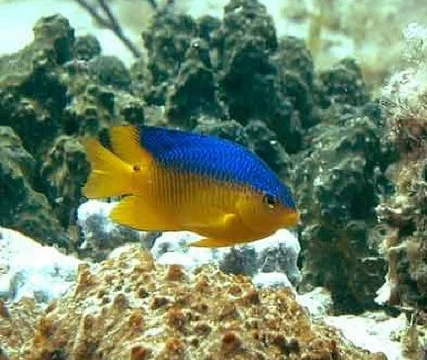
Damselfish (Chromis chromis)
Source-cited species reference: taxonomy from WoRMS, biology from FishBase, occurrence map from GBIF, conservation from IUCN Red List, description from Wikipedia.

Chromis chromis, the damselfish or Mediterranean chromis, is a small species of ray-finned fish of the family Pomacentridae from the Eastern Atlantic and Mediterranean.
- Scientific name
- Chromis chromis
- Authority
- (Linnaeus, 1758)
- Family
- Pomacentridae
- Order
- Ovalentaria incertae sedis
- Maximum length
- 25 cm
- Depth range
- 2–40 m
- Habitat zone
- reef-associated
- Iucn red list
- Least Concern
- Gbif occurrence records
- 19,288
Classification (WoRMS)
Full classification as recorded by WoRMS: Kingdom: Animalia · Phylum: Chordata · Class: Teleostei · Order: Ovalentaria incertae sedis · Family: Pomacentridae · Genus: Chromis.
Accepted name: Chromis chromis · Authority: (Linnaeus, 1758) · Taxonomic status: accepted · AphiaID: 127000.
Synonyms and superseded combinations recorded for this taxon: Chromis castanea Cuvier, 1814; Chromis mediteranea Cloquet, 1817; Heliastes castanea (Cuvier, 1814); Heliastes chromis (Linnaeus, 1758); Sparus chromis Linnaeus, 1758.
Source: World Register of Marine Species (WoRMS) — https://www.marinespecies.org/aphia.php?p=taxdetails&id=127000 (CC BY 4.0). Accessed 2026-09-23.
Biology and life history (FishBase)
Measured values published by FishBase for Chromis chromis. Only fields the database actually holds for this species are shown; these are database values, not aquarium guidance.
Maximum length: 25 cm · Common length: 13 cm · Depth range: 2–40 m · Habitat zone: reef-associated · Body shape: fusiform / normal · Vulnerability index: 35.5 of 100 · Fishery importance: minor commercial · Aquarium trade: never/rarely.
FishBase notes: Adults form small shoals in midwater above or near rocky reefs or above seagrass meadows ( Posidonia . They feed on small planktonic or benthic animals (Ref. 6760). Reproduce in summer (Ref. 6760). Eggs characterized by adhesive filaments are nested on rocky or sandy bottoms (Ref. 6760). Males guard the eggs (Ref. 6760).
Source: FishBase species summary (SpecCode 1706) — https://www.fishbase.se/summary/Chromis-chromis.html (CC BY-NC 3.0 — non-commercial use only). Accessed 2026-09-23.
Distribution and occurrence records (GBIF)
19,288 georeferenced occurrence records for Chromis chromis are published through GBIF from 41 countries or marine areas. The map above plots 131 distinct locations from a sample of 3,000 records, omitting 113 inland records that carry an institution's coordinates rather than a collection site; it shows where the species has been observed and reported, not a modelled range.
Most records by country or area: France (9,624); Spain (4,519); Greece (2,061); Croatia (875); Italy (808).
The full country table, WoRMS marine regions and the sampling notes are on this species' Distribution page.
Source: GBIF Occurrence Search (taxonKey 5212224) — https://www.gbif.org/occurrence/search?taxon_key=5212224&has_coordinate=true (records CC0 / CC BY); WoRMS distribution records (MarineRegions) — https://www.marinespecies.org/aphia.php?p=taxdetails&id=127000 (CC BY 4.0); Natural Earth 110m basemap — https://www.naturalearthdata.com/ (public domain). Accessed 2026-09-23.
Conservation status (IUCN Red List)
The IUCN Red List assesses Chromis chromis (Linnaeus, 1758) as Least Concern (code LC). No trend, population estimate or threat analysis is given here, because none is available from this source without the Red List API; follow the source link for the full assessment, including its date.
Source: IUCN Red List of Threatened Species (taxon 188324) — https://www.iucnredlist.org/species/188324/0; GBIF IUCN Red List category endpoint (taxonKey 5212224) — https://api.gbif.org/v1/species/5212224/iucnRedListCategory. Accessed 2026-09-23.
Description and natural history (Wikipedia)
Chromis chromis has an oval and laterally compressed body with an noticeably large eye. Its mouth is strongly protractile, reaching to below the centre of the eye, with small canine-like teeth set in 3 rows on the jaws. The preoperculum is not serrated and the anterior gill arch has 30 slender gill rakers. There are 13–14 spines and 10–11 soft rays in the dorsal fin and in the anal fin has 11 spines and 10–12 soft rays. Its body is covered in large scales, including the head, and there are 24–30 scales along the lateral line. The youngest fish are a brilliant iridescent blue in colour; older juveniles have blue stripes with the dorsal and anal fins outlined in blue while the adults are dark brown with the centres of each scale a paler golden brown or grey-brow and with the edge of the caudal fin lacking any colour, especially in the centre of the fork. The males become a vivid pale violet. There is a single pair of nostrils.
It can grow up to a size of 25 cm in length, with a common length of 13 cm.
Chromis chromis occurs in the Black Sea, Mediterranean Sea and eastern Atlantic, from Portugal to Angola including the Macaronesian Islands and the Gulf of Guinea Islands, appearing to be commoner off islands than off the mainland. It is uncommon in the Black Sea and Sea of Marmara.
C. chromis inhabits littoral, mainly in rocky areas from 2 to 40 m in depth, in small shoals in midwater above or near rocky reefs and above sea-grass meadows.
It feeds on small zooplankton and benthic algae. Its main food components are copepods, appendicularia, cladocera, gastropod larvae, bivalve larvae, fish eggs and fish larvae.
C. chromis feeding patterns are altered when schools are confronted with an increase in top water activity, resultantly, the species obtained a behavioral response referred to as polarizing. Polarization occurs when the species dives to deeper depths, leaving their food behind, as a mechanism to avoid confrontation.
Spawning depends on location, but it occurs during summer. The male and females pair up and engage in courtship behaviour and the eggs are laid in a nest which is created on rocky, sometimes sandy bottoms. The eggs adhere to the substrate and are guarded by the male. The female can lay between 6,050 and 73,688 eggs.
Due to small size Chromis chromis has minor role in commercial fishing. As a game fish, it is often caught during the day on light tackle. Small hooks are baited with bread, pasta, small chunks of fish, mussels, worms, small prawns etc. It can be caught in fish traps and nets. Due to small size, it is rarely caught with a speargun. It is also used as a baitfish for larger species which predate on damselfish schools such as conger eel Conger conger and common dentex Dentex dentex.
Source: Wikipedia: Chromis chromis — https://en.wikipedia.org/wiki/Chromis_chromis (CC BY-SA 4.0). Accessed 2026-09-23.
Frequently Asked Questions
Who is Damselfish (Chromis chromis)?
Chromis chromis is a small ray-finned fish in the family Pomacentridae, first formally described by Linnaeus back in 1758. It is commonly called the Mediterranean chromis or simply the damselfish and is native to the Eastern Atlantic and Mediterranean Sea.
What are Damselfish (Chromis chromis)'s powers/role?
In its natural habitat, this species acts as an algae grazer and a prey item for larger predators, helping keep coastal ecosystems in balance. It can reach a maximum length of about 25 cm and typically occupies depths between 2 and 40 meters.
Why is Damselfish (Chromis chromis) important?
It occupies a key mid-trophic position in Eastern Atlantic and Mediterranean food webs, transferring energy from primary producers like algae up to larger fish and marine mammals. It also serves as a convenient study subject for researchers examining reef ecology, schooling behavior, and population dynamics in the region.
Where can I find Damselfish (Chromis chromis)?
Look for it along rocky shores, seagrass beds, and coral reefs throughout the Mediterranean and the adjacent Eastern Atlantic, generally at depths of 2 to 40 meters. Its broad distribution is well documented in global occurrence databases such as GBIF.
Related in Damselfish
Links follow this subject's own source article.
Elsewhere in Damselfish
Spotted an error? Know more?
Reader corrections go straight into our review queue. Suggest an edit · How this site is sourced