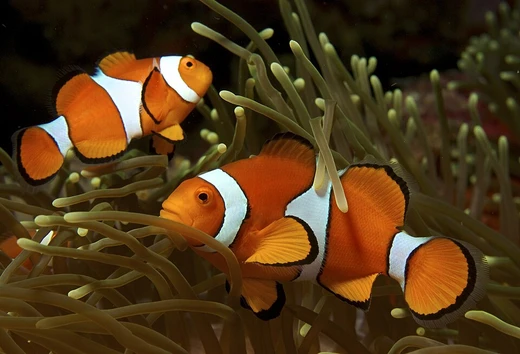
Wide-band Anemonefish (Amphiprion latezonatus)
Source-cited species reference: taxonomy from WoRMS, biology from FishBase, occurrence map from GBIF, conservation from IUCN Red List, description from Wikipedia.

Amphiprion latezonatus, also known as the wide-band anemonefish, is a species of anemonefish found in subtropical waters off the east coast of Australia. Like all anemonefishes, it forms a symbiotic mutualism with sea anemones and is unaffected by the stinging tentacles of its host. It is a sequential hermaphrodite with a strict size-based dominance hierarchy; the female is largest, the breeding male is second largest, and the male nonbreeders get progressively smaller as the hierarchy descends. They exhibit protandry, meaning the breeding male changes to female if the sole breeding female dies, with the largest nonbreeder becoming the breeding male.
- Scientific name
- Amphiprion latezonatus
- Authority
- Waite, 1900
- Family
- Pomacentridae
- Order
- Ovalentaria incertae sedis
- Maximum length
- 14 cm
- Depth range
- 10–45 m
- Habitat zone
- reef-associated
- Iucn red list
- Data Deficient
- Gbif occurrence records
- 314
Taxonomic Identity & Phylogenetic Position
The wide-band anemonefish (Amphiprion latezonatus) holds a distinctive place within the clownfish lineage. It belongs to the genus Amphiprion, a name coined in 1801 by Marcus Elieser Bloch and Johann Gottlob Theaenus Schneider, drawn from Greek roots meaning "on both sides" and "saw." The genus was originally anchored to the red saddleback anemonefish as its type species. Within the broader damselfish family Pomacentridae, the clownfish lineage split from other living damselfishes roughly 35 million years ago during the late Eocene. A 2014 genetic study identified the wide-band anemonefish as a single-species clade, setting it apart from larger multi-species complexes such as percula, akallopisos, or ephippium. The entire clownfish lineage traces its origin to the waters of the Malay Archipelago, with species diversification accelerating around 5 million years ago through two major adaptive radiations. The wide-band anemonefish's solitary clade status marks a unique evolutionary trajectory within this ancient and diverse group of Indo-Pacific reef dwellers.
Symbiotic Partnership & Social Dynamics
Like all members of its genus, the wide-band anemonefish is bound to sea anemones in a mutually beneficial partnership. The anemone offers shelter and a shield against predators, while the fish defends its host from anemone-eating species, cleans and fans the tentacles, and lures in beneficial microorganisms through its waste. Socially, these fish organise into structured groups governed by a size-based dominance hierarchy: the breeding female sits at the apex, followed by the breeding male, then non-breeding individuals in descending order. A remarkable aspect of this system is sex reversal; should the female vanish, the breeding male transforms into a female and assumes her role, while the remaining members shift upward in rank. Reproduction sees the female depositing eggs on a rock near the anemone, with the male fertilising them. Once hatched, larvae scatter into the open ocean before eventually settling on the seafloor and searching for a new anemone host as juveniles.
Physical Design & Sensory World
The wide-band anemonefish shares the characteristic body plan of the Amphiprion genus: an oval to streamlined form with a rounded head that lacks scales between the snout and eyes. Its most defining morphological trait is the saw-shaped edges running along the operculum and beneath the eyes, the very feature that gives the genus its name. The dorsal fin carries 10 spines followed by 14 to 20 soft rays, while pectoral fins bear 15 to 21 rays. Colouration follows the classic clownfish palette of a red, orange, yellow, brown, or black background crossed by zero to three white vertical bars edged in black. Sensory capabilities are notably sophisticated: the fish possess partial binocular vision, can perceive both colour and ultraviolet light through small gaps between iris and lens, and harbour a unique fork-like olfactory organ with extra lamellae found in no other fish. Their hearing is tuned to relatively low frequencies between 75 and 900 Hz.
Conservation Pressures & Cultural Footprint
The wide-band anemonefish, like its clownfish relatives, has become a recognisable symbol of marine life in popular culture, most notably through the Disney/Pixar film Finding Nemo (2003), which cemented the image of anemonefish in global consciousness. This cultural visibility has fuelled demand in the aquarium trade, where many specimens were historically collected from the wild, contributing to population declines. The fish's striking colour patterns and social behaviour make it particularly appealing to hobbyists. Conservation efforts have shown promise: clownfish populations are more numerous in marine protected areas where collecting is prohibited. Broader threats include global warming, which drives ocean warming and acidification, further stressing reef ecosystems. As a single-species clade, the wide-band anemonefish occupies a distinct evolutionary position within a lineage that has diversified across the Indo-Pacific for tens of millions of years, and its continued survival depends on safeguarding the coral reef habitats and anemone hosts upon which its entire life cycle relies.
Frequently Asked Questions
What is the Wide-band Anemonefish (Amphiprion latezonatus)?
It is a small reef fish in the damselfish family (Pomacentridae) that inhabits subtropical waters along Australia's eastern seaboard. First described by Waite in 1900, it grows to roughly 14 cm and is best known for living among sea anemones.
Where does the Wide-band Anemonefish live?
This species is restricted to subtropical coastal waters off eastern Australia, where it is typically found on reefs at depths between 10 and 45 metres. It is not found in tropical or western Australian waters.
How does the Wide-band Anemonefish reproduce?
Every individual begins life as a male, and the group follows a rigid size-based dominance order in which the largest member is the breeding female and the second-largest is the breeding male. If the breeding female dies, the breeding male will change sex to take her place, a process called protandrous sex change.
What is the Wide-band Anemonefish's relationship with sea anemones?
It forms a mutualistic partnership with its host anemone: the fish gains shelter from predators by living among the tentacles, while the anemone benefits from the fish's cleaning and nutrient contributions. The anemonefish is immune to the stinging cells that would harm most other marine animals.
How big does the Wide-band Anemonefish get, and how deep can you find it?
Adults top out at about 14 cm in total length. They are most commonly encountered on reef habitats between 10 and 45 metres depth along the Australian east coast.
Spotted an error? Know more?
Reader corrections go straight into our review queue. Suggest an edit · How this site is sourced