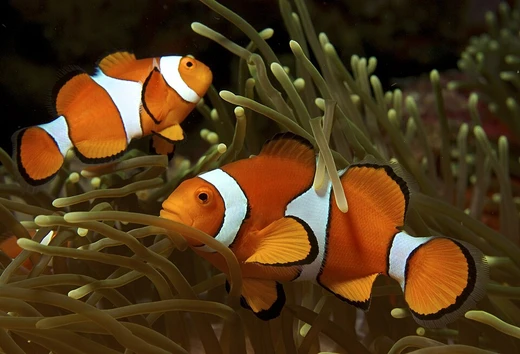
Skunk clownfish (Amphiprion akallopisos)
Source-cited species reference: taxonomy from WoRMS, biology from FishBase, occurrence map from GBIF, conservation from IUCN Red List, description from Wikipedia.

The nosestripe clownfish or nosestripe anemonefish, skunk clownfish, Amphiprion akallopisos, is an anemonefish (also called clownfish) that lives in association with sea anemones. A. akallopisos is found in the Indian Ocean. It resides in shallow inshore reefs as deep as 15 m with a moderate to strong current. The skunk clownfish can also be kept in captivity by aquarists.
- Scientific name
- Amphiprion akallopisos
- Authority
- Bleeker, 1853
- Family
- Pomacentridae
- Order
- Ovalentaria incertae sedis
- Maximum length
- 11 cm
- Depth range
- 3–25 m
- Habitat zone
- reef-associated
- Iucn red list
- Least Concern
- Gbif occurrence records
- 569
Taxonomic Standing & the Akallopisos Clade
The Skunk clownfish belongs to the genus Amphiprion, a group of damselfishes within the family Pomacentridae. The genus name itself carries a visual clue — derived from Greek roots meaning 'on both sides' and 'saw' — referencing the saw-shaped edges along the gill cover and beneath the eyes that all members share. When ichthyologist Gerald R. Allen catalogued clownfish morphology in 1972, he identified five principal clades or complexes, and the akallopisos group stood as one of them, distinct from the percula, ephippium, polymnus, and clarkii assemblages. The broader genus was formally named in 1801 by Bloch and Schneider, who used the red saddleback anemonefish as the type species. Over two centuries of taxonomic debate have shaped how these fish are grouped: Georges Cuvier once split the maroon clownfish into a separate genus, Premnas, a designation that swung between synonymy and independent status before 2021 phylogenetic work confirmed it belongs within Amphiprion. The Skunk clownfish, as a member of the akallopisos clade, sits within this long-contested but ultimately unified lineage.
Life in the Anemone
The Skunk clownfish, like all members of its genus, is bound to a sea anemone in a relationship that benefits both partners. The fish finds shelter and protection from predators within the anemone's stinging tentacles, while in return it wards off anemone-eating species, fans the host with its fins, and cleans it. Its metabolic waste even attracts beneficial microorganisms to the anemone. This partnership shapes every stage of the Skunk clownfish's life: the breeding female lays her eggs on a rock positioned near the anemone, the male fertilises them, and once the larvae hatch they drift out into the open ocean. As juveniles they eventually settle onto the seafloor and must locate a suitable anemone host to begin their adult existence. The fish is omnivorous, drawing most of its nutrition from plankton, and it inhabits the warm, tropical coral reefs of the Indo-Pacific where anemones thrive. The entire social group — breeding pair plus non-breeding juveniles — revolves around this single anemone, making the host organism the anchor of the Skunk clownfish's world.
Hierarchy, Sex, and the Breeding Cycle
Within a Skunk clownfish group, a strict size-based dominance order governs social interactions. The breeding female sits at the apex, followed by the breeding male, then the largest non-breeding individual, and so on down the line. Females are consistently larger than males, and the smallest members of a group may measure only six to fifteen millimetres. The system has a remarkable flexibility: should the breeding female vanish, the breeding male undergoes a sex change to assume her role, and every other individual shifts upward in the hierarchy. Reproduction is a coordinated act performed near the anemone — the female deposits a clutch of eggs on a nearby rock surface, and the male follows to fertilise them. This reproductive strategy, combined with the larval dispersal phase in which hatchlings drift in the open ocean before settling as juveniles, ensures genetic mixing across reef systems. The Skunk clownfish's social architecture thus blends rigid rank with the potential for dramatic individual transformation, a duality that keeps the group stable yet adaptable.
Deep Roots and Modern Pressures
The clownfish lineage split from other living damselfishes roughly thirty-five million years ago in the late Eocene, and the most recent common ancestor of all extant species dates to about ten and a half million years ago in the Early Miocene. A 2014 study traced the origin of the group to the waters surrounding the Malay Archipelago. Beginning around five million years ago, diversification accelerated through two major adaptive radiations — one centred on the Malay Archipelago and a later one in the western Indian Ocean. Speciation in the genus is closely tied to the particular sea anemone species each clownfish associates with, since different anemones occupy different habitats and thereby drive ecological separation. Genetic evidence also reveals substantial interbreeding among species throughout their evolutionary history. Today, the Skunk clownfish and its relatives face mounting pressures: wild collection for the aquarium trade has reduced populations, while global warming drives ocean heating and acidification. Marine protected areas, where harvesting is prohibited, harbour noticeably higher clownfish numbers, underscoring the value of legal safeguards.
Frequently Asked Questions
What is the Skunk clownfish (Amphiprion akallopisos)?
The Skunk clownfish is a small anemonefish species native to the Indian Ocean, recognized by its striking black-and-white coloration. It lives in a symbiotic relationship with sea anemones, using them for protection from predators.
Where does the Skunk clownfish live in the wild?
It inhabits shallow inshore reefs in the Indian Ocean, typically between 3 and 25 meters depth. The species prefers areas with moderate to strong water currents around its host anemones.
How big does a Skunk clownfish get?
Adults reach a maximum length of roughly 11 centimeters, making it one of the smaller members of the Amphiprion genus.
Can I keep a Skunk clownfish in a home aquarium?
Yes, aquarists do successfully house this species in captivity. It generally needs a stable, well-filtered setup with a compatible host anemone to feel secure and display natural behavior.
What is the scientific classification of the Skunk clownfish?
It belongs to the family Pomacentridae and was originally described by Bleeker in 1853. Its full binomial name is Amphiprion akallopisos, and it sits within the order Ovalentaria incertae sedis.
Spotted an error? Know more?
Reader corrections go straight into our review queue. Suggest an edit · How this site is sourced