
Petroglyph shrimp (Alpheus deuteropus)
Source-cited species reference: taxonomy from WoRMS, biology from SeaLifeBase, occurrence map from GBIF, description from Wikipedia.
Alpheus deuteropus or the petroglyph shrimp is a snapper or pistol shrimp in the family Alpheidae. It lives on coral reefs in tropical parts of the Indian and Pacific Oceans and in the Red Sea, as a commensal of corals such as Porites lobata. Its presence among the lobes leaves tunnels, cracks and grooves in the surface.
- Scientific name
- Alpheus deuteropus
- Authority
- Hilgendorf, 1879
- Family
- Alpheidae
- Order
- Decapoda
- Habitat zone
- reef-associated
- Gbif occurrence records
- 143
Classification (WoRMS)
Full classification as recorded by WoRMS: Kingdom: Animalia · Phylum: Arthropoda · Class: Malacostraca · Order: Decapoda · Family: Alpheidae · Genus: Alpheus.
Accepted name: Alpheus deuteropus · Authority: Hilgendorf, 1879 · Taxonomic status: accepted · AphiaID: 210499.
Source: World Register of Marine Species (WoRMS) — https://www.marinespecies.org/aphia.php?p=taxdetails&id=210499 (CC BY 4.0). Accessed 2026-09-23.
Biology and life history (SeaLifeBase)
Measured values published by SeaLifeBase for Alpheus deuteropus. Only fields the database actually holds for this species are shown; these are database values, not aquarium guidance.
Habitat zone: reef-associated.
SeaLifeBase notes: Intertidal to subtidal (Ref. 106854).
Source: SeaLifeBase species summary (SpecCode 20815) — https://www.sealifebase.se/summary/Alpheus-deuteropus.html (CC BY-NC 3.0 — non-commercial use only). Accessed 2026-09-23.
Distribution and occurrence records (GBIF)
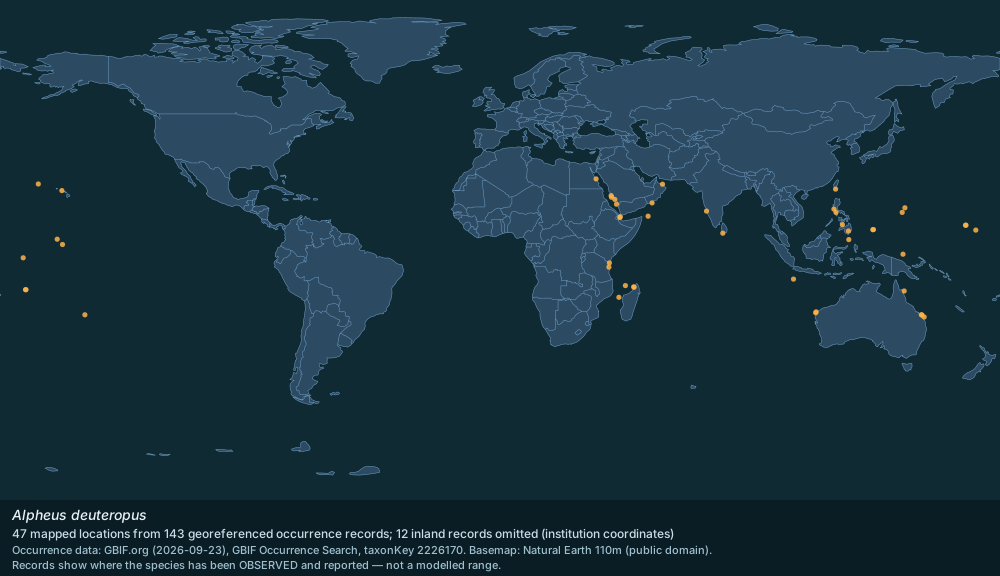
143 georeferenced occurrence records for Alpheus deuteropus are published through GBIF from 26 countries or marine areas. The map above plots 47 distinct locations from a sample of 143 records, omitting 12 inland records that carry an institution's coordinates rather than a collection site; it shows where the species has been observed and reported, not a modelled range.
Most records by country or area: United States of America (72); Kiribati (8); Philippines (8); Australia (7); Oman (6); Marshall Islands (5); Saudi Arabia (5); Djibouti (3); Madagascar (3); Papua New Guinea (3); Mayotte (3); American Samoa (2); Palau (2); French Southern Territories (2); Chinese Taipei (2).
Marine regions with a valid WoRMS distribution record: Indo-Pacific; Mayotte Disputed area: France / Comoros; East African Coral Coast.
Source: GBIF Occurrence Search (taxonKey 2226170) — https://www.gbif.org/occurrence/search?taxon_key=2226170&has_coordinate=true (records CC0 / CC BY); WoRMS distribution records (MarineRegions) — https://www.marinespecies.org/aphia.php?p=taxdetails&id=210499 (CC BY 4.0); Natural Earth 110m basemap — https://www.naturalearthdata.com/ (public domain). Accessed 2026-09-23.
Description and natural history (Wikipedia)
The shrimp has red dots on its carapace and is otherwise colorless. Male shrimp can grow to 3 cm. Like other snapper shrimp, one of the chelipeds is much bigger than the other and is modified to make an explosive clicking noise. The body is only slightly laterally compressed and does not have a crest on the carapace. There is an orbital hood surrounding the eyes. It uses drag powered swimming with its legs to move through the water. Like other shrimps in the same family, its body is bilaterally symmetrical. The primary food source of the shrimp is algae.
Mainly distributed in the Indo-West Pacific ocean regions, with most specimens found in East Africa, the Philippines, and Hawaii. Lives in tropical, coral reef environments and can be found at a depth of 1 to 15 meters below sea level. Optimal temperature for survival is 23°C to 29°C.
The common name is referencing how the burrows of the shrimp have been known to resemble ancient Hawaiian petroglyphs.
Source: Wikipedia: Alpheus deuteropus — https://en.wikipedia.org/wiki/Alpheus_deuteropus (CC BY-SA 4.0). Accessed 2026-09-23.
Gallery
Spotted an error? Know more?
Reader corrections go straight into our review queue. Suggest an edit · How this site is sourced