
Lobe coral (Porites lobata)
Source-cited species reference: taxonomy from WoRMS, biology from SeaLifeBase, occurrence map from GBIF, conservation from IUCN Red List, description from Wikipedia.
Porites lobata, known by the common name lobe coral, is a species of stony coral in the family Poritidae. It is found growing on coral reefs in tropical parts of the Indian and Pacific Oceans.
- Scientific name
- Porites lobata
- Authority
- Dana, 1846
- Family
- Poritidae
- Order
- Scleractinia
- Depth range
- 0–98 m
- Habitat zone
- reef-associated
- Iucn red list
- Least Concern
- Gbif occurrence records
- 5,938
Classification (WoRMS)
Full classification as recorded by WoRMS: Kingdom: Animalia · Phylum: Cnidaria · Class: Hexacorallia · Order: Scleractinia · Family: Poritidae · Genus: Porites.
Accepted name: Porites lobata · Authority: Dana, 1846 · Taxonomic status: accepted · AphiaID: 207225.
Synonyms and superseded combinations recorded for this taxon: Porites (Porites) lobata Dana, 1846; Porites baueri Squires, 1959; Porites excavata Verrill, 1870; Porites globosa Nemenzo, 1976; Porites lobata f. aperta Vaughan, 1907; Porites lobata f. centralis Vaughan, 1918; Porites lobata f. centralis alpha Vaughan, 1907; Porites lobata f. centralis beta Vaughan, 1907; Porites lobata f. centralis delta Vaughan, 1907; Porites lobata f. centralis epsilon Vaughan, 1907; Porites lobata f. centralis gamma Vaughan, 1907; Porites lobata f. infundibulum Vaughan, 1907; Porites lobata f. lacera Vaughan, 1907; Porites lobata f. nodulosa Hoffmeister, 1925; Porites lobata f. parvicalyx Vaughan, 1907; Porites paschalensis Vaughan, 1906.
Source: World Register of Marine Species (WoRMS) — https://www.marinespecies.org/aphia.php?p=taxdetails&id=207225 (CC BY 4.0). Accessed 2026-09-23.
Biology and life history (SeaLifeBase)
Measured values published by SeaLifeBase for Porites lobata. Only fields the database actually holds for this species are shown; these are database values, not aquarium guidance.
Depth range: 0–98 m · Habitat zone: reef-associated.
SeaLifeBase notes: Maximum depth from Ref. 100941. Can be found in shallow waters (Ref. 122680). Has moderate bleaching level and moderate estimated mortality (10-40%) in Palau (Ref. 66144). Found encrusting rocks. Can also form massive heads. Tolerant of exposed conditions. Seldomly bored by bivalves, but more associated with polychaetes like Stylarioides spp. (Ref. 130769).
Source: SeaLifeBase species summary (SpecCode 45720) — https://www.sealifebase.se/summary/Porites-lobata.html (CC BY-NC 3.0 — non-commercial use only). Accessed 2026-09-23.
Distribution and occurrence records (GBIF)
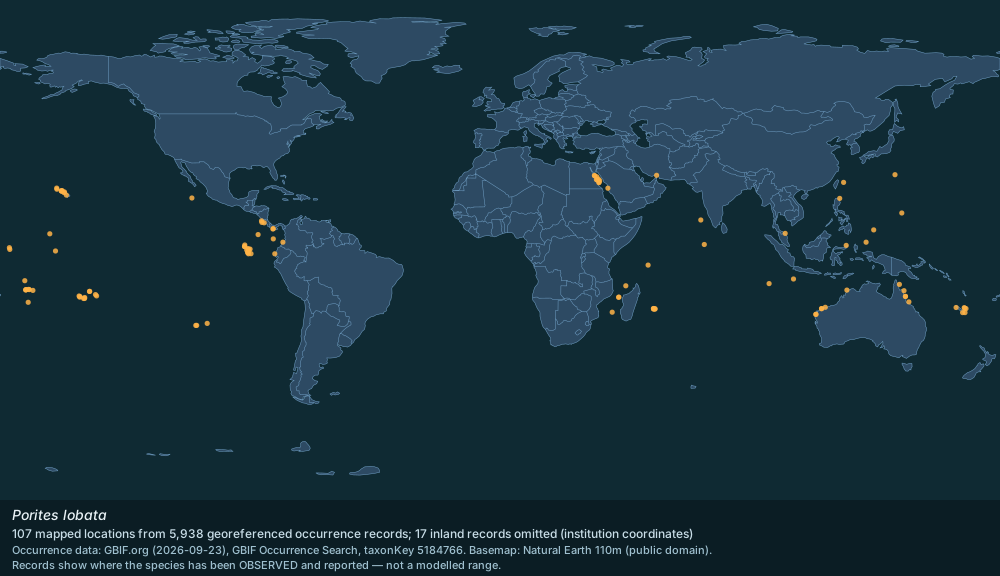
5,938 georeferenced occurrence records for Porites lobata are published through GBIF from 47 countries or marine areas. The map above plots 107 distinct locations from a sample of 3,000 records, omitting 17 inland records that carry an institution's coordinates rather than a collection site; it shows where the species has been observed and reported, not a modelled range.
Most records by country or area: United States Minor Outlying Islands (1,802); Colombia (1,775); Ecuador (413); Australia (400); United States of America (299).
The full country table, WoRMS marine regions and the sampling notes are on this species' Distribution page.
Source: GBIF Occurrence Search (taxonKey 5184766) — https://www.gbif.org/occurrence/search?taxon_key=5184766&has_coordinate=true (records CC0 / CC BY); WoRMS distribution records (MarineRegions) — https://www.marinespecies.org/aphia.php?p=taxdetails&id=207225 (CC BY 4.0); Natural Earth 110m basemap — https://www.naturalearthdata.com/ (public domain). Accessed 2026-09-23.
Conservation status (IUCN Red List)
The IUCN Red List assesses Porites lobata Dana, 1846 as Least Concern (code LC). No trend, population estimate or threat analysis is given here, because none is available from this source without the Red List API; follow the source link for the full assessment, including its date.
Source: IUCN Red List of Threatened Species (taxon 133216) — https://www.iucnredlist.org/species/133216/0; GBIF IUCN Red List category endpoint (taxonKey 5184766) — https://api.gbif.org/v1/species/5184766/iucnRedListCategory. Accessed 2026-09-23.
Description and natural history (Wikipedia)
Porites lobata is a hermatypic or reef-building coral. It varies greatly in size and shape depending on its environment. On wave-exposed reef slopes it is encrusting whereas in calm water areas it can grow into large helmet-shaped or hemispherical hummocks up to 6 m high and wide. Growth rates are very slow, sometimes being as little as 1 cm per year, and this means that large corals are very old. The general colour is greenish, yellow or tan because of the zooxanthellae, single-celled microalgae, that live symbiotically within the tissues. These make organic nutrients available to the polyps through photosynthesis.
The corallites are very small and closely packed. They are joined directly to one another by fused but porous walls and have diagnostic skeletal characteristics that are only visible under the microscope. The septa are also fused. The polyps are 1 millimetre (0.04 in) in diameter and the coenosarc covering the skeleton is thin.
Porites lobata is a common species of coral and is found in the tropical parts of the Indian and Pacific Oceans. The range extends from East Africa, the Red Sea and the Gulf of Aden, through Indonesia and Australian waters to the Pacific coasts of Gulf of California and Central America. It is the most common coral species in Hawaii. It is often the dominant species on reef margins, in lagoons and on fringing reefs at depths down to 30 m. It occurs in a slightly deeper zone than cauliflower coral.
Porites lobata is gonochoristic which means that individual colonies are either male or female. Gametes are liberated into the water column and the developing planula larvae drift with the currents as part of the zooplankton. These later settle, undergo metamorphosis and develop into polyps which found new colonies. Mortality is very high and very few recruits are found in the Eastern Pacific. Fragments of coral that become detached from the colony may also develop into new colonies. Breakup may happen as a result of wave damage or it may be due to the skeletal structure of the coral being weakened by the boring activities of date mussels (Lithophaga spp.) or the feeding activities of fish such as the stone triggerfish (Pseudobalistes naufragium).
Porites lobata forms part of the coral reef biome. Several fish species live among the lobes of the coral, some sheltering there and others, like the puffer fish (Arothron meleagris) grazing on the polyps. The snapping or pistol shrimp (Alpheus deuteropus) is a commensal and lives among the lobes where it may form grooves and tunnels.
Porites lobata is one of the more resilient species of coral. A rise in sea temperature may kill the zooxanthellae and cause bleaching, however, it is more resistant to bleaching than many corals and if bleaching does occur, it often recovers. Tropical reefs in general are under threat from many causes. These include El Nino events, ocean acidification which tends to dissolve the coral skeleton, trawling which results in mechanical damage to reefs, and coral diseases which kill the polyps. Due to the lack of coloration, this coral is very rarely collected for use in the aquarium hobby.
Source: Wikipedia: Porites lobata — https://en.wikipedia.org/wiki/Porites_lobata (CC BY-SA 4.0). Accessed 2026-09-23.
Gallery
Related in Lobe coral
Links follow this subject's own source article.
Elsewhere in Lobe coral
Spotted an error? Know more?
Reader corrections go straight into our review queue. Suggest an edit · How this site is sourced