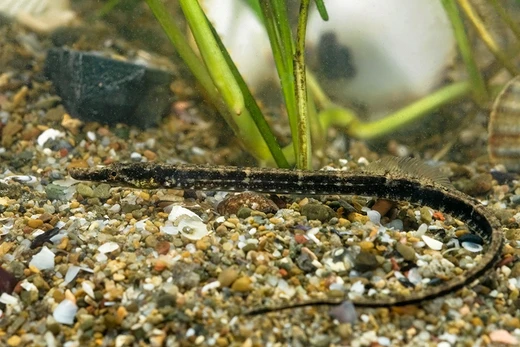
Yucatan pipefish
A threatened pipefish subspecies endemic to Mexico's Laguna Makax.

The Yucatán pipefish (Syngnathus makaxi) is a demersal fish species native to the Gulf of Mexico. It is a subspecies of the gulf pipefish (Syngnathus scovelli) and is notable for its restricted geographic range, being indigenous to the Caribbean coast of Mexico near Isla Majeures in Laguna Makax. Its habitat has been heavily impacted by dredging and construction, leading to its listing as threatened on the IUCN Red List.
Quick Facts
- Taxon
- Syngnathus makaxi
Facts from the source article.
Lore & Background
The Yucatán pipefish belongs to the order Gasterosteiformes, meaning 'bony belly,' and its body is covered with bony plates for protection. It has 22–26 dorsal fin rays, 11–12 pectoral rays, and 3 anal fin rays. Compared to the gulf pipefish, it has fewer trunk rings and is significantly smaller in length. Males possess a brood pouch that can hold 5–16 eggs. The species is assumed to have a development similar to the gulf pipefish, spawning most of the year in fresh, brackish, or saline water. Juveniles are amphidromous, traveling from fresh water to marine water during development. Males selectively choose mates and brood young until hatching, after which planktonic larvae are released with no further parental investment.
Reader's Guide
The Yucatán pipefish is significant as a subspecies that evolved in isolation from the gulf pipefish, developing defining characteristics due to its restricted range in Laguna Makax. Its habitat—shallow coastal waters with sea grasses—provides camouflage and food resources, but dredging and construction have destroyed much of this unique environment, leading to its threatened conservation status. The species is also important for scientific study of reverse sex roles and reproductive ecology, as males carry offspring and females compete for mates. Females are larger and more vibrant, and polygamous mating patterns are observed. The cost of brooding lowers male survival through winter due to reduced fat deposition. The species is carnivorous, feeding on amphipods and copepods using a sit-and-wait technique, and avoids predation through disguise and masquerade. Its removal could disrupt local ecosystems.
Did You Know?
- Males brood 5–16 eggs in a pouch and have a lower survival rate through winter due to parental investment.
- It is listed as threatened on the IUCN Red List as of 2014 due to habitat loss from dredging and construction.
- Females are larger and more colorful than males, and they compete for male mates.
More in Seahorses and Pipefish, Part 2 1-24
Spotted an error? Know more?
Reader corrections go straight into our review queue. Suggest an edit · How this site is sourced