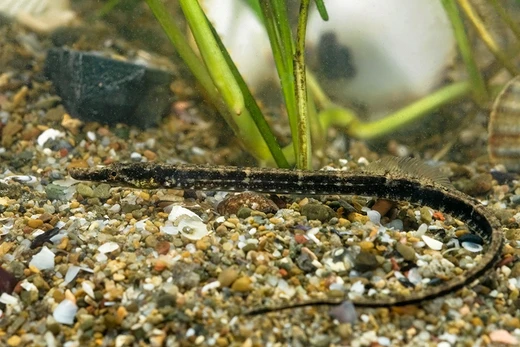
Ruby seadragon
Third seadragon species discovered in 150 years.

The ruby seadragon (Phyllopteryx dewysea) belongs to the Syngnathidae family, which also includes seahorses and pipefishes. It became the third known seadragon species when it was formally described in 2015, marking the first such discovery in 150 years. Sightings have occurred off the coast of Western Australia. By 2025, scientists still know very little about this fish, with only a handful of wild individuals ever observed.
Its name honors Mary "Dewy" Lowe, a supporter of seadragon research and conservation.
The ruby seadragon has a ruby red body marked by pink vertical bars that rise halfway up the sides and meet the lateral trunk ridges. Like the common seadragon, its body is slender and elongated. It has 18 trunk segments, with an enlarged pectoral area and spines. Unlike the other two seadragon species, it possesses a curved, prehensile tail tipped in yellow. It also lacks the leaf-like dermal appendages seen on other seadragons, though it still has the bony spines where those structures would attach.
Sexual dimorphism may exist. Of the two live observations, one individual—possibly a female—had a deeper, rounder body, darker red coloring, and more pronounced vertical bars.
The holotype, a single male used to formally describe the species, was carrying a brood. It had light markings on its snout, and its uniform color faded to brown after preservation. Five paratypes were later identified. The holotype is housed at the Western Australian Museum in Perth (code WAM P33223.002).
No quantitative measurements distinguish the three seadragon species, but visual observation works. The common seadragon has a spotted pattern that persists after preservation, while the leafy seadragon shows white and purple vertical bars that extend past the body. Both also have paired backward-facing spines and a head spine, features absent in the ruby seadragon.
As of 2025, no population estimates exist. By 2017, all six known specimens had been collected in Western Australia: three near Perth, one in the Recherche Archipelago, one at Culver Cliffs, and one near Esperance. The species likely evaded earlier detection because it lives in deep water, beyond recreational scuba depths. The holotype was trawled at 51–72 meters in the Recherche Archipelago, suggesting a preference for deeper waters.
Quick Facts
- Genus
- Phyllopteryx
- Species
- dewysea
Facts from the source article.
Lore & Background
The ruby seadragon is named to honor Mary 'Dewy' Lowe, a supporter of seadragon conservation and research. It is characterized by a ruby red body with pink vertical bars that extend halfway up, meeting lateral trunk ridges. It has a slender, elongated body with 18 trunk segments, an enlarged pectoral area, and spines. In contrast to the other two seadragon species, it has a curved prehensile tail with a yellow tip and lacks dermal appendages (the leaf-like structures) despite possessing the bony spines these would attach to. The holotype was a male carrying its brood, and five paratypes were identified following its discovery. The holotype specimen is kept in the Western Australian Museum in Perth (Code WAM P33223.002).
Reader's Guide
The ruby seadragon is significant as the first new seadragon species described in 150 years, highlighting how little is known about deep-water marine life. Its discovery in 2015 from specimens collected off Western Australia, including the Recherche Archipelago, suggests a preference for deeper waters (50+ meters) outside recreational scuba depth, which may explain why it evaded prior identification. The species' lack of dermal appendages is attributed to its sparse, turbulent habitat, where bulky appendages would add drag. Its red coloration may serve as camouflage in low-light depths, as red surfaces are not visible to species that rely on bioluminescence. The curved prehensile tail may be used for stabilization in reef habitats during strong current surges. Phylogenetically, it is the sister-species to the common seadragon, with the leafy seadragon as a sister to the clade. The discovery of a prehensile tail in this species complicates the proposed phylogeny, as its closest relative cannot bend its tail. Researchers have proposed two explanations: either the prehensile tail is a retained ancestral trait lost in the other two species, or it was independently re-acquired. The species is listed as Data Deficient on the IUCN Red List, and researchers have advocated for state and federal listing to afford it similar protection as other seadragon species.
Did You Know?
- The ruby seadragon is the third known seadragon species and the first discovered in 150 years.
- It has a curved prehensile tail with a yellow tip, unlike the common and leafy seadragons.
- The holotype was a male carrying its brood, collected in the Recherche Archipelago at 51–72 meters depth.
- Its red coloration may be a camouflage strategy against bioluminescence in deep, low-light waters.
Form and Camouflage
The common seadragon, scientifically named Phyllopteryx taeniolatus, is a marine fish placed within the order Syngnathiformes, a group that also includes seahorses, pipefishes, and trumpetfishes. Adults present a reddish body tone accented by yellow and purple striped markings. Perhaps their most remarkable trait is the array of small, leaf-like appendages that closely resemble kelp or seaweed fronds, granting them exceptional camouflage in their natural environment. Short spines scattered across the body add a layer of physical defense. The head features a tubular snout paired with a fused, toothless jaw, a combination that lets the fish snap up tiny invertebrate prey at lightning speed. Males tend to be narrower in build and darker in coloration than their female counterparts. A long dorsal fin runs along the back, and small pectoral fins positioned on either side of the neck help maintain balance. Fully grown individuals can reach roughly 45 centimeters (18 inches) in length. Notably, unlike many seahorses and pipefishes, seadragons do not possess a prehensile tail for gripping; they instead drift through kelp and seaweed masses, their leafy protrusions rendering them nearly invisible to predators.
Reproduction and Captive Breeding
Seadragon reproduction follows the syngnathid pattern in which the male incubates the young. A female deposits roughly 120 eggs onto a brood patch on the underside of the male's tail, where he fertilizes and carries them for about a month before the hatchlings emerge. Newborns are immediately independent, feeding on their own shortly after birth. Sexual maturity arrives at around 28 months, and the species may live up to six years. Juvenile survival in the wild is notably low, yet in captivity it rises to roughly 60 percent. Breeding these fish outside their natural habitat has proven extremely challenging, as researchers still lack a clear understanding of the biological or environmental cues that trigger reproduction. Only a handful of facilities worldwide have achieved successful captive breeding, including the Melbourne Aquarium, the Aquarium of the Pacific in Long Beach, the Tennessee Aquarium, the Georgia Aquarium, the Monterey Bay Aquarium, and the Birch Aquarium in San Diego. Keepers must meticulously manage water parameters, diet, and tank setup, because captive seadragons are susceptible to a range of ailments—scuticociliatosis, myxozoanosis, fungal infections, intestinal coccidiosis, neoplasia, and swim bladder disorders—often linked to parasites thriving in the captive environment.
Range, Habitat, and Feeding Ecology
The common seadragon is endemic to the coastal waters of southeastern Australia, the northern Southern Ocean, and the southwestern Pacific. Its range stretches along the entire southern coastline of the Australian continent, encompassing Tasmania and various offshore islands. Regular observations span from Port Stephens in New South Wales to Geraldton in Western Australia, with additional populations off South Australia and the Great Australian Bight. These fish occupy coastal waters at depths of roughly 10 to 30 meters, favoring rocky reefs, seaweed beds, seagrass meadows, and structures colonized by seaweed. They are slow-moving creatures that depend on their seaweed-mimicking camouflage rather than speed to evade predators. Typically encountered alone or in pairs, they feed on tiny crustaceans and other zooplankton, rapidly sucking prey into their toothless mouths. Beyond its ecological role, the common seadragon holds a position of cultural significance as the designated marine emblem of the Australian state of Victoria.
Conservation Status and Threats
The common seadragon carries a Vulnerable classification on the IUCN Red List. Although it is a desired species in the international aquarium trade, the volume of wild-caught individuals remains small and is not considered a primary threat. The most pressing dangers stem from habitat loss and degradation driven by human activities and pollution, particularly the decline of seagrass beds and canopy seaweed on inshore rock reefs. Compounding these pressures, seadragons are poor dispersers, making them especially vulnerable to localized habitat destruction. Unlike many related seahorse and pipefish populations, the weedy seadragon is not currently a target of bycatch or the traditional Chinese medicine trade. A 2023 study by Edgar and colleagues suggested a 59 percent population decline between 2011 and 2021, linked to climate change-induced marine heatwaves on the Great Southern Reef—a figure that would warrant an Endangered listing. However, Schlögl and Booth (2025) argued the underlying citizen science data were too sparse to support such a conclusion. In most Australian states, it is illegal to take or export the species. The community-driven Dragon Search database, supported by groups including the Marine Life Society of South Australia and the Australian Marine Conservation Society, encourages divers to report sightings for ongoing population monitoring.
Frequently Asked Questions
What is the Ruby seadragon?
The Ruby seadragon (Phyllopteryx dewysea) is a small marine fish in the Syngnathidae family, making it a close relative of seahorses and pipefishes. It was formally described in 2015 and is recognized as the third known species of seadragon.
Why was the Ruby seadragon such a big deal when it was named?
It marked the first new seadragon species to be identified in roughly 150 years, so the discovery was a major milestone for marine biologists. By 2025, only a handful of wild individuals had ever been sighted, keeping it one of the rarest known seadragons.
Who is the Ruby seadragon named after?
The species epithet 'dewysea' honors Mary 'Dewy' Lowe, a supporter of seadragon research and conservation efforts. The name is a tribute to her contributions to the field rather than to a geographic feature.
Where does the Ruby seadragon live?
Sightings have been recorded off the coast of Western Australia, with the type locality being the Recherche Archipelago. The holotype specimen is held at the Western Australian Museum in Perth under the code WAM P33223.002.
What does the Ruby seadragon look like?
It has a striking ruby-red body accented by pink vertical bars that extend about halfway up its flanks. Beyond that basic coloration, very little detailed morphological information has been published because so few individuals have been observed in the wild.
More in Seahorses and Pipefish, Part 2 1-24
Spotted an error? Know more?
Reader corrections go straight into our review queue. Suggest an edit · How this site is sourced