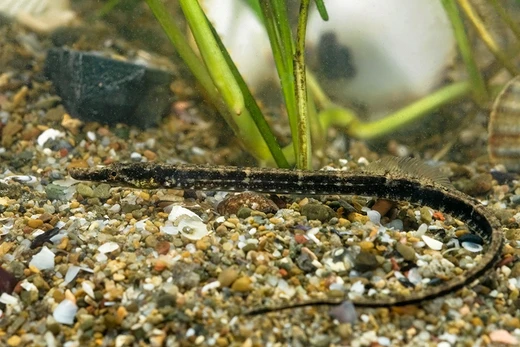
Hippocampus colemani
Tiny seahorse camouflaged by algae on seagrass blades.

Hippocampus colemani, called Coleman's pygmy seahorse, belongs to the Syngnathidae family. This fish is known for being very small—it reaches a maximum length of just 2.7 centimeters. Its head is small, its snout short, its trunk thick, and its coronet low. Algae from seagrass blades attaches to its skin, which helps camouflage it. The body is usually pale whitish to yellowish, with white circles or ovals outlined in thin red lines on the trunk, dark brown bands radiating from the eye, brownish-red appendages, and a tail that is slightly brownish with red marks. It lives in coarse sand and among Zostera and Halophila seagrasses at depths of about 4 to 12 meters. Its diet is thought to consist of small crustaceans, like other seahorses. Reproduction is likely ovoviviparous, with males carrying eggs in a pouch and giving birth to live young. The species was named after Neville Coleman, an Australian photographer, explorer, and conservationist who collected the holotype. Its confirmed range is off Lord Howe Island, Australia, though there are unconfirmed sightings from Milne Bay and the Ryukyu Islands.
Quick Facts
- Taxon
- Hippocampus colemani
Facts from the source article.
Lore & Background
Hippocampus colemani was named after Neville Coleman, an Australian photographer, explorer, and conservationist who collected the holotype. Individuals are tiny, growing to a maximum recorded length of 2.7 centimetres. They have small heads, short snouts, thick trunks, and low coronets. Algae found on seagrass blades attach to their skins, acting as a form of camouflage. Colouration is generally pale whitish to yellowish, with white circular or elliptical markings outlined with narrow red lines on the trunk, dusky brown bands radiating from the eye, brownish-red appendages, and a slightly brownish tail with red markings.
Reader's Guide
Coleman's pygmy seahorse is significant as a recently described species from a restricted geographic range, primarily known from Lord Howe Island, with unconfirmed sightings elsewhere. Its reliance on seagrass beds of Zostera and Halophila at shallow depths highlights the importance of these habitats. The species is expected to feed on small crustaceans, like other seahorses, and is presumed to be ovoviviparous, with males brooding eggs in a pouch. Its tiny size and effective camouflage—using algae attached to its skin—make it a remarkable example of adaptation. The species' legacy is tied to Neville Coleman, who collected the type specimen, and its conservation status remains unassessed in the source article.
Did You Know?
- Hippocampus colemani grows to a maximum recorded length of only 2.7 cm.
- It is named after Australian photographer and explorer Neville Coleman.
- Algae from seagrass blades attach to its skin for camouflage.
- Unconfirmed occurrences have been reported from Milne Bay and the Ryukyu Islands.
Frequently Asked Questions
What is Hippocampus colemani?
Hippocampus colemani, commonly known as Coleman's pygmy seahorse, is a tiny marine fish belonging to the Syngnathidae family. It is one of the smallest seahorse species, reaching a maximum total length of only about 2.7 centimeters (roughly 1.1 inches).
Where does Coleman's pygmy seahorse live?
This species inhabits shallow waters between 4 and 12 meters (13–39 feet) over coarse sand beds and among Zostera and Halophila seagrass meadows. Its type locality is Lord Howe Island, off the coast of Australia.
How does Hippocampus colemani camouflage itself?
Algae that grows on nearby seagrass blades clings to the fish's skin, effectively blending it into the surrounding vegetation. Its pale whitish-to-yellowish body, thin red-outlined white markings, and brownish-red appendages further help it disappear against the grassy substrate.
What does Hippocampus colemani look like?
It has a small head, a short snout, a thick trunk, and a low coronet. The trunk bears white circles or ovals ringed in thin red lines, dark brown bands radiate from the eye, and the tail is slightly brownish with red markings.
Who is Hippocampus colemani named after?
The species was named in honor of Neville Coleman, a marine biologist and seahorse researcher. His contribution to documenting and studying seahorse diversity made him a fitting namesake for this tiny Lord Howe Island resident.
More in Seahorses and Pipefish, Part 2 1-24
Spotted an error? Know more?
Reader corrections go straight into our review queue. Suggest an edit · How this site is sourced