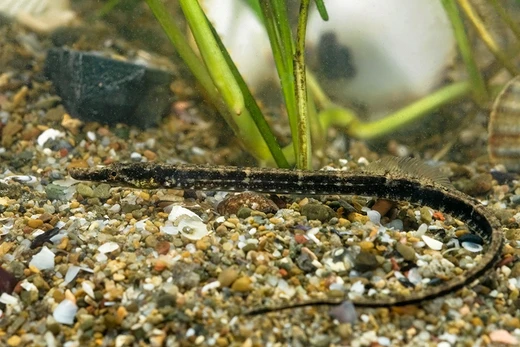
Hippocampus bargibanti
A tiny seahorse that lives exclusively on gorgonian coral.

**Hippocampus bargibanti**, known as Bargibant's seahorse or the pygmy seahorse, belongs to the family Syngnathidae and inhabits the central Indo-Pacific. This tiny seahorse measures under 2 centimeters and spends its entire life on gorgonian sea-fans, relying on its coloration and body shape for expert camouflage. The relationship with its host coral is neither invasive nor parasitic; the sea-fan simply provides shelter. Two color forms exist—grey with red tubercles or yellow with orange tubercles—and it is suspected, though not confirmed, that these match specific host gorgonians.
**Description** At less than 2 centimeters long, the pygmy seahorse is so well camouflaged that it was not formally discovered until 1969, when scientist Georges Bargibant noticed a pair on a Muricella gorgonian coral he had collected for a museum in Nouméa. The species was officially named the following year by Whitley. Its body is covered with large, bulbous tubercles that mimic the polyps of its host coral in both color and shape, while its tail wraps around the coral’s stem for stability. It is unknown whether individuals can change color if they switch sea-fans, though some other seahorses, like *Hippocampus whitei*, can. Other traits include a fleshy head and body, a very short snout, and a long, prehensile tail.
**Evolution** In 2025, a team of Chinese and German scientists (Qu et al.) published the first sequenced genome of Bargibant's seahorse in PNAS. By comparing it with other fish and seahorse genomes, they estimated that this species split from non-pygmy seahorses about 18.2 million years ago, during the Early Miocene. Over time, it has lost 438 genes entirely, another 635 genes are no longer expressed due to extensive DNA loss, and 5,135 genes have lost sensitivity to certain signals. The researchers also identified mutations that may explain the seahorse’s immunity to coral venom.
**Distribution** This species occurs in coastal waters from southern Japan and Indonesia to northern Australia and New Caledonia, on reefs and slopes at depths of 10 to 40 meters.
**Reproduction** Adults are often found in pairs or small clusters, with up to 28 individuals recorded on a single gorgonian, and they may be monogamous. Like other seahorses, males carry the young.
Quick Facts
- Taxon
- Hippocampus bargibanti
Facts from the source article.
Lore & Background
The pygmy seahorse measures less than one inch in length and is naturally well camouflaged, making it extremely difficult to see amongst the gorgonian coral it lives on. So effective is this camouflage that the species was not formally discovered until 1969, when New Caledonian scientist Georges Bargibant, collecting specimens of Muricella gorgonians for the Nouméa museum, spotted a pair on the coral upon his examination table. The next year, they were officially named by Whitley as 'Bargibant's pygmy seahorse'. Large, bulbous tubercles cover its body, matching the colors and forms of the host coral's polyps, while its body matches the gorgonian stem, to which it wraps its tail for stability. It is unknown whether individuals can change color if they alternate sea-fans, though such ability exists in other seahorse species. Other distinctive characteristics include a fleshy head and body, a very short snout, and a long, prehensile tail.
Reader's Guide
The pygmy seahorse's significance lies in its extreme specialization and the challenges it poses to research and conservation. Its relationship with host gorgonians is non-invasive and non-parasitic, serving only for shelter. The species has been classified as Data Deficient on the IUCN Red List due to very little known about total numbers, population trends, distribution, or major threats. It may be collected for the aquaria trade, though no international trade has been recorded; under experienced researchers at national aquaria, all pygmy seahorses and their gorgonians have died. All seahorses are listed on CITES Appendix II, and Australian populations require export permits. The remarkably effective camouflage of this species may make surveys particularly challenging. Its genome was sequenced for the first time in 2025, revealing that it diverged from non-pygmy seahorses 18.2 million years ago, has lost 438 genes found in other seahorses, and carries mutations suspected to confer immunity to coral venom.
Did You Know?
- The pygmy seahorse was first discovered in 1969 when a scientist spotted a pair on a gorgonian coral examination table.
- It has two known color variations: grey with red tubercles and yellow with orange tubercles.
- Male Bargibant's seahorses carry the young in a brood pouch unusually deep inside the body, with gestation averaging two weeks.
- The species has lost 438 genes found in other seahorses over its evolutionary history.
A Tiny, Armoured Body Built for Precision
The Bargibanti pygmy seahorse stands only about one to two centimetres tall, making it one of the smallest members of the Syngnathidae family. Despite its diminutive stature, it shares the hallmark features of all syngnathids: an elongated snout, a fused jaw (the very trait that gives the family its Greek-derived name, combining the words for "together" and "jaw"), and a complete absence of pelvic fins. Its body is encased in thick plates of bony armour, which render it rigid and prevent the undulating swimming typical of most fish. Instead, it propels itself by rapidly fanning its fins, a method that makes it comparatively slow but grants it extraordinary control over its movements. It can hover in place for extended periods, a skill well suited to its life in shallow coastal waters. Like other seahorses and pipefish, it also employs elastic recoil feeding, storing energy in its epaxial muscles and releasing it in a burst that snaps its mouth toward unsuspecting prey with startling speed.
A Pouch That Moved Home
The Bargibanti pygmy seahorse belongs to a small group of trunk-brooding species that are phylogenetically embedded among tail-brooding relatives. This arrangement is a striking example of convergent evolution: rather than inheriting its abdominal brood pouch from a shared trunk-brooding ancestor, the pygmy seahorses (including H. bargibanti, H. denise, and H. pontohi) most likely relocated their pouch from the tail to the trunk independently. The driving pressure behind this shift appears to have been a correlated selection for both a prehensile tail and an extremely small body size. As the tail became adapted for gripping, the brood pouch was displaced to the abdomen, yielding a creature barely a couple of centimetres tall. This stands in contrast to the broader family pattern, where the split between trunk-brooding Nerophinae and tail-brooding Syngnathinae dates back to the Paleocene, and where genome sequencing reveals parallel increases in pouch complexity across both major groups.
The Male's Burden of Pregnancy
In the Bargibanti pygmy seahorse, as in all seahorses, the reproductive burden falls squarely on the male. After the female deposits her eggs, the male fertilizes them and carries them in a specialized ventral brood pouch until they hatch. In species with more developed, fully enclosed pouches, the male does far more than simply provide a container: he actively supplies his developing brood with nutrients and confers immunity against pathogens. He also retains the ability to partially or completely abort a brood if the female's fitness is judged to be low, a quality-control mechanism that shapes mate selection. This arrangement has driven a broad sex-role reversal across the family. In many conventional syngnathids, males compete for access to females and most are monogamous, whereas in sex-role-reversed species, females compete and polygamous behaviour predominates. The co-evolution of behavioural, physiological, morphological, and immunological traits in the most complex pouch systems has made male pregnancy a remarkably sophisticated reproductive strategy.
Deep Roots in Ancient Seas
The lineage that would eventually produce the Bargibanti pygmy seahorse stretches back to the earliest syngnathid fossils, found in Danian-age (Paleocene) strata of Egypt's Dakhla Formation and in Eocene deposits at Monte Bolca, Italy. Phylogenetic analysis suggests the most recent common ancestor of all syngnathids was pouchless, and that oviparity—laying eggs without parental incubation—was the ancestral condition. The evolution of viviparity and male pregnancy required the integration of multiple complex traits spanning morphology, physiology, and behaviour, and genome sequencing now reveals that similar brood pouch structures arose independently multiple times across and within the family. The family's very name, Syngnathidae, is a nod to the one feature all members share: a fused jaw, drawn from the Ancient Greek sún ("together") and gnáthos ("jaw"). Today, syngnathids occupy temperate and tropical seas worldwide, with most species favouring shallow coastal habitats, though a few venture into open-ocean sargassum mats.
Frequently Asked Questions
What is Hippocampus bargibanti?
Bargibant's seahorse is a pygmy species in the Syngnathidae family that never grows beyond two centimetres in length. It is found in coastal waters across the central Indo-Pacific, ranging from southern Japan and Indonesia to northern Australia and New Caledonia.
Where does Hippocampus bargibanti live and at what depth?
This tiny seahorse is found anchored to gorgonian sea-fans at depths of roughly 10 to 40 metres. It remains on its host coral for its entire life, relying on its body shape and colouration to disappear into the fan's structure.
Does Hippocampus bargibanti harm the coral it lives on?
No—its association with the gorgonian is neither parasitic nor invasive; the sea-fan simply provides shelter. Two colour morphs exist (grey with red tubercles and yellow with orange tubercles), and researchers suspect each may match a particular host species, though this link has not been confirmed.
How does Hippocampus bargibanti reproduce?
The male carries fertilised eggs for an average of about two weeks before releasing live young. In one documented birth, a brood of 34 juveniles was observed.
Why is Hippocampus bargibanti notable among seahorse species?
At under two centimetres, it is one of the smallest known seahorses, which makes it a prized target for reef divers and marine biologists. Its obligate dependence on a single coral type and its near-perfect camouflage make it a striking example of ecological specialisation within the Syngnathidae family.
More in Seahorses and Pipefish, Part 2 1-24
Spotted an error? Know more?
Reader corrections go straight into our review queue. Suggest an edit · How this site is sourced