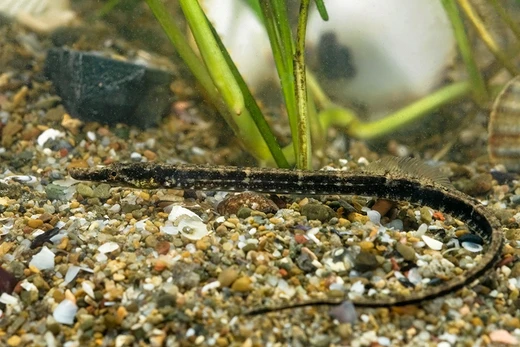
Dwarf seahorse
The slowest-moving fish, found in seagrass beds of the Atlantic.

The dwarf seahorse (Hippocampus zosterae) lives in shallow underwater grass beds in the Bahamas and parts of the United States, and is threatened when its habitat is destroyed. Guinness World Records lists it as the slowest fish, moving at a top speed of about 5 feet (1.5 meters) per hour. Its usual color is white, but it can also be tan, brown, yellow, or green. In the wild, it often has small, algae-like skin growths called cirri.
Like all seahorses, its head sits at a right angle to its body, and it swims upright, using its dorsal fin to push forward and its pectoral fins to steer. It averages 2 to 2.5 centimeters (0.8 to 1.0 inches) in length, with a maximum of 5.0 centimeters (2.0 inches). It can live up to two years, though most live about one. Its colors—beige, yellow, green, or black—may include white speckles, dark spots, or bumps, and it changes color for camouflage, when attacked, when sick, or during mating. It is well camouflaged, usually matching the gorgonian coral it lives on. Unlike other western Atlantic seahorses like H. reidi and H. erectus, H. zosterae has 10 to 13 dorsal and pectoral fin rays and 9 to 10 trunk rings, and fully grown adults are generally smaller.
This species lives in the western Atlantic Ocean, including the Gulf of Mexico, the Bahamas, Bermuda, the Florida Keys, Florida’s east coast, Old Tampa Bay, Lemon Bay, Pensacola, and Texas. It stays almost entirely in shallow seagrass microhabitats, especially in beds of the genus Zostera, and is most common in bays with high salinity, coral reefs, floating vegetation, and mangrove roots. Seahorses often live in pairs, sometimes alone. Males stay in a small home range of about 1 square meter (11 square feet), while females roam over territories about 100 times larger.
The dwarf seahorse is a lie-in-wait predator that eats only live prey, such as small crustaceans (amphipods and small shrimp), other tiny invertebrates, and fish fry. It stretches toward its target and sucks it through its snout. Food moves through its digestive system quickly, so nutrients are poorly absorbed, which is why it needs to eat a lot—up to 3,000 brine shrimp per day.
Males carry the offspring, but they still compete for mates. They wrestle tails, snap heads at each other, and make clicking sounds. Courtship begins each morning with an elaborate dance.
Quick Facts
- Taxon
- Hippocampus zosterae
Facts from the source article.
Lore & Background
The dwarf seahorse is most often white but can range from tan, brown, yellow, and green, and often has small skin growths called cirri that resemble algae. It swims upright using its dorsal fin to propel and pectoral fins to steer. It can change color for camouflage, reaction to an attack, due to illness, or during mating. Males are sedentary with a home range of about 1 square metre, while females roam territories about a hundred times larger. It is a lie-in-wait predator, feeding on small crustaceans and fish fry, and can consume up to 3,000 brine-shrimps per day due to rapid digestion and poor nutrient absorption.
Reader's Guide
The dwarf seahorse was particularly popular in the 1960s when mail order companies commonly sold them as 'perfect pets'. Due to its tiny size, it remains very popular in the aquarium market, with several Florida fisheries centered on its capture and trade. Chinese medicine is a major consumer, using an estimated 20 million seahorses annually for supposed cholesterol-decreasing virtues. Before 1970, the species was regarded as common, but numbers decreased due to seagrass reduction, pollution, oil spills, and ocean acidification. The IUCN classified it as vulnerable in 2000, but as least concern as of 2016. All Hippocampus species, including H. zosterae, are listed in Appendix II of CITES. In captivity, it requires small aquariums, frequent feeding, and specific water conditions, with a survival rate around 20%.
Did You Know?
- The dwarf seahorse is the slowest-moving fish, with a top speed of about 5 feet per hour.
- Males carry between 3 and 55 young in their brood pouch for around 10 days before release.
- Dwarf seahorses form strict monogamous pair bonds for at least an entire season.
Male Pregnancy: A Defining Trait
The most striking reproductive characteristic of seahorses, including the Dwarf seahorse, is that it is the male who becomes pregnant. This inverts the traditional understanding of pregnancy, which has long been defined as the period following egg-sperm union during which developing embryos are incubated within a body. While this term has historically been most closely associated with placental mammals, its application to fish—particularly seahorses and pipefish—highlights a remarkable biological reversal. In these species, the male takes on the role of carrying and incubating the developing young, a trait that sets them apart from the vast majority of the animal kingdom. This male-pregnancy phenomenon places seahorses in a unique position within the broader landscape of fish reproduction, where parental care varies enormously across species and modes. The fact that the male, rather than the female, assumes the incubation role makes the Dwarf seahorse a compelling subject for studying how reproductive roles can be fundamentally reorganized in vertebrates.
The Spectrum of Fish Reproduction
Fish exhibit a remarkable diversity of reproductive strategies, and understanding where seahorses fit within this spectrum provides important context. Five distinct modes can be identified based on the relationship between zygotes and their parents: ovuliparity with external fertilization and development, oviparity with internal fertilization but external egg development, ovoviviparity where young are born live but sustained by yolk without significant parental feeding, histotrophic viviparity where embryos consume the parent's eggs or siblings, and hemotrophic viviparity where the parent provides nutrients through a placenta-like structure. The Dwarf seahorse's male pregnancy represents a specialized form of internal incubation, distinct from the external egg-laying strategies seen in many other fish families such as rockfish, sculpins, and various sharks. This diversity underscores that parental investment in fish ranges from minimal to highly elaborate, and the seahorse occupies a distinctive niche within that continuum.
Terminology and Scientific Debate
The use of the word "pregnancy" for fish has not been without controversy. Researchers have historically been reluctant to apply this term to non-mammalian species, largely because of the highly developed form of viviparity seen in eutherian mammals. The traditional definition—incubation of embryos within a body after egg-sperm union—applies broadly, yet the connotation of the term in popular and scientific discourse has been strongly tied to placental mammals. However, recent investigations into the physiological, morphological, and genetic changes that accompany fish reproduction have provided evidence that incubation in certain species constitutes a highly specialized form of reproduction comparable to other viviparous strategies. The term has appeared in the titles of numerous international, peer-reviewed scientific articles on fish, signaling growing acceptance. For the Dwarf seahorse, whose male carries the developing young, this terminology debate carries particular relevance to how scientists frame and study its biology.
Nutritional Strategies During Fish Gestation
The way developing young receive nutrition during the incubation period varies dramatically across fish species, and this dimension of reproductive biology adds depth to understanding seahorse pregnancy. At one end of the spectrum, lecithotrophy means the egg is provisioned with all necessary resources before fertilization, making the embryo entirely independent of its parent. Aplacental viviparity retains embryos without nutrient transfer, relying solely on the yolk sac. At the other extreme, matrotrophy involves the parent providing additional nutrition after the yolk is exhausted, while hemotrophic nutrition passes nutritive substances between the parent's and embryo's blood vessels through a placenta-like organ. Embryotrophic or histrotrophic nutrition involves the uterine lining producing a nutritive fluid absorbed directly by the embryo. The Dwarf seahorse's male pregnancy represents one point on this continuum of parental nutritional investment, illustrating how fish have evolved multiple independent solutions to the challenge of sustaining developing offspring.
Frequently Asked Questions
What is a dwarf seahorse?
The dwarf seahorse (Hippocampus zosterae) is the smallest seahorse species, a tiny upright-swimming fish that holds the Guinness World Record as the slowest fish on Earth. It cruises at a top speed of roughly 5 feet (1.5 m) per hour while drifting through shallow Atlantic seagrass.
How big does a dwarf seahorse get?
Most adults measure just 2 to 2.5 cm (about 0.8–1.0 inches) in length, though the largest specimens can reach 5 cm (2 inches). That puts it roughly at the size of a human thumbnail.
Why is the dwarf seahorse famous among fish enthusiasts?
Guinness World Records officially lists it as the slowest fish, with a maximum speed of only about 1.5 meters per hour. Its near-stationary lifestyle among seagrass blades makes it a prized subject for macro underwater photographers.
Where do dwarf seahorses live in the wild?
They inhabit shallow seagrass beds along the Atlantic, particularly in the Bahamas and parts of the southeastern United States. Coastal development and pollution are destroying that seagrass habitat, which puts the species at risk.
How long does a dwarf seahorse live?
Most individuals survive around one year, though some can reach two years under favorable conditions. Their short lifespan is partly a consequence of their tiny body and the limited food available within a small patch of seagrass.
More in Seahorses and Pipefish, Part 2 1-24
Spotted an error? Know more?
Reader corrections go straight into our review queue. Suggest an edit · How this site is sourced