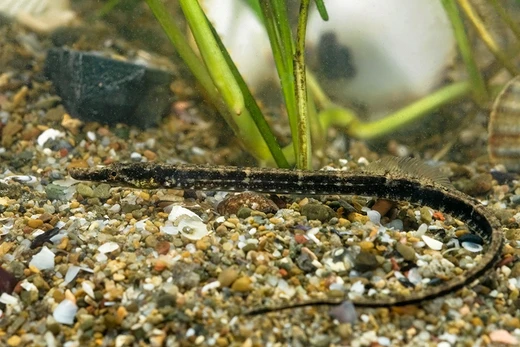
West African seahorse
A poorly known seahorse species with a confirmed Canary Islands sighting.

The West African seahorse (Hippocampus algiricus) is a species of fish in the family Syngnathidae, found in the eastern central Atlantic Ocean off Angola, Benin, Ivory Coast, Gambia, Ghana, Guinea, Liberia, Nigeria, São Tomé and Príncipe, Senegal, and Sierra Leone, as well as the Canary Islands. It is notable for being the subject of scarce information despite conservation efforts, and for a confirmed sighting at Gran Canaria Island that may be linked to ocean currents, climate warming, or human activity.
Quick Facts
- Taxon
- Hippocampus algiricus
Facts from the source article.
Lore & Background
The West African seahorse was first described from a type collected at Béjaïa, Algeria, in the 1850s by Guichenot, though no records from Algeria have been reported since, and the location given may be an error. The first records of this species at Gran Canaria Island were confirmed by genetic and morphometric analysis. This sighting could be due to the Canary current, West African coastal upwelling, trade winds, anthropogenic origin related to sporadic ship water ballast transport, or climatic warming in the canary region making it suitable for them to live in. This has caused a hybridization event between the West African Seahorse and the European short-snouted seahorse (Hippocampus hippocampus), who already resides there.
Reader's Guide
The West African seahorse is significant primarily because of the sharp rise in its export—about 600,000 seahorses annually, mostly to China for traditional medicine—despite scientists knowing virtually nothing about their numbers, habitat, or life cycle. The species was first videotaped in 2012 as part of a joint investigation between Project Seahorse, Imperial College London, and the Zoological Society of London (ZSL) into West Africa's burgeoning seahorse trade. Conservation efforts led by Project Seahorse, directed by Dr. Amanda Vincent, resulted in the Convention on Trade in Endangered Species (CITES) adopting international trade controls for seahorses in 2002. However, scarce information remains available for this species, and the confirmed sighting at Gran Canaria Island raises questions about its range expansion and hybridization with the European short-snouted seahorse.
Did You Know?
- The West African seahorse was first videotaped in 2012.
- About 600,000 seahorses are exported annually, primarily to China for traditional medicine.
- A confirmed sighting at Gran Canaria Island led to a hybridization event with the European short-snouted seahorse.
- CITES adopted international trade controls for seahorses in 2002 due to efforts by Project Seahorse.
More in Seahorses and Pipefish, Part 2 1-24
Spotted an error? Know more?
Reader corrections go straight into our review queue. Suggest an edit · How this site is sourced