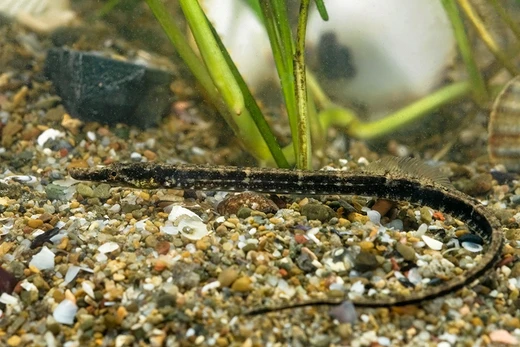
Tiger tail seahorse
A striped seahorse used in traditional medicine, threatened by overfishing.

The tiger tail seahorse (Hippocampus comes) is a species of fish in the family Syngnathidae. It is notable for its alternating yellow and black stripes, especially on the tail, and for being used in traditional Chinese medicine, with as many as 20 million seahorses caught each year for this purpose. Its populations are threatened by overfishing and habitat destruction.
Quick Facts
- Taxon
- Hippocampus comes
Facts from the source article.
Lore & Background
The tiger tail seahorse was first described by Theodore Cantor in 1850. It is found in India, Indonesia, Malaysia, the Philippines, Singapore, Thailand, and Vietnam, inhabiting subtidal aquatic beds and coral reefs. Its natural climate is tropical, between 15°N and 1°N. The species is nocturnal and normally found in pairs on coral reefs, sponge gardens, kelp, or floating Sargassum. The male carries the eggs in a brood pouch on his chest, holding from 1 to 2,000 eggs, with pregnancy lasting 1 to 4 weeks. They swim upright rather than horizontally and lack scales, having tough thin skin stretched over bony rings, making them too bony for most marine predators to digest. Their snout is 2.2 times the head length and is used to suck up food, which includes small fish, coral, small shrimp, and plankton.
Reader's Guide
The tiger tail seahorse holds significance primarily due to its heavy use in traditional Chinese medicine, with as many as 20 million seahorses possibly caught each year for this purpose. This demand, combined with habitat loss from destruction of its coral reef and subtidal aquatic bed environments, has endangered its populations. In response, import and export of seahorses have been controlled under CITES since May 15, 2004. The species is also notable for its distinctive appearance: alternating yellow and black stripes on the tail, a low coronet with five knobs, two spines on each cheek, and a prominent spine on the nose. It has 11 trunk rings and 33 to 37 tail rings, with a dorsal fin of 17 to 19 rays and a pectoral fin of 16 to 19 rays. Despite being harmless to humans, its bony structure makes it an unlikely prey for most marine animals. Its legacy is thus tied to both cultural medicinal use and conservation efforts.
Did You Know?
- The male carries the eggs in a brood pouch, holding from 1 to 2,000 eggs for 1 to 4 weeks.
- It is used in traditional Chinese medicine, with up to 20 million seahorses possibly caught each year.
- The species lacks scales and has tough skin over bony rings, making it too bony for most predators to digest.
More in Seahorses and Pipefish, Part 2 1-24
Spotted an error? Know more?
Reader corrections go straight into our review queue. Suggest an edit · How this site is sourced