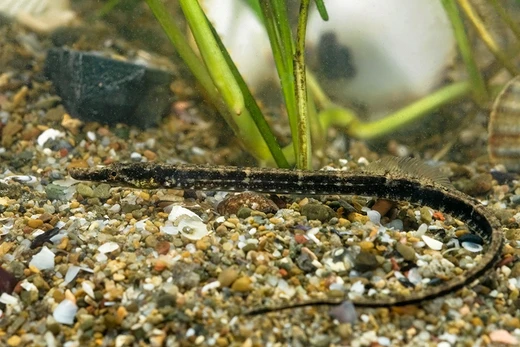
Syngnathus
A genus of pipefish with fused jaws and a wide fossil record.

Syngnathus is a genus of pipefish belonging to the family Syngnathidae. These fish inhabit marine and brackish environments, and occasionally fresh water, across the Atlantic, Indian, and Pacific Oceans. Their name derives from the Ancient Greek words for "together" and "jaw," a reference to the fused jaw structure that defines both this genus and its entire family. Fossil evidence of Syngnathus species has been uncovered in Greece, Italy, Germany, and the United States, dating from the Oligocene epoch through the Pleistocene. The genus currently includes 36 recognized species.
Quick Facts
- Taxon
- Syngnathus
- Type Species
- Syngnathus acus
- Type Species Authority
- Linnaeus, 1758
Facts from the source article.
Lore & Background
The name Syngnathus derives from Ancient Greek σύν (sún), meaning 'together', and γνάθος (gnáthos), meaning 'jaw', referring to the fused jaw that the species and the entire family Syngnathidae share. Fossils of these species are found from the Oligocene to the Pleistocene, and have been discovered in various localities of Greece, Italy, Germany and the United States.
The genus currently contains 36 recognized species, including the greater pipefish (Syngnathus acus), the black-striped pipefish (Syngnathus abaster), and the sargassum pipefish (Syngnathus pelagicus), among others. These species inhabit marine, brackish and sometimes fresh waters across the Atlantic, Indian and Pacific Oceans.
Reader's Guide
Syngnathus is significant as a genus within the Syngnathidae family, distinguished by the fused jaw that gives the group its name. Its fossil record, spanning from the Oligocene to the Pleistocene and found in localities across Greece, Italy, Germany and the United States, indicates a long evolutionary history. The genus comprises 36 recognized species, many of which bear common names reflecting their habitats or physical traits, such as the kelp pipefish, bay pipefish, and estuarine pipefish. The distribution of Syngnathus across the Atlantic, Indian and Pacific Oceans, in marine, brackish and sometimes fresh waters, highlights its adaptability to diverse aquatic environments. The legacy of the genus lies in its representation of pipefish diversity and its contribution to understanding the evolutionary history of Syngnathidae through fossil evidence.
Did You Know?
- The name Syngnathus comes from Ancient Greek words meaning 'together' and 'jaw', referring to the fused jaw.
- Fossil localities include Greece, Italy, Germany and the United States.
- There are currently 36 recognized species in the genus Syngnathus.
More in Seahorses and Pipefish, Part 2 1-24
Spotted an error? Know more?
Reader corrections go straight into our review queue. Suggest an edit · How this site is sourced