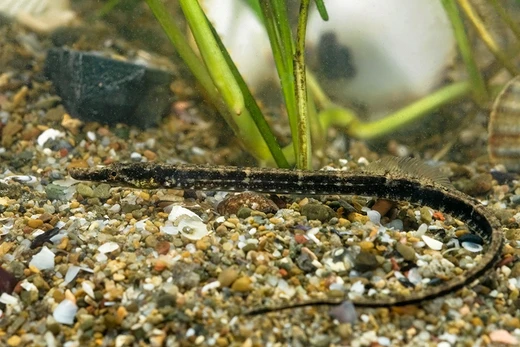
Hippocampus haema
The most common seahorse in Korean waters, named from the Korean word for seahorse.

Hippocampus haema, commonly known as the Korean seahorse, is a species of seahorse in the family Syngnathidae native to the northern Pacific Ocean, including the Korea Strait, Sea of Japan, and the northeastern coast of Honshu. It inhabits shallow soft bottom habitats with Sargassum and weeds at depths from 0 to 18 meters. This species is notable as the most common seahorse in Korean waters, and its scientific name 'haema' is derived from the Korean word for seahorse.
Quick Facts
- Taxon
- Hippocampus haema
Facts from the source article.
Lore & Background
Hippocampus haema had been repeatedly misidentified as the crowned seahorse (Hippocampus coronatus) and Shiho's seahorse before a taxonomic review. The two genuine species do not live in Korean waters, leading to the naming of a new scientific name, Hippocampus haema. The Japanese name 'Himetatsu' is derived from its smaller body and coronet compared to the crowned seahorse. This species exhibits sexual dimorphism: males have a longer tail, while females have a longer trunk for the same size. Sex determination is considered possible at about 2 centimeters from anatomic examination of gonad. The breeding season spans 7 months, from April to October or May to November, relating to warm water temperature. The number of fertilized eggs or larvae inside the male brood pouch averaged 38.3±14.8 (range 20-76), while female fecundity averaged 47.2±8.6 (range 31-59). The female-to-male ratio was 1:1.7, indicating male dominance.
Reader's Guide
Hippocampus haema holds significance as the most common seahorse in Korean waters, a status that led to its scientific name being derived from the Korean word for seahorse. Its legacy is tied to the taxonomic clarification that resolved repeated misidentifications as crowned seahorse and Shiho's seahorse, both of which do not occur in Korean waters. This species' description provides key biological data, including a maximum length of 11 centimeters, a breeding season of 7 months, and a male-biased sex ratio of 1:1.7. The detailed measurements of fertilized eggs in male brood pouches and female fecundity contribute to understanding its reproductive biology. The Japanese name 'Himetatsu' reflects its smaller size relative to a sister species. The species' habitat in shallow soft bottoms with Sargassum and weeds, and its depth range of 0 to 18 meters, define its ecological niche in the northern Pacific Ocean.
Did You Know?
- This species was repeatedly misidentified as crowned seahorse and Shiho's seahorse before a taxonomic review.
- The female-to-male ratio is 1:1.7, indicating male dominance.
Frequently Asked Questions
Who is Hippocampus haema?
Hippocampus haema is the Korean seahorse, a member of the family Syngnathidae found across the northern Pacific. It is the most frequently encountered seahorse in Korean waters, and its species epithet 'haema' is taken directly from the Korean word for seahorse.
How big does Hippocampus haema grow?
Adults typically measure 6 to 8 centimeters, with the species ceiling at 11 centimeters. Juveniles range from 1 to 5 centimeters, and an individual reaches sexual maturity at roughly 5 centimeters in length.
Where does Hippocampus haema live?
This species occupies shallow soft-bottom habitats dotted with Sargassum and other weeds, from the surface down to about 18 meters. Its range spans the Korea Strait, the Sea of Japan, and the northeastern coast of Honshu.
When does Hippocampus haema breed?
The breeding window lasts approximately seven months, running from April through October or May through November. Sex is determined at a tiny size of around 2 centimeters, long before the animal reaches its full adult proportions.
Why is Hippocampus haema notable among seahorse species?
It is the most common seahorse in Korean waters, making it the default species for observers in that region. Its very name is a direct linguistic nod to Korean, underscoring its geographic and cultural identity.
More in Seahorses and Pipefish, Part 2 1-24
Spotted an error? Know more?
Reader corrections go straight into our review queue. Suggest an edit · How this site is sourced