Pacific seaweed pipefish
A pipefish valued in Traditional Chinese medicine and found in seagrass beds.

The Pacific seaweed pipefish (Syngnathus schlegeli) is a marine, ocean-dwelling fish that lives near the seafloor, commonly found in beds of Zostera seagrass. It is highly valued in Traditional Chinese medicine as one of the most famous and costly ingredients, due to its unique medicinal properties. This pipefish belongs to the Syngnathidae family, which includes seahorses and seadragons.
**Distribution** This species is found in the northwestern Pacific Ocean, from near Vladivostok in Russia south to the Gulf of Tonkin. It is one of the more widespread pipefish species along Japan’s coast, inhabiting shallow seagrass beds. During breeding season, from May to October, the fish stays in these seagrass beds; in winter and early spring, it moves to deeper offshore waters to find warmer conditions. Its broad geographic range covers many different climates and microhabitats.
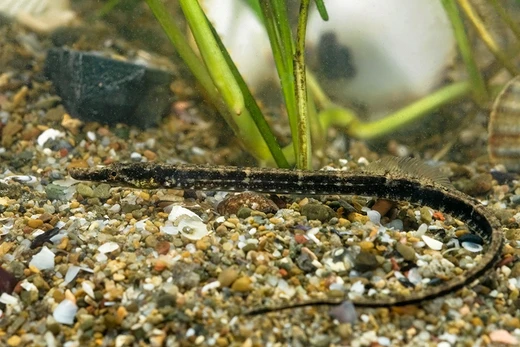
**Description** The seaweed pipefish has a slender, elongated body with a long, tube-shaped snout and a mouth at the tip. Like other syngnathids, it has no teeth, and its jaws are located at the end of the snout. The rigid, tubular snout is made of specialized skull bones. Juveniles range in standard length from 5.5 to 14.7 cm, while adults measure 13.3 to 27.7 cm. Their bodies are mostly brownish with pale markings. Compared to seahorses, most pipefish species have longer and narrower snouts. They have very small dorsal and pectoral fins, which they beat rapidly to move, steering with their heads. Lacking large caudal fins, they get less power for swimming and must rely on these fin oscillations for control. Pipefish are generally poor swimmers, especially in open water, which is why they stay in shallow areas among seaweed or seagrass. Their shape and color help them blend into surrounding vegetation, aiding both predator avoidance and prey capture.
**Reproduction** Like seahorses, pipefish have a unique reproductive method: the male becomes pregnant. The breeding season for S. schlegeli runs from May to October, lasting over six months, a pattern also seen in other pipefish such as Syngnathus abaster and Syngnathus taenionotus. As males mature, they develop a brood pouch—a secondary sexual organ where eggs develop. The brooding period lasts 14 to 28 days, after which the young are released as free-living juveniles.
Quick Facts
- Taxon
- Syngnathus schlegeli
Facts from the source article.
Lore & Background
The Pacific seaweed pipefish has a slender, elongate body with a longer, tube-shaped snout and a terminal mouth. Like other syngnathids, it lacks teeth and has jaws at the end of its snout. Its body is mainly brownish with pale markings. It has very small dorsal and pectoral fins, which it beats rapidly to propel itself, using its head to steer. The fish lacks large caudal fins, so it relies on oscillations to maneuver and is a poor swimmer, especially in open water, which is why it is mainly found in shallow water amidst seaweed or seagrass. Its shape and color allow it to blend into surrounding vegetation.
Reproduction is similar to seahorses: the male becomes pregnant. Males develop a brood pouch, and the brooding period ranges from 14 to 28 days, after which offspring are released as free-living juveniles with fully developed prey-capture abilities. Females have a higher reproductive rate than males and mate with multiple males sequentially, making the species polygamous. Once a pair mates, there is exclusive paternal care of eggs.
When hunting, the pipefish is among the fastest feeders of all fish in the act of catching prey. It finds prey through eyesight and uses a slow approach to avoid scaring it. It catches prey by positioning its snout a few millimeters away and snapping its mouth rapidly by rotating the head away from the body. The longer the snout, the further away it can attack. Juveniles are specialist feeders limited to smaller prey, while adults are more generalist. The species is carnivorous, eating small crustaceans, fish, fish eggs, and zooplankton.
Reader's Guide
The Pacific seaweed pipefish is notable primarily for its use in Traditional Chinese medicine, where it is considered one of the most famous and expensive materials due to its special medicinal composition. This economic significance, however, is not the only reason the species draws attention. Its reproductive biology—male pregnancy and polygamous mating—mirrors that of seahorses and places it within a broader syngnathid context. The species is also ecologically important as a resident of shallow seagrass beds, which serve as breeding habitat from May to October, while it moves to deeper offshore waters in winter and early spring for thermal refuge.
Despite being listed as Least Concern on the IUCN Red List (assessed December 2014), the pipefish faces threats from human activities. Its dependence on coastal habitats such as seagrass meadows, coral reefs, and mangroves puts it at risk from coastal development, pollution, and climate change. It is also susceptible to being bycatch in fisheries. Conservation efforts, including Marine Protected Areas, aim to support these threatened habitats. More research is needed to better understand the species' role in the ecosystem and its population dynamics.
Did You Know?
- The Pacific seaweed pipefish is one of the most famous and expensive materials in Traditional Chinese medicine.
- Males become pregnant and brood eggs in a special pouch for 14 to 28 days.
- The species is a poor swimmer and relies on rapid fin oscillations to maneuver.
More in Seahorses and Pipefish, Part 2 1-24
Spotted an error? Know more?
Reader corrections go straight into our review queue. Suggest an edit · How this site is sourced