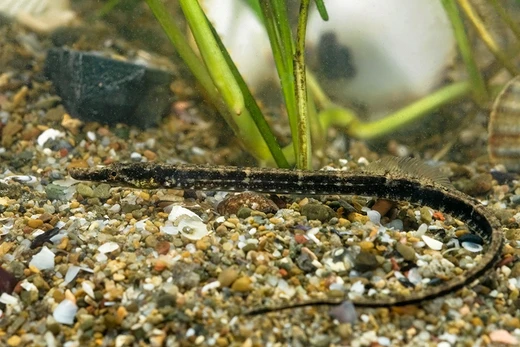
Northern pipefish
A northwest Atlantic pipefish with a rigid, bony body and brood pouch.

The northern pipefish (Syngnathus fuscus) belongs to the Syngnathidae family and lives in the northwest Atlantic. Its body is long, thin, and stiff, covered in bony rings, and can reach up to 30.0 cm in length. The head is also long and thin, with a rounded mouth at the tip. The dorsal fin stretches across four to five of the body’s bony rings. Males have a brood pouch formed by two side flaps that meet along the fish’s midline. The tail fin is rounded, the anal fin is small, and there are no ventral or pelvic fins. The upper side is usually olive or brownish. Typical length is 10 to 20 cm, though some individuals reach 30 cm. This species is often seen as an invader in freshwater habitats. It eats a variety of organisms in those ecosystems, but studies show zooplankton is its main food. There is evidence it migrates seasonally.
The northern pipefish is found in the northwestern Atlantic, from Canada’s Gulf of Saint Lawrence down to northeastern Florida in the USA, and also in the northwestern Gulf of Mexico. It lives at depths from less than 2 m down to 366 m. It is common in bays, tide pools, and other spots sheltered from breaking waves.
Quick Facts
- Taxon
- Syngnathus fuscus
Facts from the source article.
Lore & Background
The northern pipefish has a long, thin head rounded at the end of the mouth. Its dorsal fin spreads across 4 to 5 of the bony rings that span the body. The species has a brood pouch made up of two lateral flaps that meet along the central line of the fish. The caudal fin is rounded, the anal fin is small, and it lacks ventral and pelvic fins. The species is generally olive or brownish on top, typically 10 to 20 cm long, but can sometimes be seen up to 30 cm.
The northern pipefish is often regarded as an invader in freshwater ecosystems. It feeds on many different organisms within freshwater ecosystems, though studies have found zooplankton to be the primary organism in its diet. There is evidence of seasonal migration.
It occurs in the north-western Atlantic from the Gulf of Saint Lawrence in Canada to north-eastern Florida in USA and north-western Gulf of Mexico. It is found at depths less than 2 to 366 meters, commonly in bays, tide pools, and anywhere sheltered from breaking surf.
Reader's Guide
The northern pipefish is significant as a species that bridges marine and freshwater environments, often considered an invader in freshwater ecosystems. Its presence in such habitats highlights its adaptability, though the source article notes that zooplankton are the primary component of its diet in these settings. The species' distribution across a broad northwest Atlantic range—from the Gulf of Saint Lawrence to northeastern Florida and the northwestern Gulf of Mexico—and its occurrence at depths from less than 2 to 366 meters demonstrate its ecological flexibility. Its physical characteristics, including a rigid body encased in bony rings, a brood pouch formed by two lateral flaps, and the absence of ventral and pelvic fins, are typical of pipefishes. The evidence of seasonal migration adds to its biological interest. The northern pipefish's role as an invader in freshwater systems, as noted in the article, underscores its potential impact on non-native habitats, though the article does not elaborate on consequences. Its legacy is tied to its ability to thrive in diverse conditions, from sheltered tide pools to deeper waters, making it a subject of study for understanding species dispersal and adaptation.
Did You Know?
- Zooplankton are the primary organism in the diet of northern pipefish in freshwater ecosystems.
- The species is found at depths ranging from less than 2 to 366 meters.
More in Seahorses and Pipefish, Part 2 1-24
Spotted an error? Know more?
Reader corrections go straight into our review queue. Suggest an edit · How this site is sourced