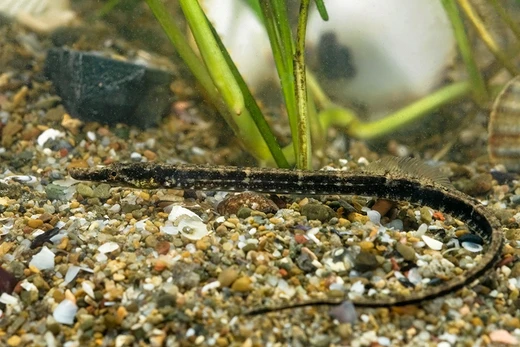
Lesser pipefish
A pipefish without a head crest, found in the eastern Atlantic.

The lesser pipefish, also called Nilsson's pipefish (Syngnathus rostellatus), resembles the greater pipefish but lacks a crest on top of its head. It typically grows to 17 centimeters long, with a maximum of 18 centimeters, though specimens in South Wales usually measure only 10 to 13 centimeters. Its coloration ranges from light to dark green-brown, with bar-like markings along the sides.
The head features a long, thin, rounded snout and a small, upturned mouth. The eyes are small and positioned far back near the gill covers. The body is long and slender, covered in bony plates. The dorsal fin sits midway along the body, with pelvic fins directly below. The caudal fin is fan-shaped, and small pectoral fins lie behind the gills. A key difference from the greater pipefish is the absence of a head crest, but young greater pipefish can look very similar to adult lesser pipefish—both share the same coloration, markings, a caudal fin, and a similar swimming style. A continuous black line running from the gills down the belly to the tail helps distinguish the lesser pipefish, though this line is faint in very young individuals.
This species lives in the eastern Atlantic, from Norway, the British Isles, the Bay of Biscay, and western Portugal. A single record exists from the Mediterranean Sea off Málaga, Spain, from 1981; reports from the eastern Mediterranean have been misidentifications.
The lesser pipefish feeds on small crustaceans and inhabits shallow water. In aquariums, it requires temperatures no higher than 18°C and must be fed live food. Breeding occurs in spring and summer. The male carries eggs and young in a brood pouch until they can fend for themselves, typically holding around 100 eggs. The young hatch after about three weeks and are pelagic.
In other languages, it is known as liten kantnål (Norwegian), mindre kantnål (Swedish), lille tangnål (Danish), and Kleine Seenadel (German).
Quick Facts
- Taxon
- Syngnathus rostellatus
Facts from the source article.
Lore & Background
The lesser pipefish has a long, thin, round snout with a small up-turned mouth; the eyes are small and situated well back towards the gill covers. The body is long and thin, covered with bony plates; the dorsal fin sits halfway along the body, with pelvic fins below it. The caudal fin is fan-shaped, and small pectoral fins are behind the gills. It differs from the greater pipefish by lacking a crest on the head, though a fully grown lesser pipefish and a young greater pipefish share similar coloration and markings, both have a caudal fin, and swim in a similar style. A distinguishing feature is a continuous black line from the gills down the belly to the tail, though this is not very apparent on very young specimens.
Reader's Guide
The lesser pipefish is notable for its similarity to the greater pipefish, from which it is distinguished primarily by the absence of a head crest. Its distribution spans the eastern Atlantic, with a single Mediterranean record from 1981 off Malaga, Spain; reports from the eastern Mediterranean are considered misidentifications. The species feeds on small crustaceans and inhabits shallow water. In aquariums, it requires temperatures no more than 18 °C and live food. Breeding occurs in spring and summer, with the adult male carrying eggs and young in a brood pouch until they are self-sufficient, typically carrying about 100 eggs. The young hatch after about three weeks and are pelagic. Its known translations include liten kantnål (Norwegian), mindre kantnål (Swedish), lille tangnål (Danish), and Kleine Seenadel (German).
Did You Know?
- The lesser pipefish has no crest above the head, unlike the greater pipefish.
- It can carry about 100 eggs in its brood pouch.
- A continuous black line from the gills to the tail is a distinguishing feature, though faint on young specimens.
More in Seahorses and Pipefish, Part 2 1-24
Spotted an error? Know more?
Reader corrections go straight into our review queue. Suggest an edit · How this site is sourced