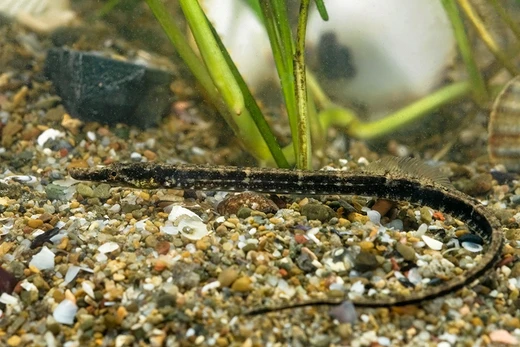
Knysna seahorse
A small seahorse endemic to three South African estuaries.

The Knysna seahorse, also called the Cape seahorse (Hippocampus capensis), is a fish from the Syngnathidae family. It lives only along South Africa’s south coast, in three brackish water spots: the Keurbooms River estuary in Plettenberg Bay, the Knysna Lagoon, and the estuarine part of the Swartvlei system in Sedgefield. Because its range is so small, this seahorse faces a high risk of extinction.
This seahorse is small and delicate, reaching a standard length of up to 12 centimetres. Its color depends heavily on its surroundings and its mood, ranging from pale green to brown (often with darker speckles) to purplish black. A series of bony rings covers its body, its snout is fairly short, and its neck arches smoothly without a crown. The muscular tail helps it grasp a mate during courtship or anchor itself to the substrate.
The Knysna seahorse usually lives in areas with at least 75% plant cover, and it associates with five main aquatic plants: Zostera capensis, Caulerpa filiformis, Codium extricatum, Halophila ovalis, and Ruppia cirrhosa. The Keurbooms and Swartvlei estuaries have very dense vegetation, but only about 11% of the Knysna Lagoon is vegetated, leaving large parts of that system possibly unsuitable. This fish is well adapted to estuaries and can handle salinities from 1 to 59 parts per thousand. Breeding happens in the austral summer when water temperatures near 20°C, and it reaches sexual maturity at about one year old and 65 millimetres standard length.
Genetic data from the mitochondrial control region show that each of the three populations has a unique set of haplotypes, but there is no evidence they are separate subspecies. More recent microsatellite data confirm this. So, if needed, moving individuals between estuaries is not a problem. Low genetic diversity in the Swartvlei estuary suggests that population is partly isolated from the other two.
Census data from 2002 and 2003 (WWF-SA) show that the Keurbooms and Swartvlei populations can sometimes be much larger than the one in the bigger Knysna Lagoon, but numbers vary a lot. In the Keurbooms estuary, strong river flow may have caused a temporary local extinction, meaning that estuary may not have a permanent population and only provides habitat when conditions are good.
Quick Facts
- Taxon
- Hippocampus capensis
Facts from the source article.
Lore & Background
The Knysna seahorse is a small, delicate creature with a standard length of up to 12 centimetres. Colouration is strongly influenced by the surrounding environment and a particular individual's mood, varying from pale green to brown (often with darker speckles) to purplish black. The body is encased in a series of bony rings, the snout is relatively short, and the neck arches in a smooth curve without a crown. The tail is muscular and is used to grasp a mate during courtship or to anchor the fish to the substrate.
The species occurs mostly in areas with high vegetation cover (at least 75%), and is associated with five dominant aquatic plants: Zostera capensis, Caulerpa filiformis, Codium extricatum, Halophila ovalis and Ruppia cirrhosa. While the Keurbooms and Swartvlei estuaries both have very dense plant cover, vegetated sites only make up approximately 11% of the Knysna Lagoon. The fish is well adapted to estuarine habitat and can tolerate a wide range of salinities from 1–59 ‰. Breeding occurs in the austral summer when water temperatures approach 20 °C, and sexual maturity is attained in about one year at 65 mm standard length.
Genetic data from the mitochondrial control region indicate that, even though each of the three populations has a unique combination of haplotypes, there is no support for the hypothesis that each represents a distinct subspecies. Low genetic diversity in the Swartvlei estuary suggests that this population is partially isolated from the other two populations. Census data from 2002 and 2003 indicated that population sizes in the Keurbooms and Swartvlei estuaries can at times far exceed that in the much larger Knysna Lagoon, but they fluctuate considerably. In the Keurbooms estuary, a period of strong river flow may even have resulted in the temporary extinction of the species, suggesting that this estuary has no permanent seahorse population and merely provides habitat when conditions are favourable.
Reader's Guide
The Knysna seahorse is notable for its extremely restricted range, being found in only three brackish water habitats on the south coast of South Africa. This limited distribution places it at great risk of extinction. The species is closely related to the Indian Ocean population of the widespread Indo-Pacific seahorse H. kuda, and its smaller size, shorter snout, and reduced coronet are likely adaptations to improve manoeuvrability in dense seagrass habitats typical of South African estuaries. Genetic studies have shown that while each of the three populations has a unique combination of haplotypes, there is no support for distinct subspecies, and thus translocation between estuaries may be considered if necessary. Population sizes fluctuate considerably, with the Keurbooms estuary potentially lacking a permanent population and being recolonized only when conditions are favorable. Captive bred populations are held at the Two Oceans Aquarium in Cape Town and at Antwerp Zoo, and the species is also bred and sold for the ornamental fish industry. The species' dependence on high vegetation cover and the limited suitable habitat within the Knysna Lagoon highlight conservation challenges.
Did You Know?
- The Knysna seahorse can tolerate salinities ranging from 1 to 59 ‰.
- It reaches sexual maturity at about 65 mm standard length in roughly one year.
- The species is associated with five dominant aquatic plants, including Zostera capensis and Caulerpa filiformis.
More in Seahorses and Pipefish, Part 2 1-24
Spotted an error? Know more?
Reader corrections go straight into our review queue. Suggest an edit · How this site is sourced