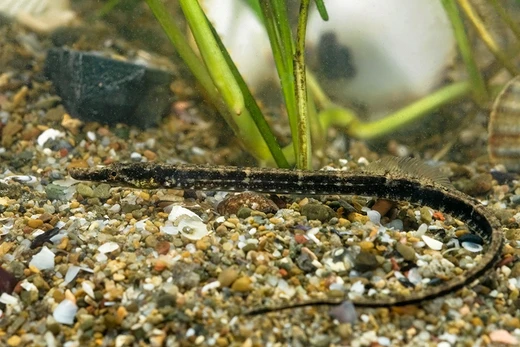
Knobby seahorse
A small seahorse with a short snout and fleshy tendrils.

The knobby seahorse (Hippocampus breviceps), also called the short-headed or short-snouted seahorse, belongs to the Syngnathidae family. Its range covers coastal waters of southwestern and southeastern Australia, stretching from Gregory to Bremer Bay in Western Australia, and from Denial Bay in South Australia to Newcastle in New South Wales.
Adults typically reach about 10 centimeters in length. They have a small, slender body, a short snout, and a raised coronet. Many individuals also carry fleshy tendrils on their head and back. Their coloration varies from dull gray to bright yellow-orange, with small black spots and ringed white ocelli scattered across the trunk and tail. Pale bars mark the underside of the tail.
This species lives in sheltered coastal reefs, favoring areas with macroalgal beds and seagrasses. It has also been found on floating macroalgae, rock reefs, jetties, and sponge reefs at depths below 15 meters, though it is more common near 5 meters.
As a carnivore, it feeds during the day on mysids, harpacticoid copepods, and gammarid and caprellid amphipods, staying close to sandy or rubble bottoms.
Breeding occurs on a roughly monthly cycle during summer. Each brood produces 50 to 100 young. Females deposit eggs into the male’s brood pouch, where they are fertilized and protected until the male gives birth to live offspring.
Coastal development may pose a local threat to this species, but such pressure is not widespread across its entire range.
Quick Facts
- Taxon
- Hippocampus breviceps
Facts from the source article.
Lore & Background
H. breviceps is usually around 10 centimetres long, with a small, slender body, short snout and raised coronet. Individuals often have fleshy tendrils on the head and back. Colouration is generally drab grey to bright yellow-orange, with small black spots and ringed white ocelli over the trunk and tail. The ventral side of the tail has pale bars.
This species lives in sheltered coastal reefs associated with macroalgal beds and seagrasses. Individuals have also been found on floating macroalgae, rock reefs, jetty habitats, and sponge reefs below depths of 15 metres, though more commonly it occurs at depths near 5 m.
It is a carnivorous species that feeds on mysids, harpacticoid copepods, and gammarid and caprellid amphipods. It feeds during the day, staying close to the sand or rubble bottom. H. breviceps breeds on an approximately monthly cycle in the summer, producing 50-100 young per brood. Females deposit eggs into the male's brood pouch, where they are fertilized and protected before the male gives birth to live young.
Reader's Guide
The knobby seahorse is notable for its restricted distribution along the southern and eastern coasts of Australia, from Western Australia to New South Wales. Its identification features—a short snout, raised coronet, and often fleshy tendrils—distinguish it from other seahorses. The species occupies a variety of habitats including macroalgal beds, seagrasses, floating algae, rock reefs, jetties, and sponge reefs, showing adaptability within its range. Its feeding ecology, targeting small crustaceans during daytime near the bottom, and its reproductive strategy of male brooding with monthly summer cycles, are characteristic of the genus. The article notes that this species may be threatened locally by coastal development, but this is not prevalent across its range, indicating a relatively stable overall population. The entry draws entirely from the provided source, which lists references such as iSeahorse, IUCN Seahorse, Pipefish & Stickleback Specialist Group, iNaturalist, Encyclopedia of Life, and Fishes of Australia.
Did You Know?
- The knobby seahorse is also called the short-headed seahorse or short-snouted seahorse.
- It produces 50-100 young per brood, with males giving birth to live young.
More in Seahorses and Pipefish, Part 2 1-24
Spotted an error? Know more?
Reader corrections go straight into our review queue. Suggest an edit · How this site is sourced