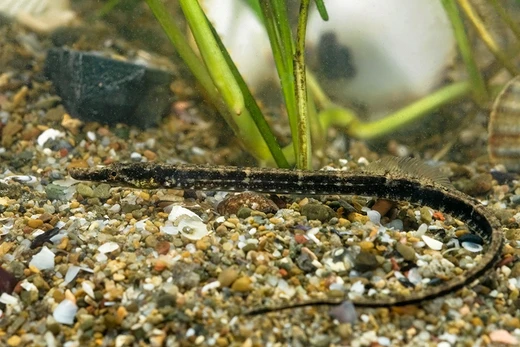
Japanese seahorse
A small seahorse with a planktonic youth and a long tail.

The Japanese seahorse, called *kitano-umi-uma* or *sangotatsu* in Japanese and also known as the lemur-tail seahorse (*Hippocampus mohnikei*), is a member of the Syngnathidae family. It grows up to 8.0 cm long, typically appears dark brown, and features a long tail, a low ridge-like coronet, and flattened spines. Many seahorse species look alike, so identification often relies on specific measurements and counts of traits like spines and tail rings.
This species spends its first six months as plankton, drifting in the water column. During this stage, its diet shifts from tiny organisms like *Oithona davisae* and *Penilia avirostris* to larger prey. After this period, it settles in *Zostera* seagrass beds or estuaries to breed. It is ovoviviparous, with males carrying eggs in a brood pouch under the tail. Unlike some seahorses, *H. mohnikei* is not used in traditional Chinese medicine.
The species’ distribution centers around 28° N latitude. For a long time, it was only confirmed around Japan, but recent sightings have occurred as far south as the Palk Bay coast of southeastern India and in Kampot, Cambodia. It is also suspected to inhabit waters near China, Thailand, and Vietnam.
At just 6.0 mm long, juveniles already have fully developed dorsal, anal, and pectoral fins, plus a tiny caudal fin with only two rays. They reach maturity at 55 mm and a maximum of 80 mm. Breeding begins the season after birth, between six months and one year of age.
Similar species include the crowned seahorse (*H. coronatus*), which has 10 trunk rings, a very high coronet, and enlarged spines near a short dorsal fin; Shiho’s seahorse (*H. sindonis*), with 10 trunk rings, fewer tail rings, and a more prominent coronet; and the Korean seahorse (*H. haema*), also with 10 trunk rings, fewer tail rings, a prominent coronet, and enlarged spines near a short dorsal fin.
Quick Facts
- Taxon
- Hippocampus mohnikei
Facts from the source article.
Lore & Background
The Japanese seahorse has a planktonic stage during the first six months of life, when it drifts with other plankton in the water column at lengths between 15.1 and 45.5 mm. During this stage, its food preferences shift from smaller items such as Oithona davisae and Penilia avirostris to larger food species. After the planktonic stage, it prefers to settle in Zostera sea grass beds and estuaries, where it begins to breed. It is ovoviviparous, and the male carries the eggs in a brood pouch under the tail. Juveniles as small as 6.0 mm have completely developed dorsal, anal, and pectoral fins, and those 6.0–26.4 mm total length also have a tiny caudal fin with just two rays. The species reaches maturity at 55 mm and can reach a length of 80 mm. Breeding starts in the season after birth, at six months to one year.
Reader's Guide
The Japanese seahorse is distinguished by its maximum length of 8.0 cm, dark brown coloration (sometimes mottled), low ridge-like coronet, low spines, laterally flattened body, double rounded cheek spines, double rounded spines below the eye, and a long tail in proportion to its body. It has slight enlargements of the 4th, 7th, and sometimes first trunk rings, and of the 5th, 10th, 14th, and sometimes 9th tail rings. For many years its only confirmed distribution was around Japan, but it has recently been observed as far south as the Palk Bay coast of southeastern India and in Kampot, Cambodia. It is also suspected to be in waters around China, Thailand, and Vietnam. Unlike several seahorse species used in traditional Chinese medicine, H. mohnikei is not one of them. Similar species include the crowned seahorse (H. coronatus), Shiho's seahorse (H. sindonis), and the Korean seahorse (H. haema), which differ in trunk ring count, coronet height, and spine development.
Did You Know?
- It reaches a maximum length of 8.0 cm and is usually dark brown all over, but may be mottled.
- Males carry the eggs in a brood pouch under the tail, as the species is ovoviviparous.
More in Seahorses and Pipefish, Part 2 1-24
Spotted an error? Know more?
Reader corrections go straight into our review queue. Suggest an edit · How this site is sourced